Graduate School of Medical Sciences, Kumamoto University, Kumamoto, Japan.
Faculty of Life Sciences, Department of Neuropsychiatry, Kumamoto University, Kumamoto, Japan.
PLoS One. 2021 Feb 18;16(2):e0247184. doi: 10.1371/journal.pone.0247184. eCollection 2021.
To investigate the behavioral characteristics of semantic dementia (SD) using an instrument originally developed for patients with autism spectrum disorder.
The behavioral symptoms of 20 patients with SD and 20 patients with Alzheimer's disease (AD) in both the preclinical state and the dementia state were evaluated using the Pervasive Developmental Disorders Autism Society Japan Rating Scale (PARS).
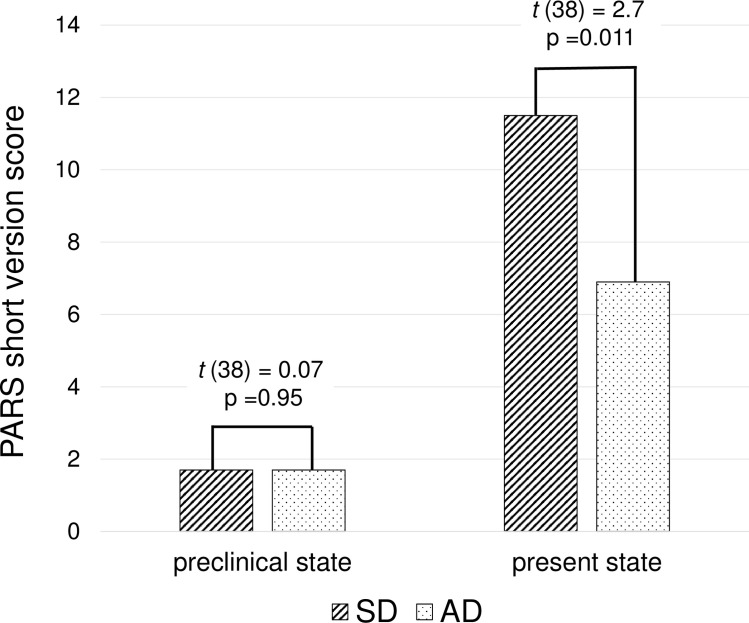
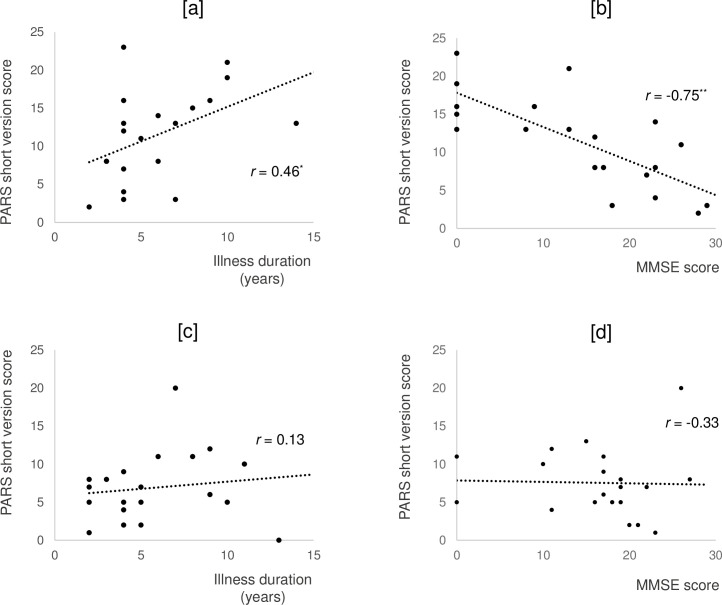
The SD group showed high prevalence in four behaviors related to stereotypy and social impairment: eating very few food items, selfishness, difficulty in recognizing others' feeling and thoughts, and interpreting language literally. Scores on the PARS short version, which is sensitive for diagnosis of autism spectrum disorder, were significantly higher in the dementia state than in the preclinical state in both the SD (11.5 ± 6.0 and 1.7 ± 2.5, respectively; t (19) = 6.7, p < 0.001) and AD (6.9 ± 4.6 and 1.7 ± 2.0, respectively; t (19) = 5.1, p < 0.001) groups. PARS short version scores after dementia onset increased in both the SD and AD groups, although the increase was significantly larger in the SD group (F = 5.6, p = 0.023). Additionally, a significantly higher rate of patients exceeded the cutoff score for autism diagnosis in the dementia state in the SD group (75%) than in the AD group (40%; χ2 = 5.0, p = 0.025). PARS scores in the dementia state were significantly correlated with illness duration (r = 0.46, p = 0.04) and Mini-Mental State Examination scores (r = -0.75, p < 0.001) in the SD group only.
Although SD and autism spectrum disorder are etiologically distinct diseases, patients with semantic dementia behave like those with autism spectrum disorder. Our findings suggest the symptomatic similarity of the two disorders.
使用原本为自闭症谱系障碍患者开发的工具,研究语义性痴呆(SD)的行为特征。
使用日本广泛性发育障碍自闭症协会评定量表(PARS)评估 20 例处于临床前期和痴呆期的 SD 患者和 20 例阿尔茨海默病(AD)患者的行为症状。
SD 组在与刻板行为和社交障碍相关的四项行为中表现出高患病率:只吃很少的食物、自私、难以识别他人的感受和想法以及逐字解读语言。在 SD(分别为 11.5 ± 6.0 和 1.7 ± 2.5;t(19)= 6.7,p < 0.001)和 AD(分别为 6.9 ± 4.6 和 1.7 ± 2.0;t(19)= 5.1,p < 0.001)组中,PARS 简易版的评分在痴呆状态下均显著高于临床前期。在 SD(F = 5.6,p = 0.023)和 AD 组(F = 5.6,p = 0.023)中,PARS 简易版评分在痴呆发病后均增加,但 SD 组的增加幅度明显更大。此外,在 SD 组,痴呆状态下超过自闭症诊断临界值的患者比例明显高于 AD 组(75%比 40%;χ2 = 5.0,p = 0.025)。在 SD 组,痴呆状态下的 PARS 评分与疾病持续时间(r = 0.46,p = 0.04)和简易精神状态检查评分(r = -0.75,p < 0.001)显著相关。
尽管 SD 和自闭症谱系障碍是病因不同的疾病,但语义性痴呆患者的行为表现与自闭症谱系障碍患者相似。我们的研究结果表明这两种疾病存在症状上的相似性。