Ning Junya, Ye Yingnan, Bu Dechao, Zhao Gang, Song Tianqiang, Liu Pengpeng, Yu Wenwen, Wang Hailong, Li Hui, Ren Xiubao, Ying Guoguang, Zhao Yi, Yu Jinpu
Cancer Molecular Diagnostics Core, Tianjin Medical University Cancer Institute & Hospital, National Clinical Research Center for Caner, Key Laboratory of Cancer Prevention and Therapy, Tianjin's Clinical Research Center for Cancer, Tianjin 300060, China; Department of Immunology, Tianjin Medical University Cancer Institute & Hospital, National Clinical Research Center for Caner, Key Laboratory of Cancer Immunology and Biotherapy, Tianjin's Clinical Research Center for Cancer, Tianjin 300060, China.
Cancer Molecular Diagnostics Core, Tianjin Medical University Cancer Institute & Hospital, National Clinical Research Center for Caner, Key Laboratory of Cancer Prevention and Therapy, Tianjin's Clinical Research Center for Cancer, Tianjin 300060, China.
Mol Ther. 2021 Jun 2;29(6):2067-2087. doi: 10.1016/j.ymthe.2021.02.016. Epub 2021 Feb 15.
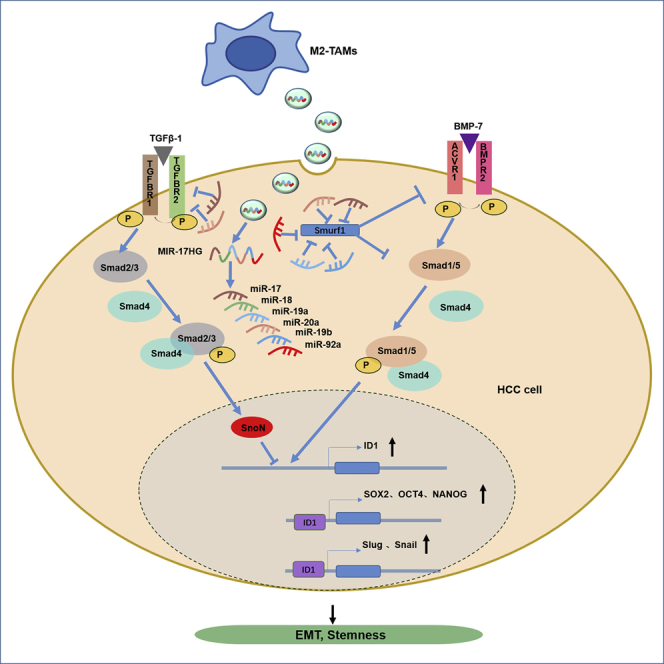
The transforming growth factor-beta (TGF-β) signaling pathway is the predominant cytokine signaling pathway in the development and progression of hepatocellular carcinoma (HCC). Bone morphogenetic protein (BMP), another member of the TGF-β superfamily, has been frequently found to participate in crosstalk with the TGF-β pathway. However, the complex interaction between the TGF-β and BMP pathways has not been fully elucidated in HCC. We found that the imbalance of TGF-β1/BMP-7 pathways was associated with aggressive pathological features and poor clinical outcomes in HCC. The induction of the imbalance of TGF-β1/BMP-7 pathways in HCC cells could significantly promote HCC cell invasion and stemness by increasing inhibitor of differentiation 1 (ID1) expression. We also found that the microRNA (miR)-17-92 cluster, originating from the extracellular vesicles (EVs) of M2-polarized tumor-associated macrophages (M2-TAMs), stimulated the imbalance of TGF-β1/BMP-7 pathways in HCC cells by inducing TGF-β type II receptor (TGFBR2) post-transcriptional silencing and inhibiting activin A receptor type 1 (ACVR1) post-translational ubiquitylation by targeting Smad ubiquitylation regulatory factor 1 (Smurf1). In vivo, short hairpin (sh)-MIR17HG and ACVR1 inhibitors profoundly attenuated HCC cell growth and metastasis by rectifying the imbalance of TGF-β1/BMP-7 pathways. Therefore, we proposed that the imbalance of TGF-β1/BMP-7 pathways is a feasible prognostic biomarker and recovering the imbalance of TGF-β1/BMP-7 pathways might be a potential therapeutic strategy for HCC.
转化生长因子-β(TGF-β)信号通路是肝细胞癌(HCC)发生发展过程中主要的细胞因子信号通路。骨形态发生蛋白(BMP)是TGF-β超家族的另一个成员,经常被发现参与与TGF-β通路的相互作用。然而,TGF-β和BMP通路之间复杂的相互作用在HCC中尚未完全阐明。我们发现TGF-β1/BMP-7通路的失衡与HCC侵袭性病理特征和不良临床预后相关。在HCC细胞中诱导TGF-β1/BMP-7通路失衡可通过增加分化抑制因子1(ID1)表达显著促进HCC细胞侵袭和干性。我们还发现,源自M2极化肿瘤相关巨噬细胞(M2-TAM)细胞外囊泡(EV)的微小RNA(miR)-17-92簇,通过诱导TGF-βⅡ型受体(TGFBR2)转录后沉默和靶向Smad泛素化调节因子1(Smurf1)抑制激活素A受体1型(ACVR1)翻译后泛素化,刺激HCC细胞中TGF-β1/BMP-7通路失衡。在体内,短发夹(sh)-MIR17HG和ACVR1抑制剂通过纠正TGF-β1/BMP-7通路失衡显著减弱HCC细胞生长和转移。因此,我们提出TGF-β1/BMP-7通路失衡是一个可行的预后生物标志物,恢复TGF-β1/BMP-7通路失衡可能是HCC的一种潜在治疗策略。