Scazzuso Fernando, González José L, Rodríguez Gerardo, Coria-Sandoval Pío, Camargo-Ballestas Juan, Moreno Mauricio, Merriam Theodore, Hemingway Lauren, Muratore Claudio
Instituto Cardiovascular de Buenos Aires, Buenos Aires, Argentina.
Hospital Universitario Fundación Favaloro, Buenos Aires, Argentina.
Arch Cardiol Mex. 2021 Feb 18;91(2):208-214. doi: 10.24875/ACM.20000305.
Catheter ablation has become a usual technique to treat atrial fibrillation (AF). Medium-term results of prospective and multicenter data concerning pulmonary veins cryoablation in Latin America are limited. The objective is to assess the safety and efficacy of ablation by second generation cryoballoon in patients with paroxysmal atrial fibrillation (PAF) or persistent atrial fibrillation (PerAF) in Latin America.
We evaluate the characteristics of the procedure and the acute and 12-month results. Inclusion criteria include patients over 18 years old with AF who have a planned procedure of pulmonary veins isolation with second generation cryoballoon. Treatment failure was defined as any episode of AF, atrial flutter or atrial tachycardia greater than 30 seconds outside the 90-day blinded period.
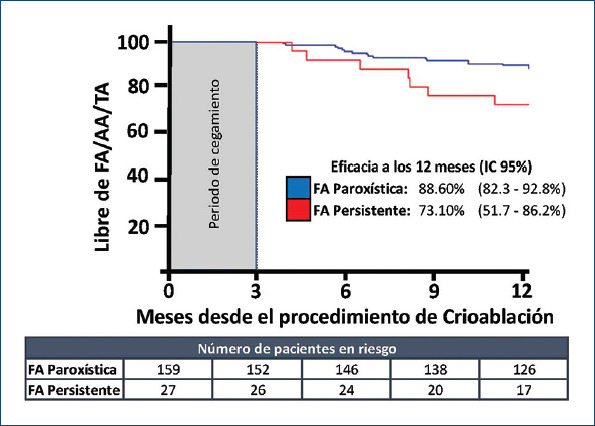
A total of 218 patients (57 ± 11 years, 66.5% men, CHA2DS2-VASc 1.2 ± 1.1) were included in the study. Of these, 83.9% evidenced PAF, 12.8% PerAF, and 2.3% long-standing PerAF. Fifteen with history of atrial flutter. Most patients had failed at least one antiarrhythmic drug (89.4%). The acute success of the procedure was obtained in 211 patients (96.8%). The average procedure time was 73.2 ± 26.7 min, the fluoroscopy time was 21.4 ± 23.9 min, and the total lab occupancy time was 114.6 ± 41.3 min. During the 12-month follow-up, freedom from AF recurrence was 88.6% in PAF, and 73.1% in PerAF. Twenty-one patients experienced device or procedure-related complications (9.6%).
These results support pulmonary veins electrical isolation with cryoballoon as an effective treatment for AF in Latin America.
导管消融已成为治疗心房颤动(AF)的常用技术。拉丁美洲有关肺静脉冷冻消融的前瞻性多中心数据的中期结果有限。目的是评估第二代冷冻球囊消融术在拉丁美洲阵发性心房颤动(PAF)或持续性心房颤动(PerAF)患者中的安全性和有效性。
我们评估了手术的特点以及急性和12个月的结果。纳入标准包括年龄超过18岁、计划采用第二代冷冻球囊进行肺静脉隔离术的AF患者。治疗失败定义为在90天盲期外发生的任何持续超过30秒的AF、心房扑动或房性心动过速发作。
共有218例患者(57±11岁,66.5%为男性,CHA2DS2-VASc评分为1.2±1.1)纳入研究。其中,83.9%为PAF,12.8%为PerAF,2.3%为长期持续性PerAF。15例有房扑病史。大多数患者至少一种抗心律失常药物治疗失败(89.4%)。211例患者手术获得急性成功(96.8%)。平均手术时间为73.2±26.7分钟,透视时间为21.4±23.9分钟,总实验室占用时间为114.6±41.3分钟。在12个月的随访中,PAF患者无AF复发率为88.6%,PerAF患者为73.1%。21例患者出现与设备或手术相关的并发症(9.6%)。
这些结果支持采用冷冻球囊进行肺静脉电隔离术作为拉丁美洲AF的有效治疗方法。