Trofimiuk Emil, Wielgat Przemysław, Car Halina
Department of Clinical Pharmacology, Medical University of Bialystok, Bialystok, Poland.
Front Syst Neurosci. 2021 Feb 2;14:614810. doi: 10.3389/fnsys.2020.614810. eCollection 2020.
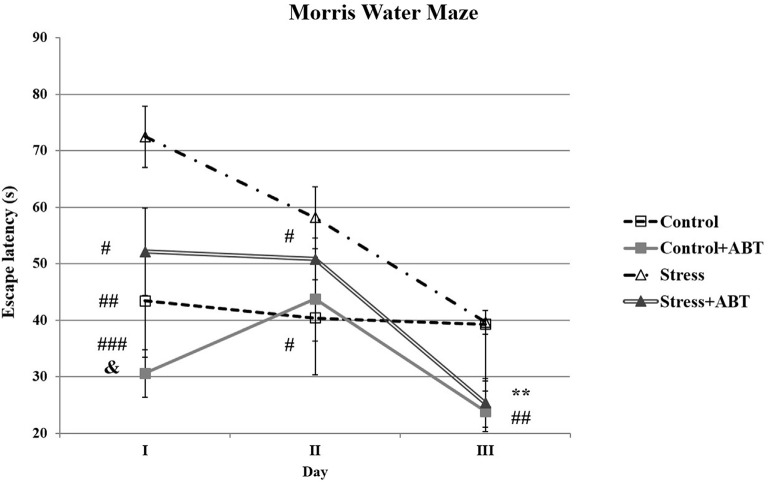
: A considerable number of competitive antagonists/inverse agonists of histamine H3 receptor (H3R) have progressed to clinical assessment, with pitolisant approved for the treatment of narcolepsy. H3R, highly expressed in the CNS, is regarded as a relevant target in CNS disorders. At the same time, new compounds including ABT-239 H3R antagonist (ABT; benzonitrile, 4-[2-[2-[(2R)-2-methyl-1-pyrrolidinyl]ethyl]-5-benzofuranyl]-) are continually being tested. The study aimed to test ABT-239 as a prophylactic agent in stress-induced memory impairments. : Stressed and non-stressed rats were pre-treated with ABT-239 and subsequently subjected to several behavioral tests aimed at assessing the animals' working and spatial reference memory [Morris water maze (MWM), Barnes maze (BM)], assessing the locomotor function and anxiety-like behavior [Open field (OF), elevated "plus" maze-EPM]. : Chronically stressed rats displayed a significant decline in spatial (working and reference) memory. In the MWM test, we observed an improvement in spatial reference memory in stressed animals and a positive after ABT-239 pre-treatment. In the BM test, the effect of ABT-239 administration on spatial memory changed in successive attempts, from negative initially to favorable in subsequent attempts, and negative in the last trial of the test in the control group of rats. However, a beneficial effect is noted in the group of stressed animals, which remained throughout the entire testing period. : Presented findings demonstrate that ABT-239 shows the potential to abolish or prevent restraint stress-induced spatial memory impairments and cognitive deficits. However, in conditions of appetitive modulation, it could increase damage to memory (unstressed animals).
相当数量的组胺H3受体(H3R)竞争性拮抗剂/反向激动剂已进入临床评估阶段,匹莫林已获批用于治疗发作性睡病。H3R在中枢神经系统中高度表达,被认为是中枢神经系统疾病的相关靶点。与此同时,包括ABT-239 H3R拮抗剂(ABT;苯甲腈,4-[2-[2-[(2R)-2-甲基-1-吡咯烷基]乙基]-5-苯并呋喃基]-)在内的新化合物也在不断进行测试。本研究旨在测试ABT-239作为预防应激诱导记忆损伤的药物。:对应激和非应激大鼠进行ABT-239预处理,随后进行多项行为测试,旨在评估动物的工作记忆和空间参考记忆[莫里斯水迷宫(MWM)、巴恩斯迷宫(BM)],评估运动功能和焦虑样行为[旷场试验(OF)、高架“十”字迷宫-EPM]。:长期应激的大鼠在空间(工作和参考)记忆方面显著下降。在MWM测试中,我们观察到应激动物的空间参考记忆有所改善,且ABT-239预处理后呈阳性。在BM测试中,给予ABT-239对空间记忆的影响在连续尝试中发生变化,最初为阴性,随后变为阳性,而在对照组大鼠测试的最后一次试验中为阴性。然而,在应激动物组中观察到有益效果,且在整个测试期间一直存在。:目前的研究结果表明,ABT-239显示出消除或预防束缚应激诱导的空间记忆损伤和认知缺陷的潜力。然而,在食欲调节的情况下,它可能会增加对记忆的损害(非应激动物)。