Vieira Igor Araujo, Andreis Tiago Finger, Fernandes Bruna Vieira, Achatz Maria Isabel, Macedo Gabriel S, Schramek Daniel, Ashton-Prolla Patricia
Programa de Pós-Graduação em Genética e Biologia Molecular, Universidade Federal do Rio Grande do Sul, Porto Alegre, Brazil.
Laboratório de Medicina Genômica, Centro de Pesquisa Experimental, Hospital de Clínicas de Porto Alegre, Porto Alegre, Brazil.
Front Genet. 2021 Feb 2;12:606537. doi: 10.3389/fgene.2021.606537. eCollection 2021.
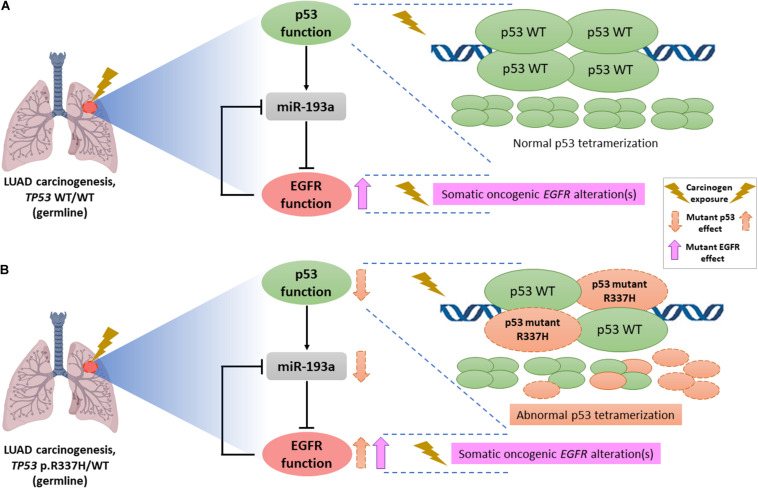
In Southern and Southeastern Brazil, there is a germline pathogenic variant with incomplete penetrance located in the oligomerization domain of , c.1010G>A (p.Arg337His). Due to a founder effect, the variant is present in 0.3% of the general population of the region. Recently, this variant was identified in 4.4 and 8.9% of two apparently unselected, single center case series of Brazilian lung adenocarcinoma (LUAD) patients from the Southeastern and Central regions of the country, respectively. In the present study, our aim was to examine c.1010G>A allele and genotype frequencies in LUAD samples obtained from patients diagnosed in Southern Brazil. A total of 586 LUAD samples (tumor DNA) recruited from multiple centers in the region were tested, and the mutant allele was identified using TaqMan assays in seven cases (7/586, 1.2%) which were submitted to next generation sequencing analyses for confirmation. Somatic mutations were more frequent in c.1010G>A carriers than in non-carriers (57.1 vs. 17.6%, respectively). Further studies are needed to confirm if c.1010G>A is a driver in LUAD carcinogenesis and to verify if there is a combined effect of and germline c.1010G>A. Although variant frequency was higher than observed in the general population, it is less than previously reported in LUAD patients from other Brazilian regions. Additional data, producing regional allele frequency information in larger series of patients and including cost-effectiveness analyses, are necessary to determine if c.1010G>A screening in all Brazilian LUAD patients is justified.
在巴西南部和东南部,存在一种位于 寡聚化结构域的具有不完全外显率的种系致病变异,即c.1010G>A(p.Arg337His)。由于奠基者效应,该变异存在于该地区0.3%的普通人群中。最近,在巴西东南部和中部地区两个明显未经选择的单中心肺腺癌(LUAD)患者病例系列中,分别有4.4%和8.9%的患者检测到该变异。在本研究中,我们的目的是检测从巴西南部诊断的LUAD患者样本中c.1010G>A等位基因和基因型频率。对从该地区多个中心招募的总共586份LUAD样本(肿瘤DNA)进行了检测,并使用TaqMan分析在7例患者(7/586,1.2%)中鉴定出突变等位基因,并对其进行二代测序分析以确认。c.1010G>A携带者的体细胞突变比非携带者更频繁(分别为57.1%和17.6%)。需要进一步研究以确认c.1010G>A是否为LUAD致癌作用的驱动因素,并验证是否存在 和种系c.1010G>A的联合效应。尽管该变异频率高于普通人群中的观察值,但低于先前在巴西其他地区的LUAD患者中报道的值。需要更多数据,包括在更大系列患者中产生区域等位基因频率信息并进行成本效益分析,以确定对所有巴西LUAD患者进行c.1010G>A筛查是否合理。