Moses Lusia Barek, Abu Bakar Mohd Fadzelly, Mamat Hasmadi, Aziz Zaleha Abdul
Faculty of Applied Sciences and Technology, Universiti Tun Hussein Onn Malaysia (UTHM), Pagoh Campus, Hub Pendidikan Tinggi Pagoh, KM1, Jalan Panchor, 84600, Muar, Johor, Malaysia.
Institute for Tropical Biology and Conservation, Universiti Malaysia Sabah, Jalan UMS, Kota Kinabalu, Sabah 88400, Malaysia.
Evid Based Complement Alternat Med. 2021 Jan 30;2021:8811236. doi: 10.1155/2021/8811236. eCollection 2021.
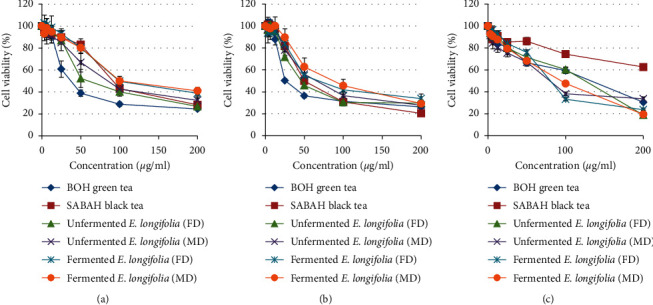
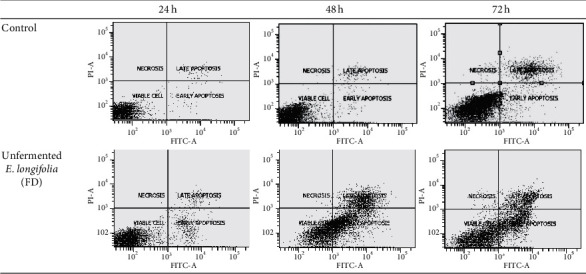
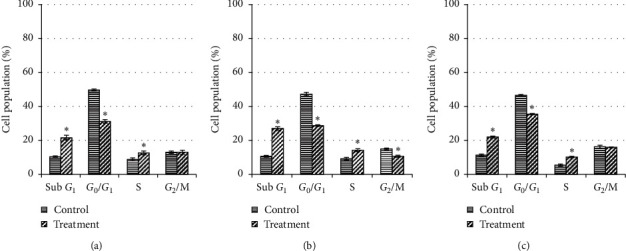
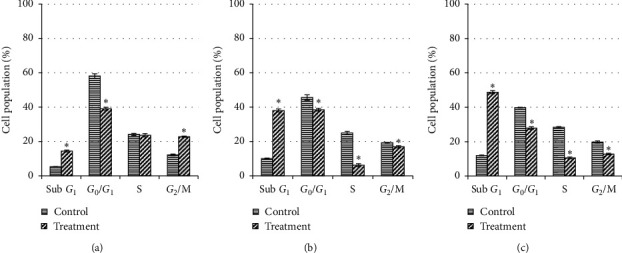
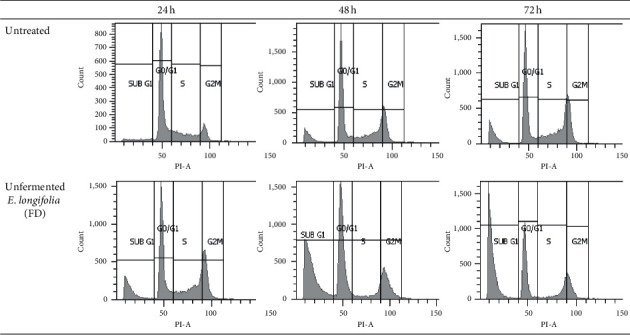
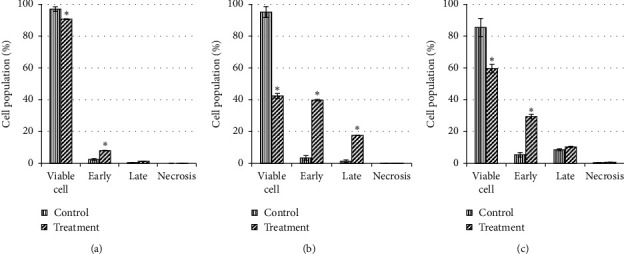
The present study was conducted to determine the cytotoxicity effect of (Jack.) leaf extracts and also its possible anticancer mechanism of action against breast cancer cell lines: non-hormone-dependent MDA-MB-231 and hormone-dependent MCF-7. The leaves of were processed into unfermented and fermented batches before drying using freeze and microwave-oven drying techniques. Obtained extracts were tested for cytotoxicity effect using MTT assay and phenolic determination using HPLC-DAD technique. The most toxic sample was analyzed for its apoptotic cell quantification, cell cycle distribution, and the expression of caspases and apoptotic protein using flow cytometry technique. Fragmentation of DNA was tested using an agarose gel electrophoresis system. The results determined that the unfermented freeze-dried leaf extract was the most toxic towards MDA-MB-231 and MCF-7 cells, in a dose-dependent manner. This extract contains the highest phenolics of gallic acid, chlorogenic acid, ECG, and EGCG. The DNA fragmentation was observed in both cell lines, where cell cycle was arrested at the /M phase in MCF-7 cells and S phase in MDA-MB-231 cells. The number of apoptotic cells for MDA-MB-231 was increased when the treatment was prolonged from 24 h to 48 h but slightly decreased at 72 h, whereas apoptosis in MCF-7 cells occurred in a time-dependent manner. There were significant activities of cytochrome c, caspase-3, Bax, and Bcl-2 apoptotic protein in MDA-MB-231 cells, whereas MCF-7 cells showed significant activities for caspase-8, cytochrome c, Bax, p53, and Bcl-2 apoptotic protein. These results indicate the ability of unfermented freeze-dried leaf extract of to induce apoptosis cell death on MDA-MB-231 and MCF-7, as well as real evidence on sample preparation effect towards its cytotoxicity level.
本研究旨在确定(杰克)叶提取物的细胞毒性作用及其对乳腺癌细胞系(非激素依赖性MDA-MB-231和激素依赖性MCF-7)可能的抗癌作用机制。在使用冷冻和微波炉干燥技术干燥之前,将(杰克)叶加工成未发酵和发酵批次。使用MTT法检测获得的提取物的细胞毒性作用,并使用HPLC-DAD技术测定酚类物质。对毒性最大的样品进行凋亡细胞定量、细胞周期分布分析,并使用流式细胞术技术检测半胱天冬酶和凋亡蛋白的表达。使用琼脂糖凝胶电泳系统检测DNA片段化。结果表明,未发酵的冻干叶提取物对MDA-MB-231和MCF-7细胞的毒性最大,呈剂量依赖性。该提取物含有最高含量的没食子酸、绿原酸、表儿茶素和表没食子儿茶素等酚类物质。在两种细胞系中均观察到DNA片段化,其中MCF-7细胞的细胞周期在G2/M期停滞,MDA-MB-231细胞的细胞周期在S期停滞。当处理时间从24小时延长到48小时时,MDA-MB-231的凋亡细胞数量增加,但在72小时时略有下降,而MCF-7细胞中的凋亡呈时间依赖性。MDA-MB-231细胞中细胞色素c、半胱天冬酶-3、Bax和Bcl-2凋亡蛋白有显著活性,而MCF-7细胞中半胱天冬酶-8、细胞色素c、Bax、p53和Bcl-2凋亡蛋白有显著活性。这些结果表明,(杰克)未发酵的冻干叶提取物能够诱导MDA-MB-231和MCF-7细胞凋亡,以及样品制备对其细胞毒性水平影响的真实证据。