Ma Huanhuan, Dong Aiqin
Department of Neurology, Cangzhou Central Hospital, Cangzhou, Hebei 061000, P.R. China.
Exp Ther Med. 2021 Mar;21(3):234. doi: 10.3892/etm.2021.9665. Epub 2021 Jan 21.
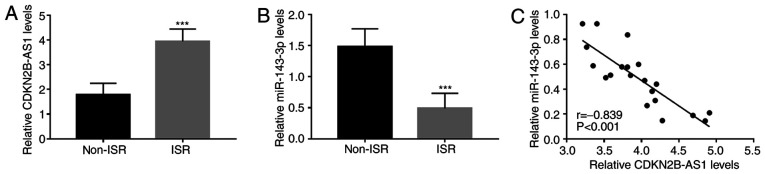
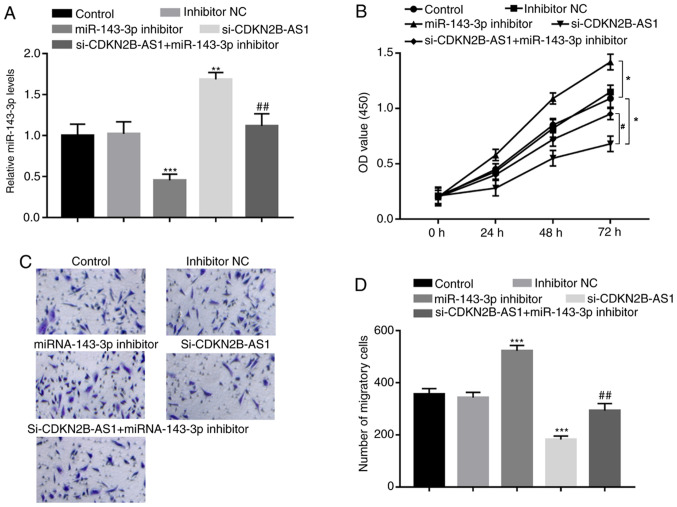
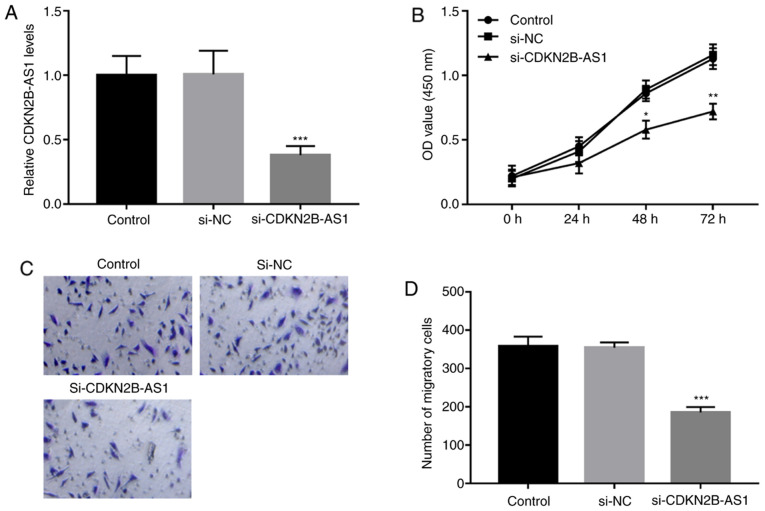
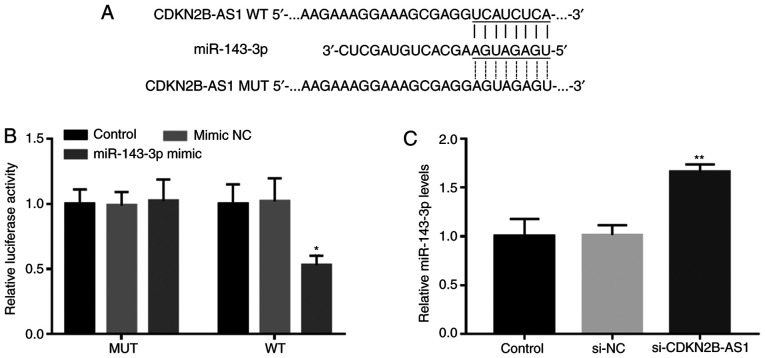
Carotid angioplasty and stenting (CAS) is an efficient therapeutic approach for carotid stenosis. However, in-stent restenosis (ISR) frequently occurs and seriously affects the therapeutic efficacy of CAS. Certain non-coding (nc)RNAs serve potential roles in ISR development and progression. Thus, the goals of the present study were to investigate novel biomarkers for ISR development and to further uncover the mechanisms underlying the progression of ISR. The expression of long ncRNA cyclin-dependent kinase inhibitor (CDKN)2B-antisense 1 (AS1) and microRNA (miR)-143-3p in patients with ISR and human carotid artery smooth muscle cells (hHCtASMCs) was analyzed using reverse transcription-quantitative PCR. A luciferase reporter assay was performed to examine the interaction between CDKN2B-AS1 and miR-143-3p. The effects of the CDKN2B/miR-143-3p axis on hHCtASMC proliferation and migration were assessed using Cell Counting Kit-8 and Transwell assays. The results indicated that serum CDKN2B-AS1 was increased and miR-143-3p was decreased in patients with ISR as compared with that in patients with no ISR (all P<0.001). CDKN2B-AS1 and miR-143-3p were identified as risk factors for ISR onset (all P<0.05) and knockdown of CDKN2B-AS1 in hHCtASMCs led to inhibited cell proliferation and migration. Furthermore, the luciferase reporter assay and expression analysis indicated that miR-143-3p is a target of CDKN2B-AS1 and may mediate the effects of CDKN2B-AS1 on hHCtASMC proliferation and migration. In conclusion, dysregulation of CDKN2B-AS1 and miR-143-3p may represent risk factors for the occurrence of ISR. The results suggested that the CDKN2B-AS1/miR-143-3p axis may regulate the proliferation and migration of hHCtASMCs, indicating its potential to be developed as a target for preventative measures and therapies for ISR.
颈动脉血管成形术和支架置入术(CAS)是治疗颈动脉狭窄的一种有效方法。然而,支架内再狭窄(ISR)经常发生,并严重影响CAS的治疗效果。某些非编码(nc)RNA在ISR的发生和发展中发挥潜在作用。因此,本研究的目的是寻找ISR发生的新生物标志物,并进一步揭示ISR进展的潜在机制。采用逆转录-定量PCR分析了ISR患者和人颈动脉平滑肌细胞(hHCtASMCs)中长链非编码RNA细胞周期蛋白依赖性激酶抑制剂(CDKN)2B反义链1(AS1)和微小RNA(miR)-143-3p的表达。进行荧光素酶报告基因检测以检测CDKN2B-AS1与miR-143-3p之间的相互作用。使用细胞计数试剂盒-8和Transwell实验评估CDKN2B/miR-143-3p轴对hHCtASMC增殖和迁移的影响。结果表明,与无ISR的患者相比,ISR患者血清中CDKN2B-AS1升高,miR-143-3p降低(均P<0.001)。CDKN2B-AS1和miR-143-3p被确定为ISR发生的危险因素(均P<0.05),敲低hHCtASMCs中的CDKN2B-AS1可导致细胞增殖和迁移受到抑制。此外,荧光素酶报告基因检测和表达分析表明,miR-143-3p是CDKN2B-AS1的靶标,可能介导CDKN2B-AS1对hHCtASMC增殖和迁移的影响。总之,CDKN2B-AS1和miR-143-3p的失调可能是ISR发生的危险因素。结果表明,CDKN2B-AS1/miR-143-3p轴可能调节hHCtASMC的增殖和迁移,表明其有潜力被开发为ISR预防措施和治疗的靶点。