Yuan Yuan, Liu Xiaoxian, Hao Shengyun, He Qian, Shen Zheng
Department of Emergency Medicine, Affiliated Hospital of Guizhou Medical University, Guiyang, China.
ICU of Internal Medicine, Affiliated Hospital of Guizhou Medical University, Guiyang, China.
Ann Transl Med. 2020 Jun;8(12):756. doi: 10.21037/atm-20-4227.
ISR remains the major adverse outcome after percutaneous coronary intervention (PCI). MicroRNAs have been demonstrated to be associated with coronary plaque and stable in the blood and can be used as biomarkers/predictors. This study aimed to investigate whether circulating microRNAs could predict in-stent restenosis (ISR).
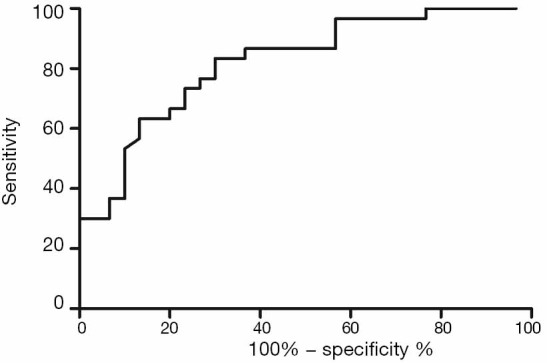
MicroRNA array was used to detect differently expressed microRNAs between 30 ISR patients and 30 non-ISR patients in the derivation cohort. Quantitative real-time polymerase chain reaction (qRT-PCR) was used to validate the microRNA array results and to detect levels of target microRNAs in the validation cohort. All patients were followed up for at least 1 year, and major adverse cardiac events (MACEs) were recorded. Univariate and multivariate logistic regression analysis were applied to find factors associated with ISR. Receiver operating characteristics (ROC) and Kaplan-Meier survival curves were used to analyze the predictive ability of the microRNA score for ISR.
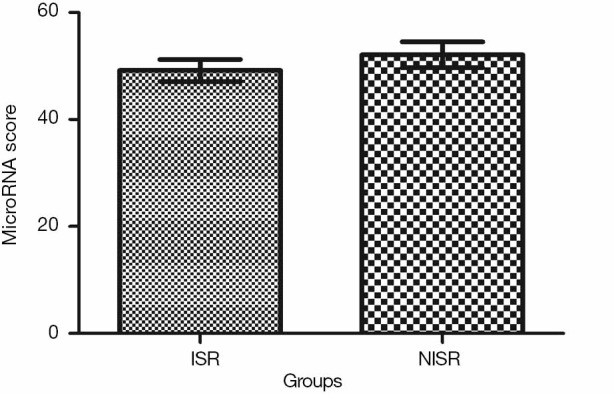
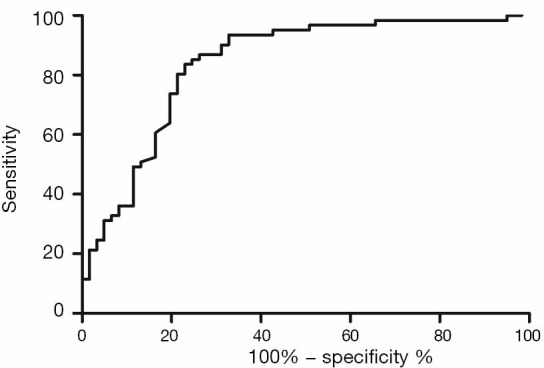
MicroRNA array and qRT-PCR showed that miR-143, 145, 425, 208, and let-7g were differently expressed between ISR patients and non-ISR patients. Multivariate analysis demonstrated that lower levels of mir-143 (OR =2.36, 95% CI: 1.43-3.67) and mir-145 (OR =2.12, 95% CI: 1.56-3.48) were associated with ISR. MicroRNA scores differed statistically between ISR patients and non-ISR patients (49.18±2.05 . 52.10±2.41, P<0.01) and has predictive ability for ISR with an area under the curve (AUC) of 0.8206 (95% CI: 0.7155-0.9256, P<0.01). In the validation cohort, Kaplan-Meier survival curves demonstrated that patients with higher microRNA scores have better prognosis in 1 year of follow-up.
A lower plasma level of mir-143/145 predicts a higher risk of ISR and a worse outcome.
支架内再狭窄(ISR)仍是经皮冠状动脉介入治疗(PCI)后的主要不良后果。微小RNA已被证明与冠状动脉斑块相关且在血液中稳定,可作为生物标志物/预测指标。本研究旨在探讨循环微小RNA是否能预测支架内再狭窄(ISR)。
在推导队列中,使用微小RNA芯片检测30例ISR患者和30例非ISR患者之间差异表达的微小RNA。采用定量实时聚合酶链反应(qRT-PCR)验证微小RNA芯片结果,并在验证队列中检测目标微小RNA的水平。所有患者至少随访1年,记录主要不良心脏事件(MACE)。应用单因素和多因素逻辑回归分析寻找与ISR相关的因素。采用受试者工作特征(ROC)曲线和Kaplan-Meier生存曲线分析微小RNA评分对ISR的预测能力。
微小RNA芯片和qRT-PCR显示,ISR患者和非ISR患者之间miR-143、145、425、208和let-7g表达存在差异。多因素分析表明,较低水平的mir-143(OR =2.36,95%CI:1.43-3.67)和mir-145(OR =2.12,95%CI:1.56-3.48)与ISR相关。ISR患者和非ISR患者的微小RNA评分在统计学上存在差异(49.18±2.05. 52.10±2.41,P<0.01),对ISR具有预测能力,曲线下面积(AUC)为0.8206(95%CI:0.7155-0.9256,P<0.01)。在验证队列中,Kaplan-Meier生存曲线表明,微小RNA评分较高的患者在1年随访中的预后较好。
血浆中较低水平的mir-143/145预示着ISR风险较高和预后较差。