Kwong Tsz Tung, Wong Chi Hang, Zhou Jing Ying, Cheng Alfred Sze Lok, Sung Joseph Jao Yiu, Chan Anthony Wing Hung, Chan Stephen Lam
Department of Clinical Oncology, Faculty of Medicine, The Chinese University of Hong Kong, Hong Kong.
School of Biomedical Sciences, The Chinese University of Hong Kong, Hong Kong.
JHEP Rep. 2020 Dec 20;3(2):100224. doi: 10.1016/j.jhepr.2020.100224. eCollection 2021 Apr.
BACKGROUND & AIMS: Immune checkpoint blockade (ICB) has been approved for treatment of hepatocellular carcinoma (HCC). However, many patients with advanced HCC are non-responders to ICB monotherapy. Cytotoxic chemotherapy has been proposed to modulate the tumor microenvironment (TME) and sensitize tumors to ICB. Thus, we aimed to study the combination of cytotoxic chemotherapy and ICB in an orthotopic HCC model.
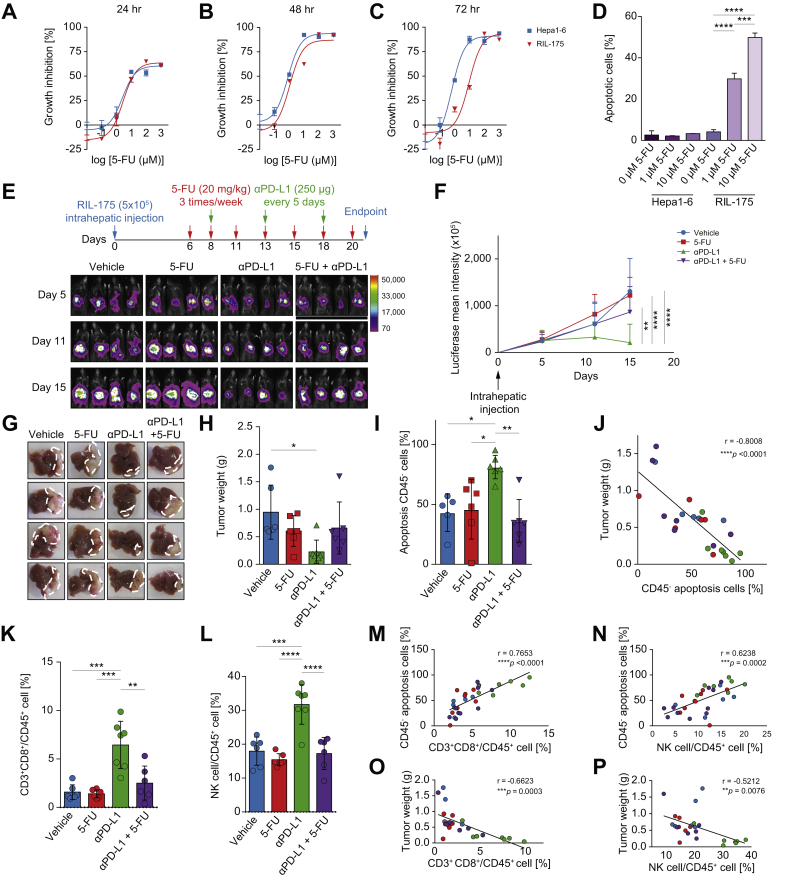
Preclinical orthotopic HCC mouse models were used to elucidate the efficacy of 5-fluorouracil (5-FU) and ICB. The mice were intrahepatically injected with RIL-175 or Hepa1-6 cells, followed by treatment with 5-FU and anti-programmed cell death ligand 1 (PD-L1) antibody. Myeloid-derived suppressor cells (MDSCs) were depleted to validate their role in attenuating sensitivity to immunotherapy. Flow cytometry-based immune profiling and immunofluorescence staining were performed in mice and patient samples, respectively.
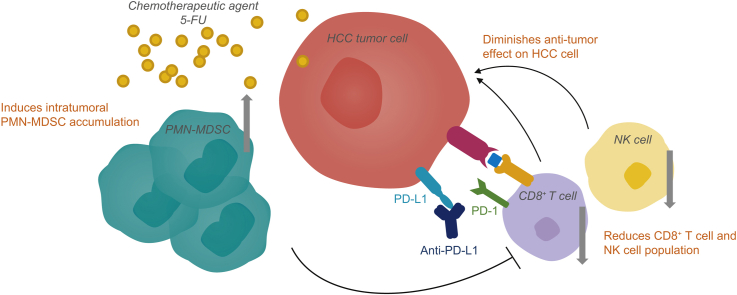
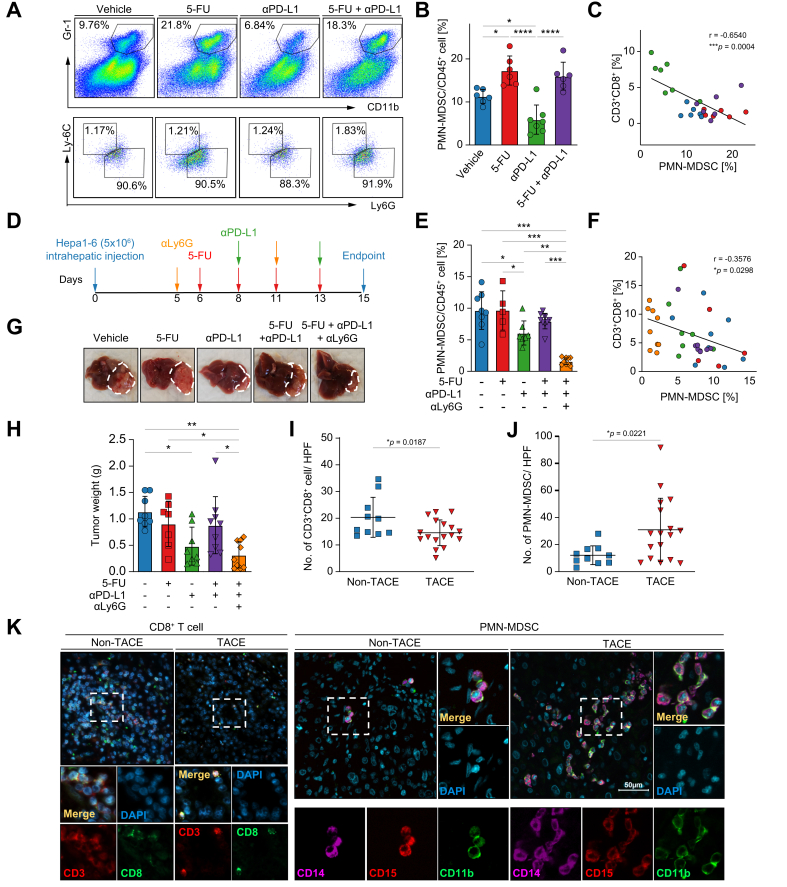
5-FU could induce intratumoral MDSC accumulation to counteract the infiltration of T lymphocytes and natural killer cells, thus abrogating the anti-tumor efficacy of PD-L1 blockade. In clinical samples, MDSCs accumulated and CD8 T cell numbers decreased following transarterial chemoembolization.
5-FU can trigger the accumulation of immunosuppressive MDSCs, impairing the response to PD-L1 blockade in HCC. Our data suggest that the combination of specific chemotherapy and ICB may impair anti-tumor immune responses, warranting further study in preclinical models and consideration in clinical settings.
Our findings suggest that some chemotherapies may impair the anti-tumor efficacy of immunotherapy. Further studies are required to uncover the specific effects of different chemotherapies on the immunological profile of tumors. This data will be critical for the rational design of combination immunotherapy strategies for patients with hepatocellular carcinoma.
免疫检查点阻断(ICB)已被批准用于治疗肝细胞癌(HCC)。然而,许多晚期HCC患者对ICB单药治疗无反应。细胞毒性化疗已被提出可调节肿瘤微环境(TME)并使肿瘤对ICB敏感。因此,我们旨在研究原位HCC模型中细胞毒性化疗与ICB的联合应用。
使用临床前原位HCC小鼠模型来阐明5-氟尿嘧啶(5-FU)与ICB的疗效。小鼠经肝内注射RIL-175或Hepa1-6细胞,随后接受5-FU和抗程序性细胞死亡配体1(PD-L1)抗体治疗。清除髓源性抑制细胞(MDSC)以验证其在减弱免疫治疗敏感性中的作用。分别在小鼠和患者样本中进行基于流式细胞术的免疫分析和免疫荧光染色。
5-FU可诱导肿瘤内MDSC积聚,以抵消T淋巴细胞和自然杀伤细胞的浸润,从而消除PD-L1阻断的抗肿瘤疗效。在临床样本中,经动脉化疗栓塞后MDSC积聚且CD8 T细胞数量减少。
5-FU可引发免疫抑制性MDSC的积聚,损害HCC对PD-L1阻断的反应。我们的数据表明,特定化疗与ICB的联合应用可能会损害抗肿瘤免疫反应,需要在临床前模型中进一步研究并在临床环境中加以考虑。
我们的研究结果表明,某些化疗可能会损害免疫治疗的抗肿瘤疗效。需要进一步研究以揭示不同化疗对肿瘤免疫谱的具体影响。这些数据对于合理设计肝细胞癌患者的联合免疫治疗策略至关重要。