Laboratory of Interventional Radiology, Department of Minimally Invasive Interventional Radiology and Interventional Cancer Center, the Second Affiliated Hospital, Guangzhou Medical University, Guangzhou, China.
College of Chemistry and Materials Science, Jinan University, Guangzhou, China.
J Immunother Cancer. 2023 Feb;11(2). doi: 10.1136/jitc-2022-006493.
Immune checkpoint blockade (ICB) monotherapy provides poor survival benefit in hepatocellular carcinoma (HCC) due to ICB resistance caused by immunosuppressive tumor microenvironment (TME) and drug discontinuation resulting from immune-related side effects. Thus, novel strategies that can simultaneously reshape immunosuppressive TME and ameliorate side effects are urgently needed.
Both in vitro and orthotopic HCC models were used to explore and demonstrate the new role of a conventional, clinically used drug, tadalafil (TA), in conquering immunosuppressive TME. In detail, the effect of TA on M2 polarization and polyamine metabolism in tumor-associated macrophages (TAMs) and myeloid-derived suppressor cells (MDSCs) was identified. After making clear the aforementioned immune regulatory effect of TA, we introduced a nanomedicine-based strategy of tumor-targeted drug delivery to make better use of TA to reverse immunosuppressive TME and overcome ICB resistance for HCC immunotherapy. A dual pH-sensitive nanodrug simultaneously carrying both TA and programmed cell death receptor 1 antibody (aPD-1) was developed, and its ability for tumor-targeted drug delivery and TME-responsive drug release was evaluated in an orthotopic HCC model. Finally, the immune regulatory effect, antitumor therapeutic effect, as well as side effects of our nanodrug combining both TA and aPD-1 were analyzed.
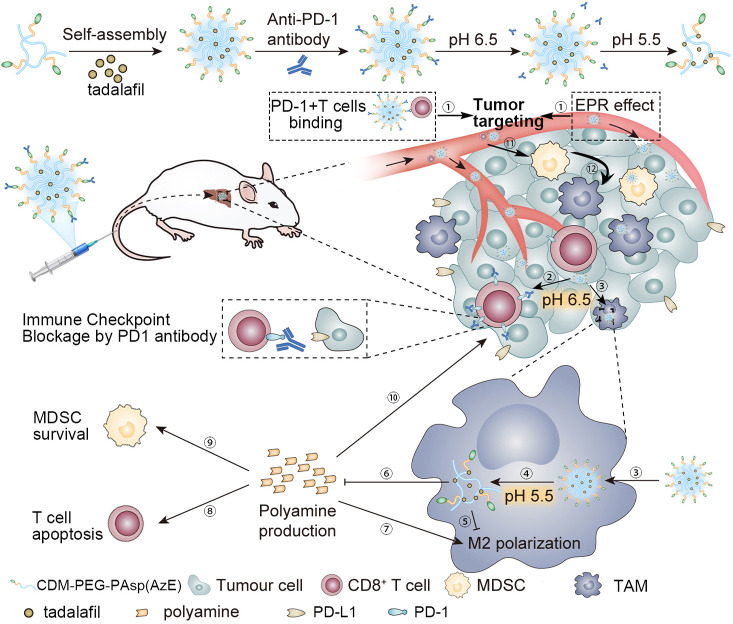
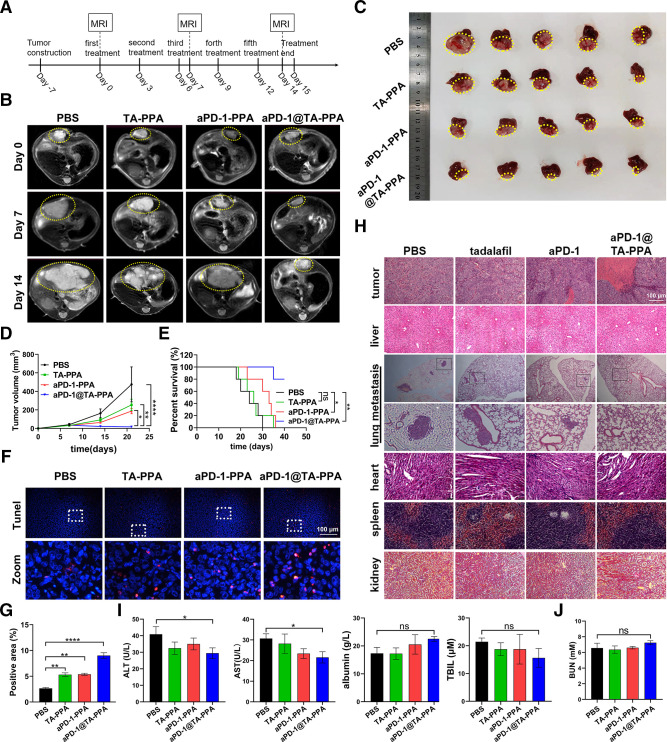
TA exerted a new role in conquering immunosuppressive TME by inhibiting M2 polarization and polyamine metabolism in TAMs and MDSCs. A dual pH-sensitive nanodrug was successfully synthesized to simultaneously carry both TA and aPD-1. On one hand, the nanodrug realized tumor-targeted drug delivery by binding to circulating programmed cell death receptor 1-positive T cells and following their infiltration into tumor. On the other hand, the nanodrug facilitated efficient intratumoral drug release in acidic TME, releasing aPD-1 for ICB and leaving TA-encapsulated nanodrug to dually regulate TAMs and MDSCs. By virtue of the combined application of TA and aPD-1, as well as the efficient tumor-targeted drug delivery, our nanodrug effectively inhibited M2 polarization and polyamine metabolism in TAMs and MDSCs to conquer immunosuppressive TME, which contributed to remarkable ICB therapeutic efficacy with minimal side effects in HCC.
Our novel tumor-targeted nanodrug expands the application of TA in tumor therapy and holds great potential to break the logjam of ICB-based HCC immunotherapy.
免疫检查点阻断(ICB)单药治疗在肝细胞癌(HCC)中的生存获益较差,这是由于免疫抑制性肿瘤微环境(TME)导致的 ICB 耐药和免疫相关副作用导致的药物停药。因此,迫切需要新的策略来同时重塑免疫抑制性 TME 并改善副作用。
本研究采用体外和原位 HCC 模型,探索并证明了一种传统的、临床应用的药物他达拉非(TA)在攻克免疫抑制性 TME 方面的新作用。具体来说,研究了 TA 对肿瘤相关巨噬细胞(TAMs)和髓样来源抑制细胞(MDSCs)中 M2 极化和多胺代谢的影响。在明确 TA 的上述免疫调节作用后,我们引入了一种基于纳米医学的肿瘤靶向药物递送策略,以更好地利用 TA 逆转免疫抑制性 TME,并克服 HCC 免疫治疗中的 ICB 耐药性。开发了一种同时携带 TA 和程序性细胞死亡受体 1 抗体(aPD-1)的双 pH 敏感纳米药物,并在原位 HCC 模型中评估了其肿瘤靶向药物递送和 TME 响应性药物释放能力。最后,分析了我们的 TA 和 aPD-1 联合纳米药物的免疫调节作用、抗肿瘤治疗效果和副作用。
TA 通过抑制 TAMs 和 MDSCs 中的 M2 极化和多胺代谢,发挥了攻克免疫抑制性 TME 的新作用。成功合成了一种双 pH 敏感纳米药物,同时携带 TA 和 aPD-1。一方面,纳米药物通过与循环中程序性细胞死亡受体 1 阳性 T 细胞结合并随其浸润肿瘤来实现肿瘤靶向药物递送。另一方面,纳米药物在酸性 TME 中促进了有效的肿瘤内药物释放,释放 aPD-1 进行 ICB,并留下 TA 包封的纳米药物来双重调节 TAMs 和 MDSCs。通过 TA 和 aPD-1 的联合应用以及有效的肿瘤靶向药物递送,我们的纳米药物有效地抑制了 TAMs 和 MDSCs 中的 M2 极化和多胺代谢,攻克了免疫抑制性 TME,从而在 HCC 中实现了显著的 ICB 治疗效果,同时副作用最小。
我们的新型肿瘤靶向纳米药物拓展了 TA 在肿瘤治疗中的应用,并具有很大的潜力打破基于 ICB 的 HCC 免疫治疗的僵局。