School of Interdisciplinary Studies, The University of Glasgow, Dumfries Campus Maxwell House Crichton University, Campus Dumfries, Glasgow, DG1 4UQ, UK.
School of Interdisciplinary Studies, The University of Glasgow, Dumfries Campus Rutherford/McCowan Building, Crichton University Campus Dumfries, Glasgow, DG1 4ZL, UK.
Ambio. 2021 Aug;50(8):1552-1573. doi: 10.1007/s13280-021-01502-4. Epub 2021 Feb 19.
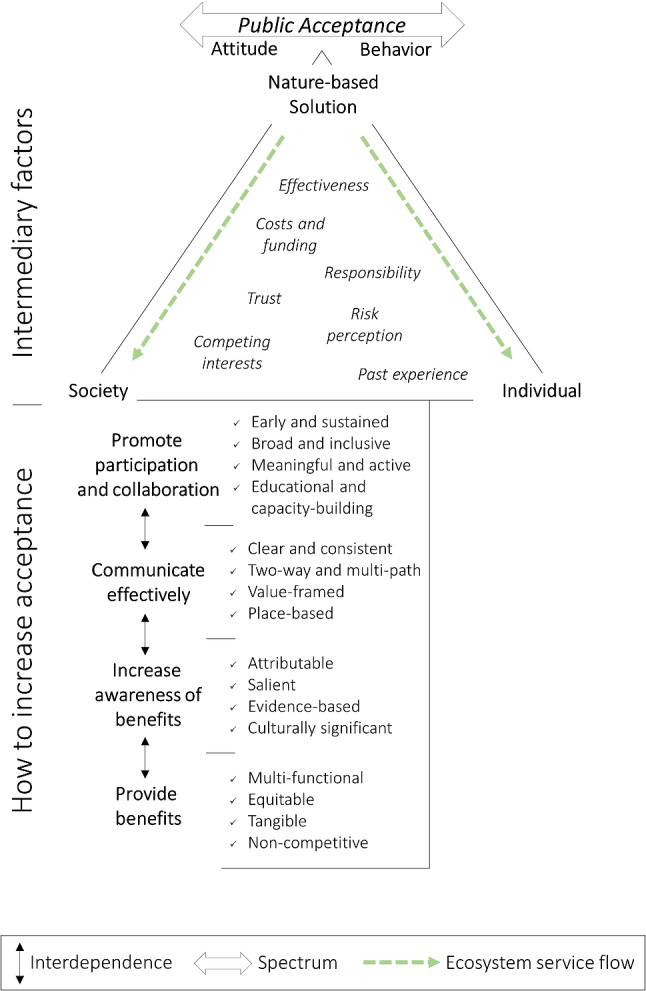
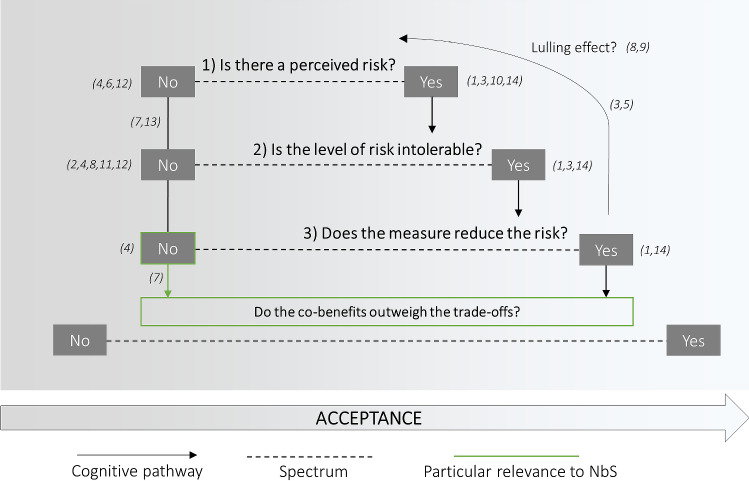
Nature-based solutions (NbS) are increasingly recognized as sustainable approaches to address societal challenges. Disaster risk reduction (DRR) has benefited by moving away from purely 'grey' infrastructure measures towards NbS. However, this shift also furthers an increasing trend of reliance on public acceptance to plan, implement and manage DRR measures. In this review, we examine how unique NbS characteristics relate to public acceptance through a comparison with grey measures, and we identify influential acceptance factors related to individuals, society, and DRR measures. Based on the review, we introduce the PA-NbS model that highlights the role of risk perception, trust, competing societal interests, and ecosystem services. Efforts to increase acceptance should focus on providing and promoting awareness of benefits combined with effective communication and collaboration. Further research is required to understand interconnections among identified factors and how they can be leveraged for the success and further uptake of NbS.
基于自然的解决方案(NbS)越来越被认为是应对社会挑战的可持续方法。减少灾害风险(DRR)已经受益于远离纯粹的“灰色”基础设施措施,转向 NbS。然而,这一转变也进一步加剧了对公众接受度的依赖,以规划、实施和管理 DRR 措施。在这篇综述中,我们通过与灰色措施进行比较,考察了 NbS 的独特特征如何通过与灰色措施进行比较,与公众接受度相关,并确定了与个人、社会和 DRR 措施相关的有影响力的接受因素。基于综述,我们引入了 PA-NbS 模型,突出了风险感知、信任、竞争的社会利益和生态系统服务的作用。提高接受度的努力应侧重于提供和宣传效益,同时结合有效的沟通和协作。需要进一步研究以了解确定因素之间的相互联系以及如何利用这些因素来促进 NbS 的成功和进一步采用。