Department of Internal Medicine, Chonnam National University Medical School, Gwangju, Republic of Korea.
Department of Nursing, College of Medicine, Chosun University, Gwangju, Republic of Korea.
PLoS Negl Trop Dis. 2021 Feb 19;15(2):e0009128. doi: 10.1371/journal.pntd.0009128. eCollection 2021 Feb.
Severe fever with thrombocytopenia syndrome (SFTS) is an acute, febrile, and potentially fatal tick-borne disease caused by the SFTS Phlebovirus. Here, we evaluated the effects of steroid therapy in Korean patients with SFTS.
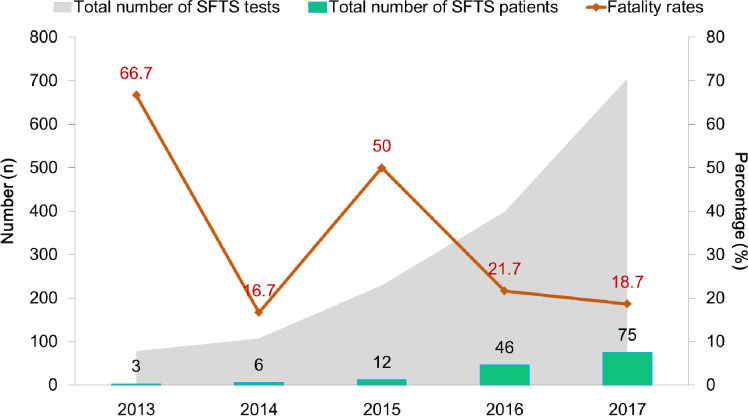
A retrospective study was performed in a multicenter SFTS clinical cohort from 13 Korean university hospitals between 2013 and 2017. We performed survival analysis using propensity score matching of 142 patients with SFTS diagnosed by genetic or antibody tests.
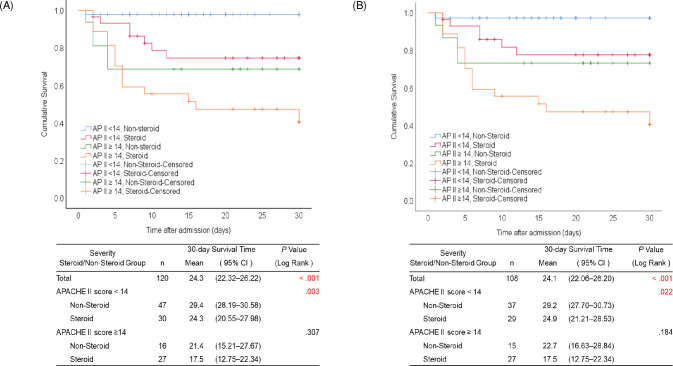
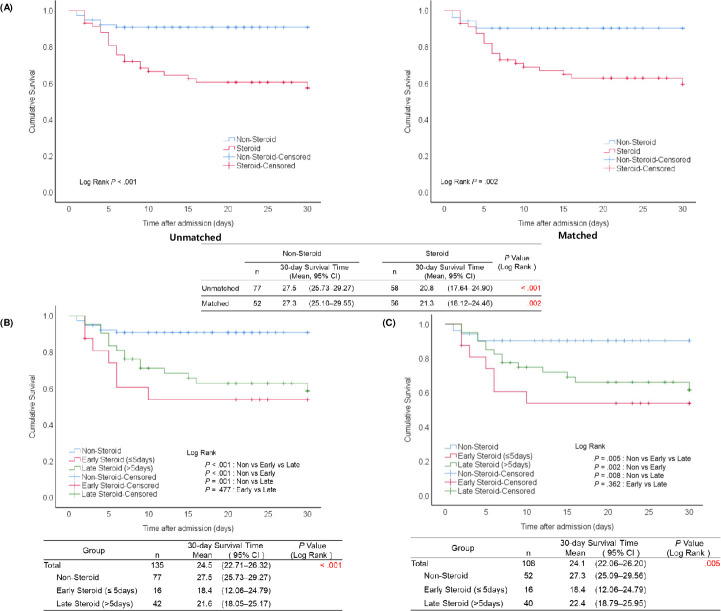
Overall fatality rate was 23.2%, with 39.7% among 58 patients who underwent steroid therapy. Complications were observed in 37/58 (63.8%) and 25/83 (30.1%) patients in the steroid and non-steroid groups, respectively (P < .001). Survival analysis after propensity score matching showed a significant difference in mean 30-day survival time between the non-steroid and steroid groups in patients with a mild condition [Acute Physiology and Chronic Health Evaluation II (APACHE II) score <14; 29.2 (95% CI 27.70-30.73] vs. 24.9 (95% CI 21.21-28.53], P = .022]. Survival times for the early steroid (≤5 days from the start of therapy after symptom onset), late steroid (>5 days), and non-steroid groups, were 18.4, 22.4, and 27.3 days, respectively (P = .005).
After steroid therapy, an increase in complications was observed among patients with SFTS. Steroid therapy should be used with caution, considering the possible negative effects of steroid therapy within 5 days of symptom onset or in patients with mild disease (APACHE II score <14).
严重发热伴血小板减少综合征(SFTS)是一种由 SFTS 病毒引起的急性、发热性、潜在致命的蜱传疾病。在此,我们评估了类固醇治疗对韩国 SFTS 患者的影响。
对 2013 年至 2017 年间 13 家韩国大学医院的 SFTS 临床队列进行了回顾性研究。我们对通过基因或抗体检测诊断为 SFTS 的 142 例患者进行了倾向评分匹配的生存分析。
总死亡率为 23.2%,其中 58 例接受类固醇治疗的患者死亡率为 39.7%。类固醇组和非类固醇组分别有 37/58(63.8%)和 25/83(30.1%)例患者出现并发症(P<.001)。倾向评分匹配后的生存分析显示,轻症患者(急性生理和慢性健康评估 II 评分<14;29.2[95%CI 27.70-30.73])与中症患者(24.9[95%CI 21.21-28.53])之间的 30 天平均生存时间存在显著差异(P=.022)。早期(发病后开始治疗 5 天内)、晚期(>5 天)和非类固醇组的类固醇治疗患者的生存时间分别为 18.4、22.4 和 27.3 天(P=.005)。
SFTS 患者接受类固醇治疗后并发症增加。考虑到发病后 5 天内或轻症(APACHE II 评分<14)患者类固醇治疗的可能负面效应,应谨慎使用类固醇治疗。