Shin Jaeseung, Kwon Donghyok, Youn Seung-Ki, Park Ji-Hyuk
Emerg Infect Dis. 2015 Oct;21(10):1704-10. doi: 10.3201/eid2110.141928.
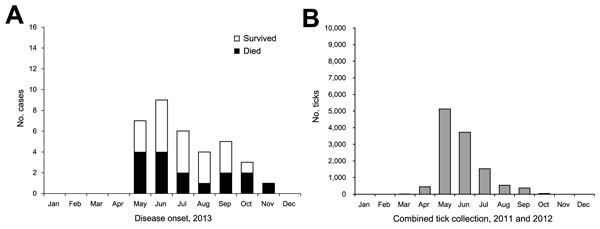
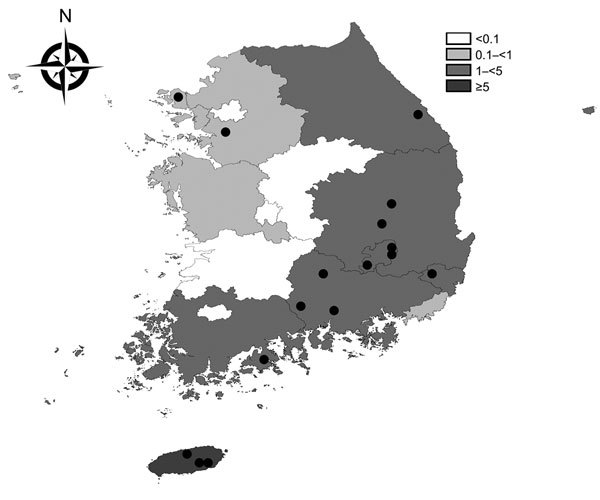
In South Korea, nationwide surveillance for severe fever with thrombocytopenia syndrome (SFTS) began during 2013. Among 301 surveillance cases, 35 hospitalized case-patients in 25 areas were confirmed by using virologic testing, and 16 (46%) case-patients subsequently died. The SFTS cases occurred during May-November and peaked during June (9 cases, 26%). The incidence of SFTS was higher in the southern regions of South Korea. Age and neurologic symptoms, including decreased level of consciousness and slurred speech, were heavily associated with death; neurologic symptoms during the first week after disease onset were also associated with death. Although melena was common among patients who died, no other hemorrhagic manifestations were substantively more common among those who died. No effective treatments, including ribavirin, were identified. Expansion of SFTS surveillance to include the outpatient sector and development of an antibody test would enhance completeness of SFTS detection in South Korea.
在韩国,2013年开始了全国范围的严重发热伴血小板减少综合征(SFTS)监测。在301例监测病例中,25个地区的35例住院病例通过病毒学检测得以确诊,其中16例(46%)病例随后死亡。SFTS病例发生在5月至11月,6月达到高峰(9例,占26%)。韩国南部地区的SFTS发病率较高。年龄以及包括意识水平下降和言语不清在内的神经系统症状与死亡密切相关;疾病发作后第一周出现的神经系统症状也与死亡有关。尽管黑便在死亡患者中很常见,但在死亡患者中没有其他出血表现明显更常见。未发现包括利巴韦林在内的有效治疗方法。将SFTS监测扩大到门诊部门并开展抗体检测将提高韩国SFTS检测的完整性。