Institute of Mathematical Statistics and Actuarial Science, University of Bern, Bern, Switzerland.
Division of Intensive Care Medicine, Cantonal Hospital, St.Gallen, Switzerland.
PLoS One. 2021 Feb 19;16(2):e0247265. doi: 10.1371/journal.pone.0247265. eCollection 2021.
The COVID-19 pandemic induces considerable strain on intensive care unit resources.
We aim to provide early predictions of individual patients' intensive care unit length of stay, which might improve resource allocation and patient care during the on-going pandemic.
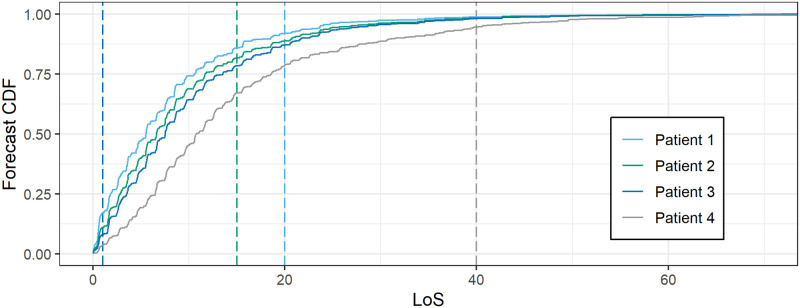
We developed a new semiparametric distributional index model depending on covariates which are available within 24h after intensive care unit admission. The model was trained on a large cohort of acute respiratory distress syndrome patients out of the Minimal Dataset of the Swiss Society of Intensive Care Medicine. Then, we predict individual length of stay of patients in the RISC-19-ICU registry.
The RISC-19-ICU Investigators for Switzerland collected data of 557 critically ill patients with COVID-19.
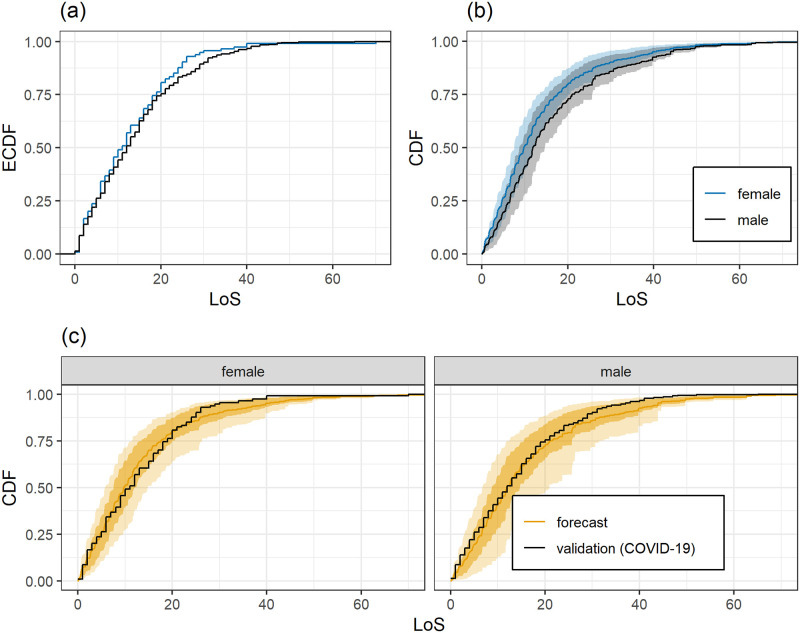
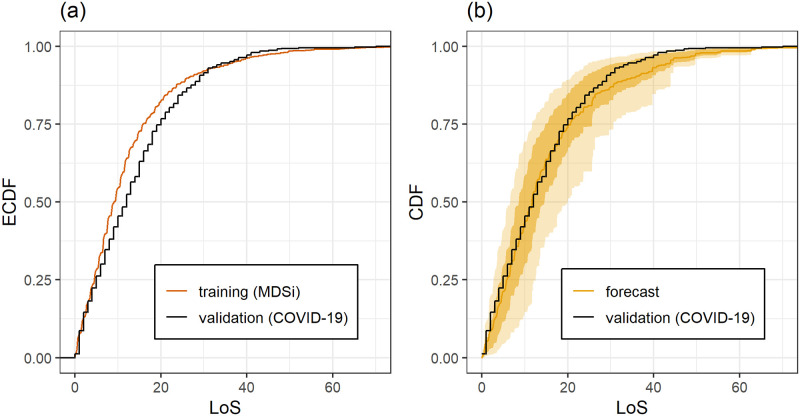
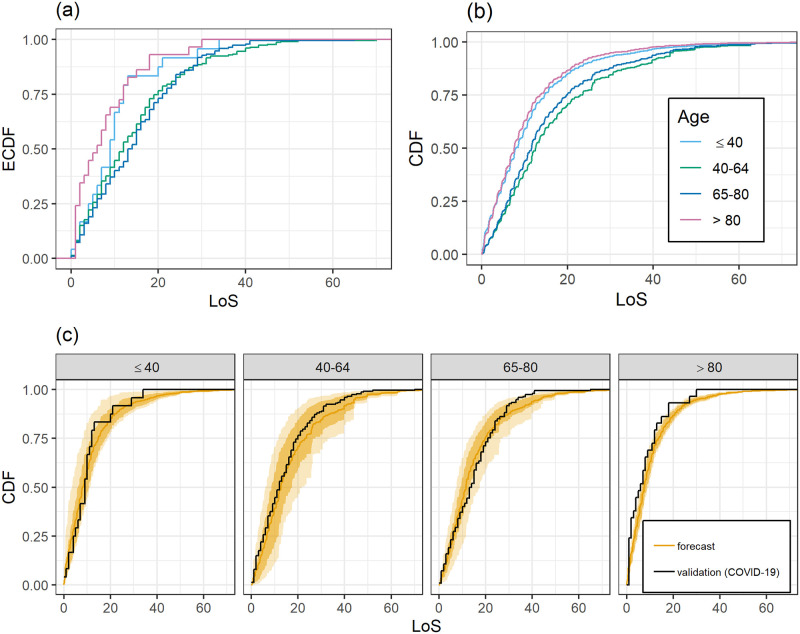
The model gives probabilistically and marginally calibrated predictions which are more informative than the empirical length of stay distribution of the training data. However, marginal calibration was worse after approximately 20 days in the whole cohort and in different subgroups. Long staying COVID-19 patients have shorter length of stay than regular acute respiratory distress syndrome patients. We found differences in LoS with respect to age categories and gender but not in regions of Switzerland with different stress of intensive care unit resources.
A new probabilistic model permits calibrated and informative probabilistic prediction of LoS of individual patients with COVID-19. Long staying patients could be discovered early. The model may be the basis to simulate stochastic models for bed occupation in intensive care units under different casemix scenarios.
COVID-19 大流行给重症监护病房资源带来了巨大压力。
我们旨在提供个体患者重症监护病房入住时间的早期预测,这可能有助于在当前大流行期间改善资源分配和患者护理。
我们开发了一种新的半参数分布指数模型,该模型依赖于重症监护病房入院后 24 小时内可用的协变量。该模型在瑞士重症监护医学学会最小数据集的急性呼吸窘迫综合征患者大队列中进行了训练。然后,我们预测了 RISC-19-ICU 登记处中患者的个体住院时间。
瑞士的 RISC-19-ICU 调查员收集了 557 名 COVID-19 危重症患者的数据。
该模型提供了概率和边缘校准的预测,比训练数据的经验住院时间分布更具信息量。然而,在整个队列和不同亚组中,大约 20 天后,边缘校准情况变得更糟。COVID-19 住院时间较长的患者比常规急性呼吸窘迫综合征患者的住院时间更短。我们发现,年龄类别和性别与 LoS 存在差异,但与重症监护病房资源压力不同的瑞士地区无关。
一种新的概率模型可以对 COVID-19 个体患者的 LoS 进行校准和信息丰富的概率预测。可以早期发现住院时间较长的患者。该模型可能是在不同病例组合情况下模拟重症监护病房床位占用的随机模型的基础。