Department of Psychology, Norwegian University of Science and Technology, Trondheim, Norway.
PLoS One. 2021 Feb 19;16(2):e0247331. doi: 10.1371/journal.pone.0247331. eCollection 2021.
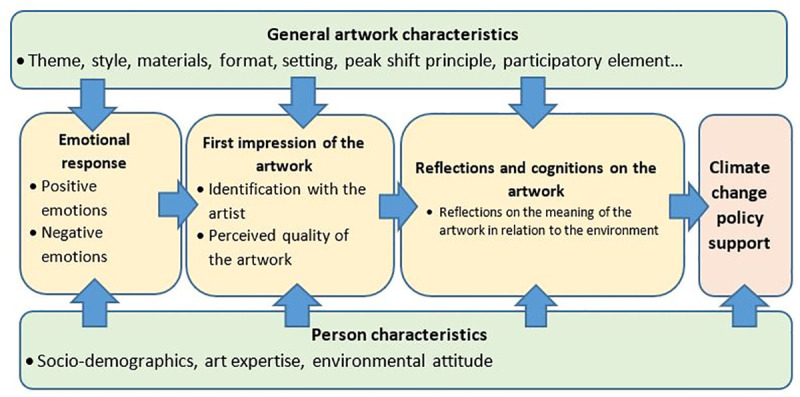
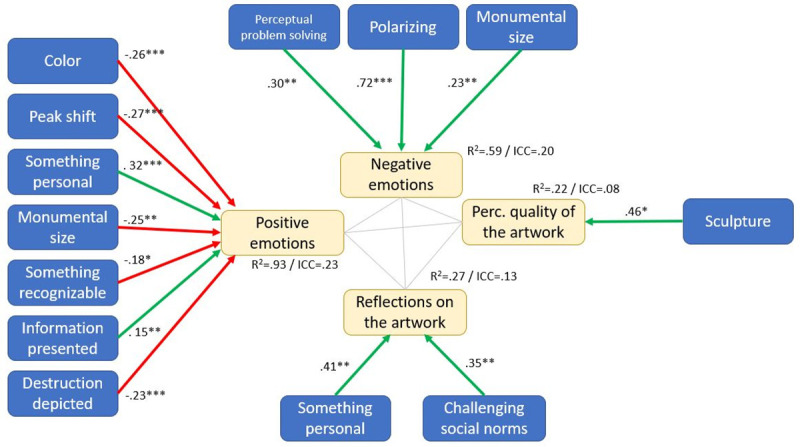
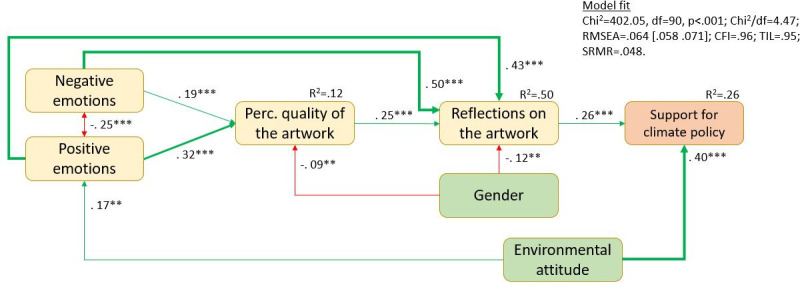
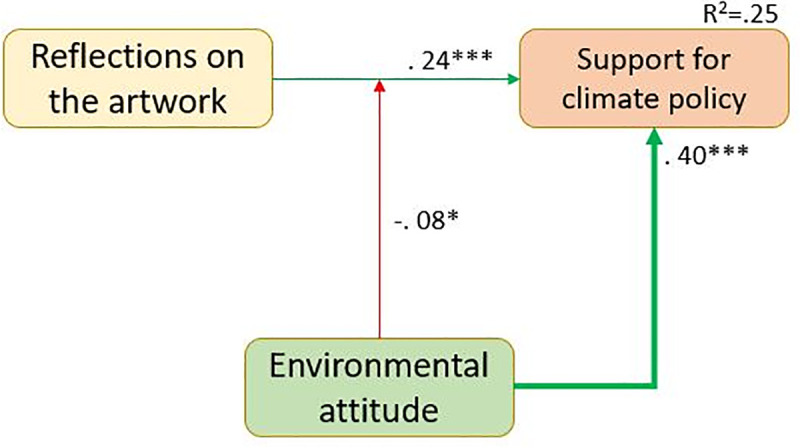
This paper suggests and tests a psychological model of environmental art perception and subsequent support for climate change policies. The model is based on findings from art perception and environmental psychology, which indicate that the response of the viewer to the artwork is (1) first an emotional reaction, which can be positive and/or negative. The emotional activation leads to (2) evaluation of the perceived quality of the artwork. This forms the first impression of the artwork the viewer gets, which then triggers (3) reflections on the artwork that are finally related to support for climate policies. The model test uses data collected at the ArtCOP21 that accompanied the 21st UN climate summit in Paris. At 37 connected events, the research team collected 883 audience responses with a brief quantitative paper-pencil questionnaire. The data were analyzed using a multilevel-structural equation modeling approach. Results support the suggested theoretical model. Moreover, the effect of reflections on the artwork on support for climate policies is moderated by environmental attitudes, meaning the lower the environmental attitudes, the higher the effect of reflections on policy support. Finally, artwork features like color, size, displaying something personal, etc., could be identified that had a significant relation to differences on the artwork level regarding the first impression of the artwork and the reflections elicited. The study shows that being confronted with climate change-related artwork relates at least in the short run to increased climate policy support, which is mostly channeled through an emotional activation with following cognitive processing. Features of the artwork relate to how strongly and which emotions are activated.
本文提出并检验了一个环境艺术感知与随后支持气候变化政策的心理模型。该模型基于艺术感知和环境心理学的研究结果,表明观众对艺术品的反应首先是(1)情感反应,可以是积极的,也可以是消极的。情感激活导致(2)对艺术品感知质量的评价。这形成了观众对艺术品的第一印象,然后引发(3)对艺术品的反思,最终与支持气候政策相关联。该模型测试使用了在巴黎举行的第 21 届联合国气候峰会期间举办的 ArtCOP21 收集的数据。在 37 个相关活动中,研究团队使用简短的纸笔问卷收集了 883 名观众的反应。使用多层次结构方程建模方法对数据进行了分析。结果支持了所建议的理论模型。此外,对艺术品的反思对支持气候变化政策的影响受到环境态度的调节,这意味着环境态度越低,对政策支持的反思影响越大。最后,可以确定艺术品的特征,如颜色、大小、展示个人物品等,这些特征与艺术品层面上对艺术品的第一印象和引发的反思差异有关。该研究表明,至少在短期内,接触与气候变化相关的艺术品会增加对气候变化政策的支持,这主要是通过情感激活和随后的认知处理来实现的。艺术品的特征与情感激活的强烈程度和类型有关。