Department of Global Health, University of Washington, Seattle, WA; Department of Obstetrics & Gynecology, University of Washington, Seattle, WA.
Department of Epidemiology, University of Washington, Seattle, WA.
Am J Obstet Gynecol. 2021 Jul;225(1):75.e1-75.e16. doi: 10.1016/j.ajog.2021.02.011. Epub 2021 Feb 16.
During the early months of the coronavirus disease 2019 pandemic, risks associated with severe acute respiratory syndrome coronavirus 2 in pregnancy were uncertain. Pregnant patients can serve as a model for the success of clinical and public health responses during public health emergencies as they are typically in frequent contact with the medical system. Population-based estimates of severe acute respiratory syndrome coronavirus 2 infections in pregnancy are unknown because of incomplete ascertainment of pregnancy status or inclusion of only single centers or hospitalized cases. Whether pregnant women were protected by the public health response or through their interactions with obstetrical providers in the early months of pandemic is not clearly understood.
This study aimed to estimate the severe acute respiratory syndrome coronavirus 2 infection rate in pregnancy and to examine the disparities by race and ethnicity and English language proficiency in Washington State.
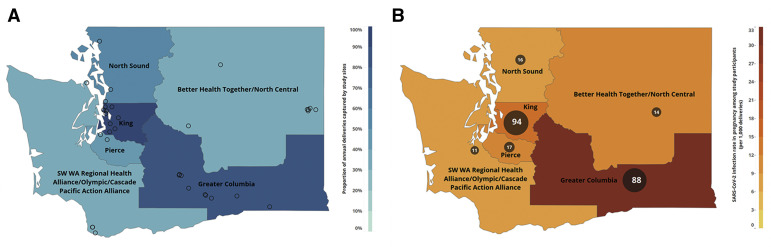
Pregnant patients with a polymerase chain reaction-confirmed severe acute respiratory syndrome coronavirus 2 infection diagnosed between March 1, 2020, and June 30, 2020 were identified within 35 hospitals and clinics, capturing 61% of annual deliveries in Washington State. Infection rates in pregnancy were estimated overall and by Washington State Accountable Community of Health region and cross-sectionally compared with severe acute respiratory syndrome coronavirus 2 infection rates in similarly aged adults in Washington State. Race and ethnicity and language used for medical care of pregnant patients were compared with recent data from Washington State.
A total of 240 pregnant patients with severe acute respiratory syndrome coronavirus 2 infections were identified during the study period with 70.7% from minority racial and ethnic groups. The principal findings in our study were as follows: (1) the severe acute respiratory syndrome coronavirus 2 infection rate was 13.9 per 1000 deliveries in pregnant patients (95% confidence interval, 8.3-23.2) compared with 7.3 per 1000 (95% confidence interval, 7.2-7.4) in adults aged 20 to 39 years in Washington State (rate ratio, 1.7; 95% confidence interval, 1.3-2.3); (2) the severe acute respiratory syndrome coronavirus 2 infection rate reduced to 11.3 per 1000 deliveries (95% confidence interval, 6.3-20.3) when excluding 45 cases of severe acute respiratory syndrome coronavirus disease 2 detected through asymptomatic screening (rate ratio, 1.3; 95% confidence interval, 0.96-1.9); (3) the proportion of pregnant patients in non-White racial and ethnic groups with severe acute respiratory syndrome coronavirus disease 2 infection was 2- to 4-fold higher than the race and ethnicity distribution of women in Washington State who delivered live births in 2018; and (4) the proportion of pregnant patients with severe acute respiratory syndrome coronavirus 2 infection receiving medical care in a non-English language was higher than estimates of pregnant patients receiving care with limited English proficiency in Washington State (30.4% vs 7.6%).
The severe acute respiratory syndrome coronavirus 2 infection rate in pregnant people was 70% higher than similarly aged adults in Washington State, which could not be completely explained by universal screening at delivery. Pregnant patients from nearly all racial and ethnic minority groups and patients receiving medical care in a non-English language were overrepresented. Pregnant women were not protected from severe acute respiratory syndrome coronavirus 2 infection in the early months of the pandemic. Moreover, the greatest burden of infections occurred in nearly all racial and ethnic minority groups. These data coupled with a broader recognition that pregnancy is a risk factor for severe illness and maternal mortality strongly suggested that pregnant people should be broadly prioritized for coronavirus disease 2019 vaccine allocation in the United States similar to some states.
在 2019 年冠状病毒病(COVID-19)大流行的早期,与妊娠相关的严重急性呼吸综合征冠状病毒 2(SARS-CoV-2)的风险尚不确定。妊娠患者可以作为临床和公共卫生应对公共卫生紧急情况成功的模型,因为她们通常与医疗系统密切接触。由于不完全确定妊娠状态或仅包括单一中心或住院病例,因此未知妊娠中 SARS-CoV-2 感染的人群发生率。在大流行的早期,孕妇是否受到公共卫生应对措施或与产科提供者的互动的保护,目前尚不清楚。
本研究旨在估计华盛顿州妊娠中 SARS-CoV-2 感染率,并检查种族和族裔以及英语熟练程度的差异。
在 2020 年 3 月 1 日至 2020 年 6 月 30 日期间,在 35 家医院和诊所内确定了经聚合酶链反应(PCR)确诊的 SARS-CoV-2 感染的妊娠患者,该研究覆盖了华盛顿州 61%的年分娩量。总体上和按华盛顿州负责社区健康区域(accountable community of health region)以及与华盛顿州同龄成人的 SARS-CoV-2 感染率进行了比较。比较了妊娠患者的种族和族裔以及用于医疗保健的语言与华盛顿州最近的数据。
在研究期间共发现 240 例 SARS-CoV-2 感染的妊娠患者,其中 70.7%来自少数族裔群体。我们的主要研究结果如下:(1)与 20 至 39 岁的华盛顿州成年人中 SARS-CoV-2 感染率为 7.3/1000 (95%置信区间,7.2-7.4)相比,妊娠患者中 SARS-CoV-2 感染率为 13.9/1000 (95%置信区间,8.3-23.2)(率比,1.7;95%置信区间,1.3-2.3);(2)当排除通过无症状筛查发现的 45 例 SARS-CoV-2 感染病例后,SARS-CoV-2 感染率降至 11.3/1000 (95%置信区间,6.3-20.3)(率比,1.3;95%置信区间,0.96-1.9);(3)患有 SARS-CoV-2 疾病的妊娠患者中,非白种人群的比例是华盛顿州白人种族和族裔的妇女在 2018 年分娩的种族和族裔分布的 2-4 倍;(4)患有 SARS-CoV-2 感染的妊娠患者中,接受非英语医疗服务的比例高于华盛顿州英语能力有限的妊娠患者的估计(30.4% vs 7.6%)。
与华盛顿州同龄成年人相比,妊娠患者的 SARS-CoV-2 感染率高 70%,这不能完全用分娩时的普遍筛查来解释。来自几乎所有少数族裔群体的妊娠患者和接受非英语医疗服务的患者都存在比例过高的情况。在大流行的早期,孕妇并未免受 SARS-CoV-2 感染。此外,几乎所有的少数族裔群体都受到了最大的感染负担。这些数据加上更广泛地认识到妊娠是严重疾病和孕产妇死亡的一个风险因素,强烈表明在美国,应像一些州那样,将孕妇作为 COVID-19 疫苗分配的重点人群。