Department of Obstetrics and Gynecology (Drs Prasannan, Rochelson, Shan, and Nicholson; Ms Solmonovich; and Drs Lewis, Greenberg, Nimaroff, and Blitz).
Department of Obstetrics and Gynecology (Drs Prasannan, Rochelson, Shan, and Nicholson; Ms Solmonovich; and Drs Lewis, Greenberg, Nimaroff, and Blitz).
Am J Obstet Gynecol MFM. 2021 Jul;3(4):100349. doi: 10.1016/j.ajogmf.2021.100349. Epub 2021 Mar 21.
The social and physical environments in which people live affect the emergence, prevalence, and severity of both infectious and noninfectious diseases. There are limited data on how such social determinants of health, including neighborhood socioeconomic conditions, affect the risk of severe acute respiratory syndrome coronavirus 2 infection and severity of coronavirus disease 2019 during pregnancy.
Our objective was to determine how social determinants of health are associated with severe acute respiratory syndrome coronavirus 2 infection and the severity of coronavirus disease 2019 illness in hospitalized pregnant patients in New York during the global coronavirus disease 2019 pandemic.
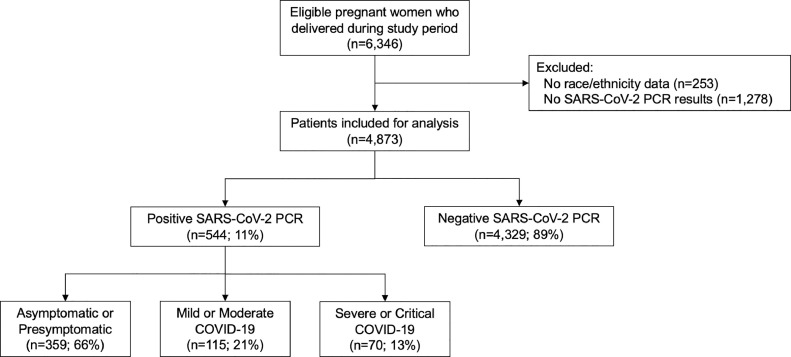
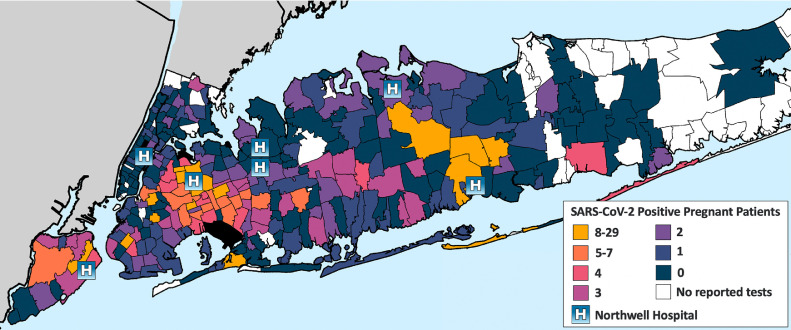
This cross-sectional study evaluated all pregnant patients who delivered and had polymerase chain reaction testing for severe acute respiratory syndrome coronavirus 2 between March 15, 2020, and June 15, 2020, at 7 hospitals within Northwell Health, the largest academic health system in New York. During the study period, universal severe acute respiratory syndrome coronavirus 2 testing protocols were implemented at all sites. Polymerase chain reaction testing was performed using nasopharyngeal swabs. Patients were excluded if the following variables were not available: polymerase chain reaction results, race, ethnicity, or zone improvement plan (ZIP) code of residence. Clinical data were obtained from the enterprise electronic health record system. For each patient, ZIP code was used as a proxy for neighborhood. Socioeconomic characteristics were determined by linking to ZIP code data from the United States Census Bureau's American Community Survey and the Internal Revenue Service's Statistics of Income Division. Specific variables of interest included mean persons per household, median household income, percent unemployment, and percent with less than high school education. Medical records were manually reviewed for all subjects with positive polymerase chain reaction test results to correctly identify symptomatic patients and then classify those subjects using the National Institutes of Health severity of illness categories. Classification was based on the highest severity of illness throughout gestation and not necessarily at the time of presentation for delivery.
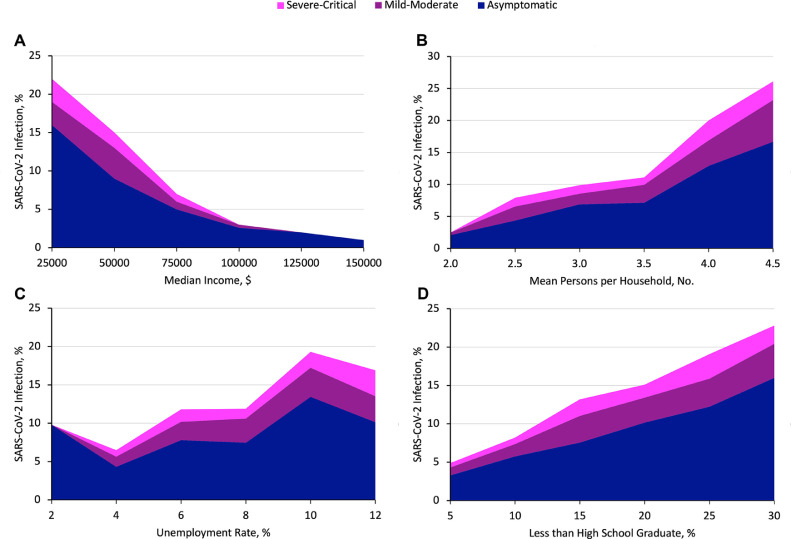
A total of 4873 patients were included in the study. The polymerase chain reaction test positivity rate was 11% (n=544). Among this group, 359 patients (66%) were asymptomatic or presymptomatic, 115 (21%) had mild or moderate coronavirus disease 2019, and 70 (13%) had severe or critical coronavirus disease 2019. On multiple logistic regression modeling, pregnant patients who had a positive test result for severe acute respiratory syndrome coronavirus 2 were more likely to be younger or of higher parity, belong to minoritized racial and ethnic groups, have public health insurance, have limited English proficiency, and reside in low-income neighborhoods with less educational attainment. On ordinal logit regression modeling, obesity, income and education were associated with coronavirus disease 2019 severity.
Social and physical determinants of health play a role in determining the risk of infection. The severity of coronavirus disease 2019 illness was not associated with race or ethnicity but was associated with maternal obesity and neighborhood level characteristics such as educational attainment and household income.
人们生活的社会和物理环境会影响传染病和非传染病的出现、流行和严重程度。关于社会决定因素(包括邻里社会经济状况)如何影响严重急性呼吸综合征冠状病毒 2 感染的风险以及 2019 年冠状病毒病怀孕期间疾病的严重程度,数据有限。
我们的目的是确定健康的社会决定因素如何与纽约 2019 年全球冠状病毒病大流行期间在诺斯韦尔健康系统(Northwell Health)的 7 家医院住院的孕妇中严重急性呼吸综合征冠状病毒 2 感染和 2019 年冠状病毒病严重程度相关。
这是一项横断面研究,评估了 2020 年 3 月 15 日至 2020 年 6 月 15 日期间在诺斯韦尔健康系统内的 7 家医院分娩且接受过严重急性呼吸综合征冠状病毒 2 聚合酶链反应检测的所有孕妇。在此期间,所有地点都实施了普遍的严重急性呼吸综合征冠状病毒 2 检测方案。聚合酶链反应检测使用鼻咽拭子进行。如果以下变量不可用,则排除患者:聚合酶链反应结果、种族、族裔或居住的区域改进计划(ZIP)代码。临床数据来自企业电子健康记录系统。对于每一位患者,ZIP 码都被用作邻里的代理。社会经济特征是通过与美国人口普查局的美国社区调查和美国国税局收入统计司的 ZIP 码数据相关联来确定的。感兴趣的具体变量包括每户平均人数、家庭收入中位数、失业率和未受过高中教育的百分比。对所有聚合酶链反应检测结果呈阳性的患者的医疗记录进行了人工审查,以正确识别有症状的患者,然后根据美国国立卫生研究院的疾病严重程度类别对这些患者进行分类。分类是基于整个妊娠期间的最高疾病严重程度,而不一定是在分娩时的表现。
共有 4873 名患者纳入研究。聚合酶链反应检测阳性率为 11%(n=544)。在这一组中,359 名患者(66%)为无症状或前驱症状,115 名(21%)为轻度或中度 2019 年冠状病毒病,70 名(13%)为严重或危急 2019 年冠状病毒病。在多变量逻辑回归模型中,聚合酶链反应检测呈阳性的孕妇更年轻或更高的产次、属于少数族裔、拥有公共医疗保险、英语水平有限以及居住在收入较低、教育程度较低的社区。在有序逻辑回归模型中,肥胖、收入和教育与 2019 年冠状病毒病的严重程度有关。
社会和物理决定因素在确定感染风险方面起着作用。2019 年冠状病毒病的严重程度与种族或族裔无关,但与产妇肥胖以及邻里层面的特征(如教育程度和家庭收入)有关。