Néphrologie-Immunologie Clinique, Hôpital Bretonneau, CHU Tours, Tours, France.
University of Tours, Tours, France.
BMC Nephrol. 2021 Feb 19;22(1):62. doi: 10.1186/s12882-021-02263-8.
Renal resistive index (RI) predicts mortality in renal transplant recipients (RTR). However, its predictive value may be different according to the time of measurement. We analysed RI changes between 1 month and 3 months after transplantation and its predictive value for death with a functioning graft (DWFG).
We conducted a retrospective study in 1685 RTR between 1985 and 2017. The long-term predictive value of changes in RI value from 1 month to 3 months was assessed in diabetic and non-diabetic RTR.
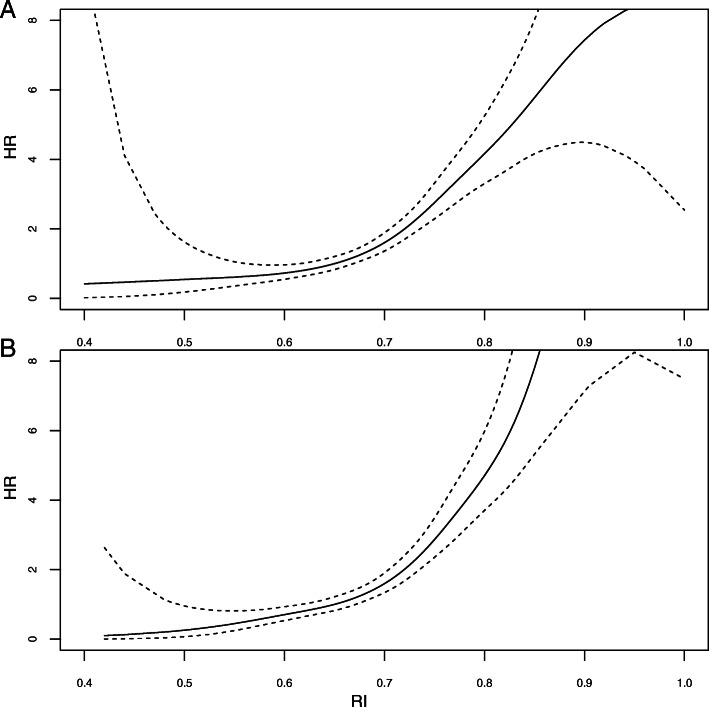
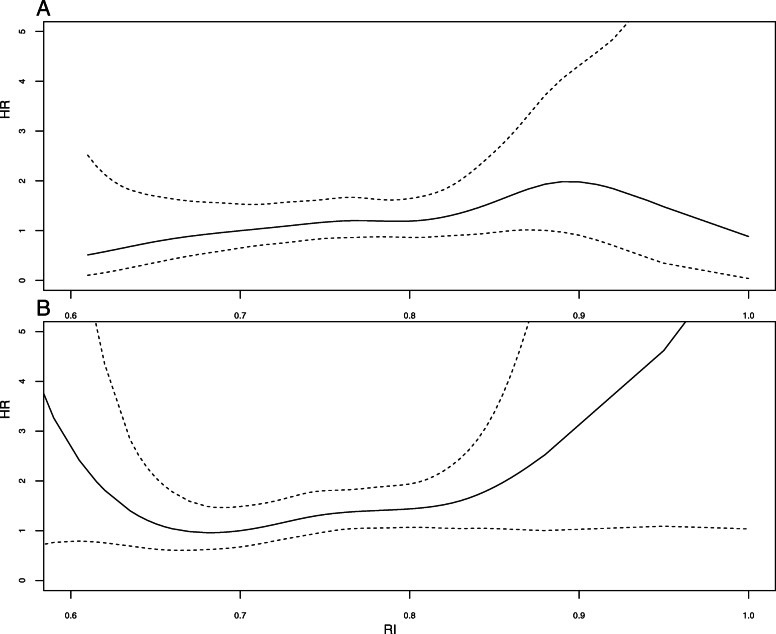
Best survival was observed in RTR with RI < 0.70 both at 1 and 3 months, and the worst survival was found in RTR with RI ≥ 0.70 both at 1 and 3 months (HR = 3.77, [2.71-5.24], p < 0.001). The risk of DWFG was intermediate when RI was < 0.70 at 1 month and ≥ 0.70 at 3 months (HR = 2.15 [1.29-3.60], p = 0.003) and when RI was ≥0.70 at 1 month and < 0.70 at 3 months (HR = 1.90 [1.20-3.03], p = 0.006). In diabetic RTR, RI was significantly associated with an increased risk of death only in those with RI < 0.70 at 1 month and ≥ 0.70 at 3 months (HR = 4.69 [1.07-20.52], p = 0.040). RI considered as a continuous variable at 1 and 3 months was significantly associated with the risk of DWFG in nondiabetic but not in diabetic RTR.
RI changes overtime and this impacts differently diabetic and nondiabetic RTR. RI short-term changes have a strong prognosis value and refines the risk of DWFG associated with RI.
肾阻力指数(RI)可预测肾移植受者(RTR)的死亡率。然而,其预测价值可能因测量时间的不同而有所不同。我们分析了移植后 1 个月至 3 个月 RI 的变化及其对有功能移植物死亡(DWFG)的预测价值。
我们对 1985 年至 2017 年间的 1685 例 RTR 进行了回顾性研究。评估了 RI 值从 1 个月到 3 个月的变化在糖尿病和非糖尿病 RTR 中的长期预测价值。
在 1 个月和 3 个月时 RI<0.70 的 RTR 患者的最佳存活率,而在 1 个月和 3 个月时 RI≥0.70 的 RTR 患者的存活率最差(HR=3.77,[2.71-5.24],p<0.001)。在 1 个月时 RI<0.70 而 3 个月时 RI≥0.70 时(HR=2.15 [1.29-3.60],p=0.003)和在 1 个月时 RI≥0.70 而 3 个月时 RI<0.70 时(HR=1.90 [1.20-3.03],p=0.006),RI 与 DWFG 的风险呈中度相关。在糖尿病 RTR 中,仅在 1 个月时 RI<0.70 而 3 个月时 RI≥0.70 时,RI 与死亡风险显著相关(HR=4.69 [1.07-20.52],p=0.040)。RI 被视为 1 个月和 3 个月的连续变量与非糖尿病 RTR 的 DWFG 风险显著相关,但与糖尿病 RTR 无关。
RI 随时间的变化会对糖尿病和非糖尿病 RTR 产生不同的影响。RI 的短期变化具有很强的预后价值,并细化了与 RI 相关的 DWFG 风险。