Cancer Immunotherapeutics Center, University of Pittsburgh Medical Center, Pittsburgh, Pennsylvania, USA
Multidisciplinary Oncology & Therapeutic Innovations Department, Aix-Marseille University, Assistance Publique Hôpitaux de Marseille, CNRS, INSERM, CRCM, CEPCM CLIP2, Marseille, France.
J Immunother Cancer. 2021 Feb;9(2). doi: 10.1136/jitc-2020-002015.
CD40 agonist immunotherapy can potentially license antigen-presenting cells to promote antitumor T-cell activation and re-educate macrophages to destroy tumor stroma. Systemic administration of CD40 agonists has historically been associated with considerable toxicity, providing the rationale for development of tumor-targeted immunomodulators to improve clinical safety and efficacy. This phase I study assessed the safety, tolerability, preliminary antitumor activity, and preliminary biomarkers of ABBV-428, a first-in-class, mesothelin-targeted, bispecific antibody designed for tumor microenvironment-dependent CD40 activation with limited systemic toxicity.
ABBV-428 was administered intravenously every 2 weeks to patients with advanced solid tumors. An accelerated titration (starting at a 0.01 mg/kg dose) and a 3+3 dose escalation scheme were used, followed by recommended phase II dose cohort expansions in ovarian cancer and mesothelioma, tumor types associated with high mesothelin expression.
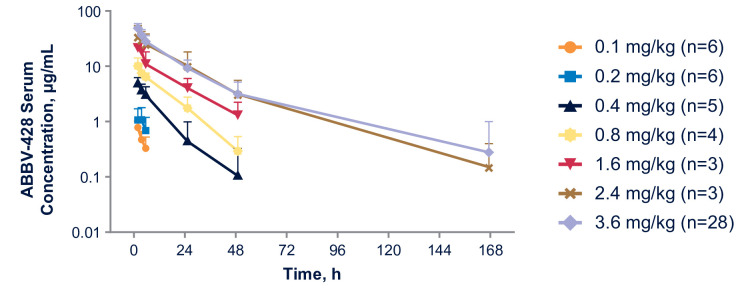
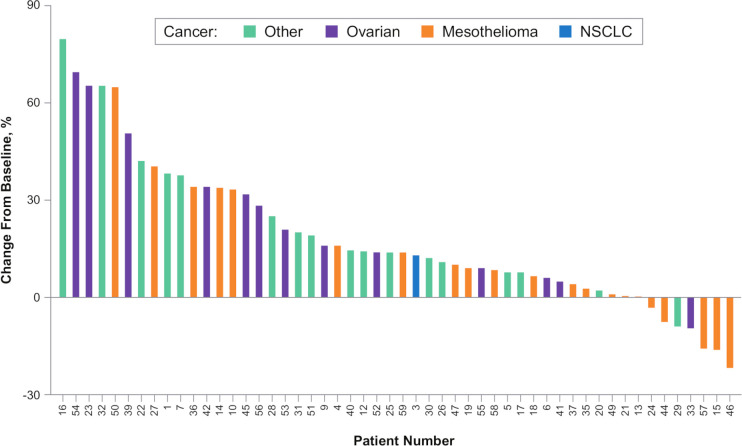
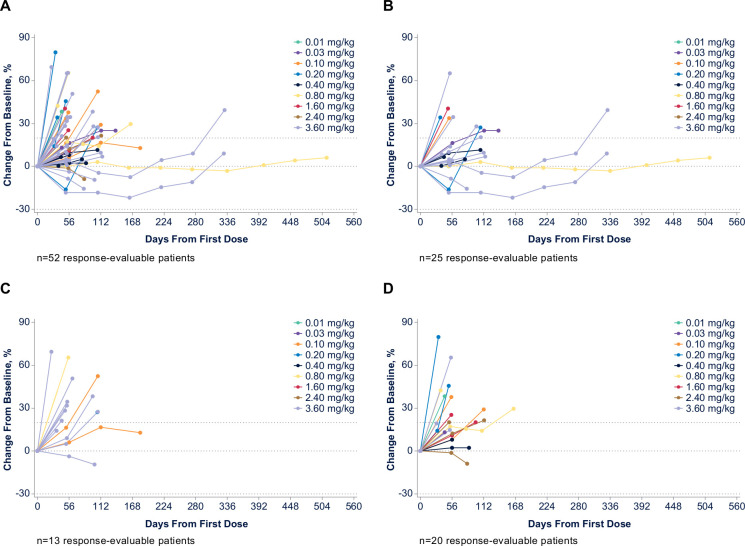
Fifty-nine patients were treated at doses between 0.01 and 3.6 mg/kg. The maximum tolerated dose was not reached, and 3.6 mg/kg was selected as the recommended phase II dose. Seven patients (12%) reported infusion-related reactions. Treatment-related grade ≥3 treatment-emergent adverse events were pericardial effusion, colitis, infusion-related reaction, and pleural effusion (n=1 each, 2%), with no cytokine release syndrome reported. The pharmacokinetic profile demonstrated roughly dose-proportional increases in exposure from 0.4 to 3.6 mg/kg. Best response was stable disease in 9/25 patients (36%) treated at the recommended phase II dose. CD40 receptor occupancy >90% was observed on peripheral B-cells starting from 0.8 mg/kg; however, no consistent changes from baseline in intratumoral CD8+ T-cells, programmed death ligand-1 (PD-L1+) cells, or immune-related gene expression were detected post-ABBV-428 treatment (cycle 2, day 1). Mesothelin membrane staining showed greater correlation with progression-free survival in ovarian cancer and mesothelioma than in the broader dose escalation population.
ABBV-428 monotherapy exhibited dose-proportional pharmacokinetics and an acceptable safety profile, particularly for toxicities characteristic of CD40 agonism, illustrating that utilization of a tumor-targeted, bispecific antibody can improve the safety of CD40 agonism as a therapeutic approach. ABBV-428 monotherapy had minimal clinical activity in dose escalation and in a small expansion cohort of patients with advanced mesothelioma or ovarian cancer.
NCT02955251.
CD40 激动剂免疫疗法有可能使抗原呈递细胞获得许可,从而促进抗肿瘤 T 细胞的激活,并重新教育巨噬细胞破坏肿瘤基质。历史上,全身性给予 CD40 激动剂与相当大的毒性有关,这为开发肿瘤靶向免疫调节剂提供了依据,以提高临床安全性和疗效。这项 I 期研究评估了 ABBV-428 的安全性、耐受性、初步抗肿瘤活性和初步生物标志物,这是一种首创的、针对间皮素的双特异性抗体,旨在通过有限的全身毒性依赖肿瘤微环境激活 CD40。
ABBV-428 每 2 周静脉给药一次,用于治疗晚期实体瘤患者。采用加速滴定(起始剂量为 0.01mg/kg)和 3+3 剂量递增方案,随后在卵巢癌和间皮瘤中扩展推荐的 II 期剂量队列,这两种肿瘤类型与高间皮素表达相关。
59 名患者在 0.01 至 3.6mg/kg 的剂量下接受治疗。未达到最大耐受剂量,选择 3.6mg/kg 作为推荐的 II 期剂量。7 名患者(12%)报告了与输注相关的反应。与治疗相关的 3 级及以上治疗后出现的不良事件包括心包积液、结肠炎、输注相关反应和胸腔积液(各 1 例,2%),未报告细胞因子释放综合征。药代动力学特征表明,从 0.4 至 3.6mg/kg 时,暴露量呈大致剂量比例增加。在推荐的 II 期剂量下,25 名患者中有 9 名(36%)最佳反应为疾病稳定。从 0.8mg/kg 开始,外周 B 细胞上观察到 CD40 受体占有率>90%;然而,在 ABBV-428 治疗后(第 2 周期,第 1 天),未检测到肿瘤内 CD8+T 细胞、程序性死亡配体-1(PD-L1+)细胞或免疫相关基因表达的基线变化。间皮素膜染色显示,在卵巢癌和间皮瘤中与无进展生存期的相关性大于更广泛的剂量递增人群。
ABBV-428 单药治疗具有剂量比例的药代动力学特征和可接受的安全性特征,特别是对于 CD40 激动剂特有的毒性,这表明利用肿瘤靶向的双特异性抗体可以提高 CD40 激动剂作为治疗方法的安全性。在剂量递增和晚期间皮瘤或卵巢癌的小扩展队列中,ABBV-428 单药治疗的临床活性最小。
NCT02955251。