Department of Medical Oncology, Monash Health, Melbourne, Victoria, Australia.
Faculty of Medicine, Nursing and Health Sciences, Monash University, Melbourne, Victoria, Australia.
J Immunother Cancer. 2024 Apr 19;12(4):e008037. doi: 10.1136/jitc-2023-008037.
Studies showed that vascular endothelial growth factor (VEGF) inhibitors could improve therapeutic efficacy of PD-1/PD-L1 antibodies by transforming the immunosuppressive tumor microenvironment (TME) into an immunoresponsive TME. Ivonescimab is a first-in-class, humanized tetravalent bispecific antibody targeting PD-1 and VEGF-A simultaneously. Here, we report the first-in-human, phase 1a study of ivonescimab in patients with advanced solid tumors.
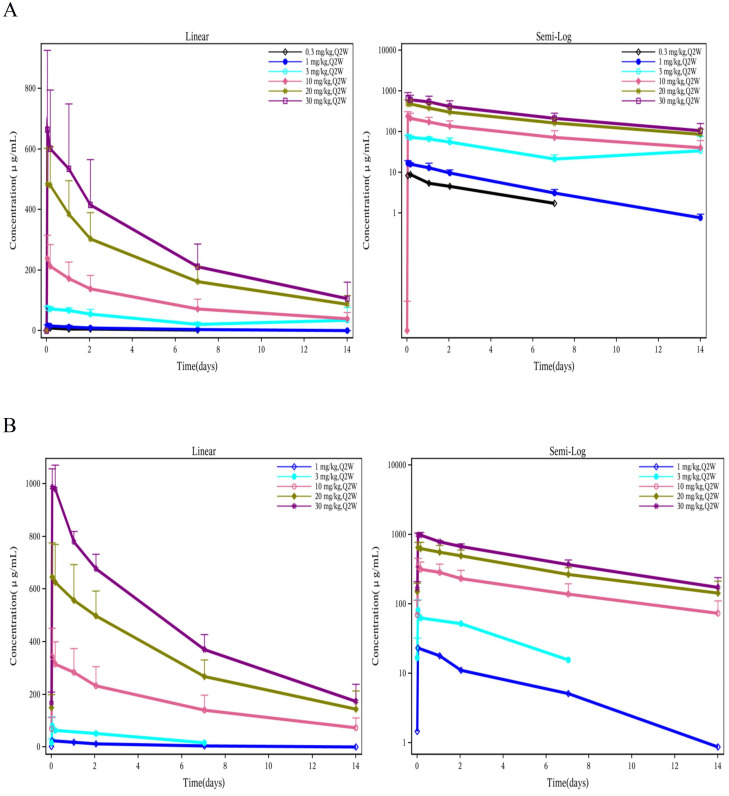
Patients with advanced solid tumors were treated with ivonescimab 0.3, 1, 3, 10, 20 or 30 mg/kg intravenously every 2 weeks using a 3+3+3 dose escalation design. Dose expansion occurred at 10 and 20 mg/kg in selected tumor types. The primary objective was to assess the safety and tolerability, and to determine the maximum tolerated dose (MTD). The secondary objectives included pharmacokinetics, pharmacodynamics and preliminary antitumor activity based on Response Evaluation Criteria in Solid Tumors V.1.1.
Between October 2, 2019 and January 14, 2021, a total of 51 patients were enrolled and received ivonescimab. Two dose-limiting toxicities were reported at 30 mg/kg. The MTD of ivonescimab was 20 mg/kg every 2 weeks. Grade≥3 treatment-related adverse events (TRAEs) occurred in 14 patients (27.5%). The most common TRAEs of any grade were rash (29.4%), arthralgia (19.6%), hypertension (19.6%), fatigue (17.6%), diarrhea (15.7%) and pruritus (11.8%). The most common grade≥3 TRAEs were hypertension (7/51, 13.7%), alanine aminotransferase increased (3/51, 5.2%), aspartate aminotransferase increased (2/51, 3.9%) and colitis (2/51, 3.9%). Of 47 patients who had at least one postbaseline assessment, the confirmed objective response rate was 25.5% (12/47) and disease control rate was 63.8% (30/47). Among 19 patients with platinum-resistant ovarian cancer, 5 patients (26.3%) achieved partial response (PR). Efficacy signals were also observed in patients with mismatch repair proficient (pMMR) colorectal cancer, non-small cell lung cancer, and both MMR deficient and pMMR endometrial cancer.
Ivonescimab demonstrated manageable safety profiles and promising efficacy signals in multiple solid tumors. Exploration of alternative dosing regimens of ivonescimab monotherapy and combination therapies is warranted.
NCT04047290.
研究表明,血管内皮生长因子(VEGF)抑制剂可以通过将免疫抑制性肿瘤微环境(TME)转化为免疫应答性 TME,提高 PD-1/PD-L1 抗体的治疗效果。Ivonescimab 是一种首创的、靶向 PD-1 和 VEGF-A 的人源化四价双特异性抗体。在这里,我们报告了 Ivonescimab 在晚期实体瘤患者中的首次人体、I 期临床试验。
晚期实体瘤患者采用静脉注射 Ivonescimab 0.3、1、3、10、20 或 30mg/kg,每 2 周一次,采用 3+3+3 剂量递增设计。在选定的肿瘤类型中,10mg/kg 和 20mg/kg 进行了剂量扩展。主要目的是评估安全性和耐受性,并确定最大耐受剂量(MTD)。次要目标包括药代动力学、药效学和根据实体瘤反应评估标准 1.1 初步抗肿瘤活性。
2019 年 10 月 2 日至 2021 年 1 月 14 日,共纳入 51 例患者接受 Ivonescimab 治疗。2 例患者在 30mg/kg 时出现 2 例剂量限制毒性。Ivonescimab 的 MTD 为每 2 周 20mg/kg。14 例患者(27.5%)出现任何级别≥3 级的治疗相关不良事件(TRAEs)。任何级别最常见的 TRAEs 为皮疹(29.4%)、关节炎(19.6%)、高血压(19.6%)、疲劳(17.6%)、腹泻(15.7%)和瘙痒(11.8%)。最常见的≥3 级 TRAEs 为高血压(7/51,13.7%)、丙氨酸氨基转移酶升高(3/51,5.2%)、天门冬氨酸氨基转移酶升高(2/51,3.9%)和结肠炎(2/51,3.9%)。在至少有一次基线后评估的 47 例患者中,确认的客观缓解率为 25.5%(12/47),疾病控制率为 63.8%(30/47)。在 19 例铂耐药卵巢癌患者中,5 例(26.3%)患者获得部分缓解(PR)。在错配修复功能正常(pMMR)结直肠癌、非小细胞肺癌以及错配修复缺陷和 pMMR 子宫内膜癌患者中也观察到了疗效信号。
Ivonescimab 在多种实体瘤中表现出可管理的安全性和有前景的疗效信号。值得探索 Ivonescimab 单药治疗和联合治疗的替代给药方案。
NCT04047290。