• 文献检索
  • 文档翻译
  • 深度研究
  • 学术资讯
  • Suppr Zotero 插件Zotero 插件
  • 邀请有礼
  • 套餐&价格
  • 历史记录
应用&插件
Suppr Zotero 插件Zotero 插件浏览器插件Mac 客户端Windows 客户端微信小程序
定价
高级版会员购买积分包购买API积分包
服务
文献检索文档翻译深度研究API 文档MCP 服务
关于我们
关于 Suppr公司介绍联系我们用户协议隐私条款
关注我们

Suppr 超能文献

核心技术专利:CN118964589B侵权必究
粤ICP备2023148730 号-1Suppr @ 2026

文献检索

告别复杂PubMed语法,用中文像聊天一样搜索,搜遍4000万医学文献。AI智能推荐,让科研检索更轻松。

立即免费搜索

文件翻译

保留排版,准确专业,支持PDF/Word/PPT等文件格式,支持 12+语言互译。

免费翻译文档

深度研究

AI帮你快速写综述,25分钟生成高质量综述,智能提取关键信息,辅助科研写作。

立即免费体验

基于深度学习的乳腺组织病理图像导管原位癌分级。

Deep learning-based grading of ductal carcinoma in situ in breast histopathology images.

机构信息

Medical Image Analysis Group, Department of Biomedical Engineering, Eindhoven University of Technology, Eindhoven, The Netherlands.

Department of Pathology, University Medical Center Utrecht, University Utrecht, Utrecht, The Netherlands.

出版信息

Lab Invest. 2021 Apr;101(4):525-533. doi: 10.1038/s41374-021-00540-6. Epub 2021 Feb 19.

DOI:10.1038/s41374-021-00540-6
PMID:33608619
原文链接:https://pmc.ncbi.nlm.nih.gov/articles/PMC7985025/
Abstract

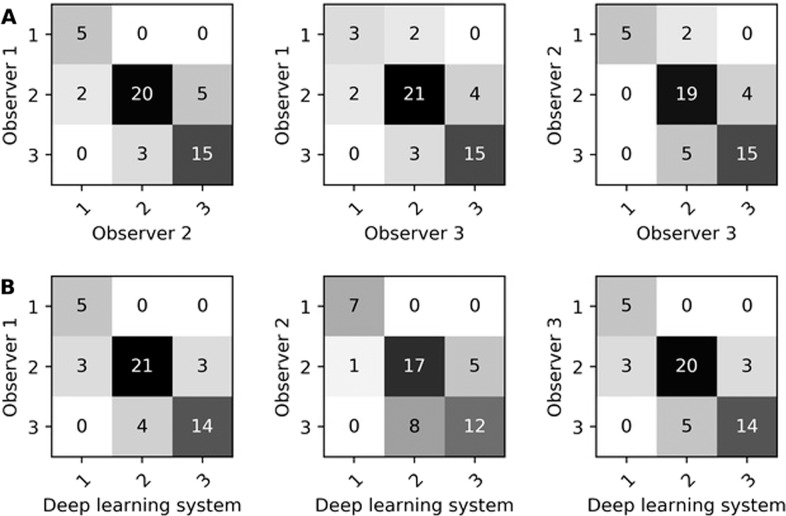
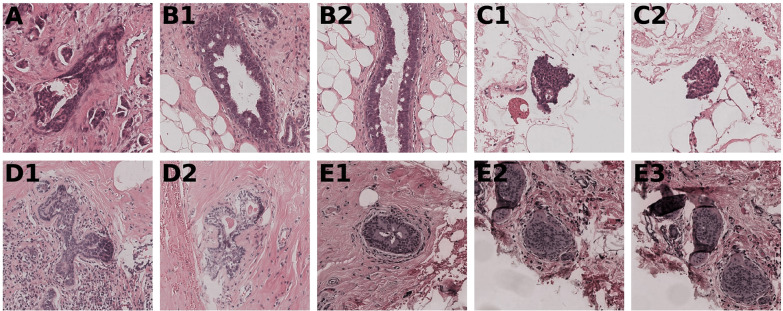
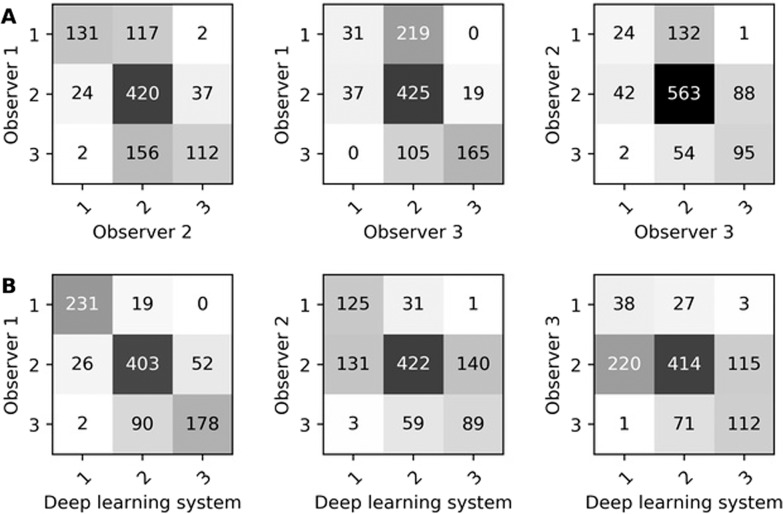
Ductal carcinoma in situ (DCIS) is a non-invasive breast cancer that can progress into invasive ductal carcinoma (IDC). Studies suggest DCIS is often overtreated since a considerable part of DCIS lesions may never progress into IDC. Lower grade lesions have a lower progression speed and risk, possibly allowing treatment de-escalation. However, studies show significant inter-observer variation in DCIS grading. Automated image analysis may provide an objective solution to address high subjectivity of DCIS grading by pathologists. In this study, we developed and evaluated a deep learning-based DCIS grading system. The system was developed using the consensus DCIS grade of three expert observers on a dataset of 1186 DCIS lesions from 59 patients. The inter-observer agreement, measured by quadratic weighted Cohen's kappa, was used to evaluate the system and compare its performance to that of expert observers. We present an analysis of the lesion-level and patient-level inter-observer agreement on an independent test set of 1001 lesions from 50 patients. The deep learning system (dl) achieved on average slightly higher inter-observer agreement to the three observers (o1, o2 and o3) (κ= 0.81, κ= 0.53 and κ= 0.40) than the observers amongst each other (κ= 0.58, κ= 0.50 and κ= 0.42) at the lesion-level. At the patient-level, the deep learning system achieved similar agreement to the observers (κ= 0.77, κ= 0.75 and κ= 0.70) as the observers amongst each other (κ= 0.77, κ= 0.75 and κ= 0.72). The deep learning system better reflected the grading spectrum of DCIS than two of the observers. In conclusion, we developed a deep learning-based DCIS grading system that achieved a performance similar to expert observers. To the best of our knowledge, this is the first automated system for the grading of DCIS that could assist pathologists by providing robust and reproducible second opinions on DCIS grade.

摘要

导管原位癌 (DCIS) 是一种非浸润性乳腺癌,可能进展为浸润性导管癌 (IDC)。研究表明,DCIS 常常被过度治疗,因为相当一部分 DCIS 病变可能永远不会进展为 IDC。低级别病变进展速度和风险较低,可能允许治疗降级。然而,研究表明 DCIS 分级存在显著的观察者间差异。自动化图像分析可能为解决病理学家对 DCIS 分级的高度主观性提供客观的解决方案。在这项研究中,我们开发并评估了一种基于深度学习的 DCIS 分级系统。该系统是使用三位专家观察者对来自 59 名患者的 1186 个 DCIS 病变数据集的共识 DCIS 分级开发的。使用二次加权 Cohen's kappa 衡量观察者间一致性,用于评估系统并比较其性能与专家观察者的性能。我们对来自 50 名患者的 1001 个病变的独立测试集进行了病变水平和患者水平的观察者间一致性分析。深度学习系统 (dl) 在病变水平上平均比三位观察者 (o1、o2 和 o3) 获得更高的观察者间一致性 (κ=0.81、κ=0.53 和 κ=0.40),而观察者之间的一致性则较低 (κ=0.58、κ=0.50 和 κ=0.42)。在患者水平上,深度学习系统与观察者的一致性相似 (κ=0.77、κ=0.75 和 κ=0.70),与观察者之间的一致性也相似 (κ=0.77、κ=0.75 和 κ=0.72)。深度学习系统比两位观察者更能反映 DCIS 的分级范围。总之,我们开发了一种基于深度学习的 DCIS 分级系统,其性能与专家观察者相似。据我们所知,这是第一个用于 DCIS 分级的自动化系统,可以通过提供稳健且可重复的 DCIS 分级第二意见来协助病理学家。
https://cdn.ncbi.nlm.nih.gov/pmc/blobs/9131/7985025/eb0dd2ed7e76/41374_2021_540_Fig3_HTML.jpg
https://cdn.ncbi.nlm.nih.gov/pmc/blobs/9131/7985025/c2ffbd4fc494/41374_2021_540_Fig1_HTML.jpg
https://cdn.ncbi.nlm.nih.gov/pmc/blobs/9131/7985025/d0d3afe1ac64/41374_2021_540_Fig2_HTML.jpg
https://cdn.ncbi.nlm.nih.gov/pmc/blobs/9131/7985025/eb0dd2ed7e76/41374_2021_540_Fig3_HTML.jpg
https://cdn.ncbi.nlm.nih.gov/pmc/blobs/9131/7985025/c2ffbd4fc494/41374_2021_540_Fig1_HTML.jpg
https://cdn.ncbi.nlm.nih.gov/pmc/blobs/9131/7985025/d0d3afe1ac64/41374_2021_540_Fig2_HTML.jpg
https://cdn.ncbi.nlm.nih.gov/pmc/blobs/9131/7985025/eb0dd2ed7e76/41374_2021_540_Fig3_HTML.jpg

相似文献

1
Deep learning-based grading of ductal carcinoma in situ in breast histopathology images.基于深度学习的乳腺组织病理图像导管原位癌分级。
Lab Invest. 2021 Apr;101(4):525-533. doi: 10.1038/s41374-021-00540-6. Epub 2021 Feb 19.
2
Automated deep-learning system for Gleason grading of prostate cancer using biopsies: a diagnostic study.利用活检进行前列腺癌 Gleason 分级的自动化深度学习系统:一项诊断研究。
Lancet Oncol. 2020 Feb;21(2):233-241. doi: 10.1016/S1470-2045(19)30739-9. Epub 2020 Jan 8.
3
Deep-learning model to improve histological grading and predict upstaging of atypical ductal hyperplasia / ductal carcinoma in situ on breast biopsy.深度学习模型改善乳腺活检中不典型导管增生/导管原位癌的组织学分级和预测升级。
Histopathology. 2024 May;84(6):983-1002. doi: 10.1111/his.15144. Epub 2024 Jan 30.
4
The effect of an e-learning module on grading variation of (pre)malignant breast lesions.电子学习模块对(前)恶性乳腺病变分级变异性的影响。
Mod Pathol. 2020 Oct;33(10):1961-1967. doi: 10.1038/s41379-020-0556-6. Epub 2020 May 13.
5
Low-Grade Ductal Carcinoma In Situ.低级别导管原位癌。
Am J Clin Pathol. 2020 Feb 8;153(3):360-367. doi: 10.1093/ajcp/aqz179.
6
Histopathological grading of breast ductal carcinoma in situ: validation of a web-based survey through intra-observer reproducibility analysis.乳腺导管原位癌的组织病理学分级:通过观察者内再现性分析对一项基于网络的调查进行验证
Diagn Pathol. 2015 Jul 10;10:93. doi: 10.1186/s13000-015-0320-2.
7
Assessment of Machine Learning of Breast Pathology Structures for Automated Differentiation of Breast Cancer and High-Risk Proliferative Lesions.基于机器学习的乳腺病理学结构评估在乳腺癌和高危增殖性病变自动鉴别中的应用。
JAMA Netw Open. 2019 Aug 2;2(8):e198777. doi: 10.1001/jamanetworkopen.2019.8777.
8
Significant inter- and intra-laboratory variation in grading of ductal carcinoma in situ of the breast: a nationwide study of 4901 patients in the Netherlands.荷兰全国范围内对 4901 例乳腺导管原位癌患者的研究显示,导管原位癌分级存在显著的实验室间和实验室内差异。
Breast Cancer Res Treat. 2019 Apr;174(2):479-488. doi: 10.1007/s10549-018-05082-y. Epub 2018 Dec 11.
9
The diagnostic challenge of low-grade ductal carcinoma in situ.低级别导管原位癌的诊断挑战
Eur J Cancer. 2017 Jul;80:39-47. doi: 10.1016/j.ejca.2017.04.013. Epub 2017 May 20.
10
Application of deep learning on mammographies to discriminate between low and high-risk DCIS for patient participation in active surveillance trials.深度学习在乳腺 X 光片中的应用,以区分低风险和高风险 DCIS,以便患者参与主动监测试验。
Cancer Imaging. 2024 Apr 5;24(1):48. doi: 10.1186/s40644-024-00691-x.

引用本文的文献

1
Deep learning for predicting invasive recurrence of ductal carcinoma in situ: leveraging histopathology images and clinical features.用于预测导管原位癌浸润性复发的深度学习:利用组织病理学图像和临床特征
EBioMedicine. 2025 Jun;116:105750. doi: 10.1016/j.ebiom.2025.105750. Epub 2025 May 28.
2
Invasive recurrence after breast conserving treatment of ductal carcinoma in situ of the breast in the Netherlands: time trends and the association with tumour grade.荷兰保乳治疗乳腺导管原位癌的侵袭性复发:时间趋势及与肿瘤分级的关系。
Br J Cancer. 2024 Sep;131(5):852-859. doi: 10.1038/s41416-024-02785-6. Epub 2024 Jul 9.
3

本文引用的文献

1
Automated Quantitative Measures of Terminal Duct Lobular Unit Involution and Breast Cancer Risk.终末导管小叶单位萎缩的自动定量测量与乳腺癌风险。
Cancer Epidemiol Biomarkers Prev. 2020 Nov;29(11):2358-2368. doi: 10.1158/1055-9965.EPI-20-0723. Epub 2020 Sep 11.
2
Immune response and stromal changes in ductal carcinoma in situ of the breast are subtype dependent.乳腺导管原位癌的免疫反应和基质变化与亚型相关。
Mod Pathol. 2020 Sep;33(9):1773-1782. doi: 10.1038/s41379-020-0553-9. Epub 2020 Apr 27.
3
Deep learning assessment of breast terminal duct lobular unit involution: Towards automated prediction of breast cancer risk.
Current status and prospects of artificial intelligence in breast cancer pathology: convolutional neural networks to prospective Vision Transformers.
人工智能在乳腺癌病理学中的现状与展望:从卷积神经网络到有前景的 Vision Transformers。
Int J Clin Oncol. 2024 Nov;29(11):1648-1668. doi: 10.1007/s10147-024-02513-3. Epub 2024 Apr 15.
4
An algorithm-based technique for counting mitochondria in cells using immunohistochemical staining of formalin-fixed and paraffin-embedded sections.一种基于算法的技术,用于通过福尔马林固定和石蜡包埋切片的免疫组织化学染色来计数细胞中的线粒体。
J Cancer Res Clin Oncol. 2024 Apr 3;150(4):172. doi: 10.1007/s00432-024-05653-1.
5
Computational pathology in cancer diagnosis, prognosis, and prediction - present day and prospects.癌症诊断、预后和预测中的计算病理学 - 现状与展望。
J Pathol. 2023 Aug;260(5):551-563. doi: 10.1002/path.6163. Epub 2023 Aug 14.
6
Comparative Evaluation of Breast Ductal Carcinoma Grading: A Deep-Learning Model and General Pathologists' Assessment Approach.乳腺导管癌分级的比较评估:一种深度学习模型与普通病理学家的评估方法
Diagnostics (Basel). 2023 Jul 10;13(14):2326. doi: 10.3390/diagnostics13142326.
7
Deep learning-based breast cancer grading and survival analysis on whole-slide histopathology images.基于深度学习的全切片病理图像乳腺癌分级和生存分析。
Sci Rep. 2022 Sep 6;12(1):15102. doi: 10.1038/s41598-022-19112-9.
8
Automated Diagnosis of Cervical Intraepithelial Neoplasia in Histology Images via Deep Learning.通过深度学习实现组织学图像中宫颈上皮内瘤变的自动诊断
Diagnostics (Basel). 2022 Feb 21;12(2):548. doi: 10.3390/diagnostics12020548.
9
A deep learning model for breast ductal carcinoma in situ classification in whole slide images.一种用于全切片图像中乳腺导管原位癌分类的深度学习模型。
Virchows Arch. 2022 May;480(5):1009-1022. doi: 10.1007/s00428-021-03241-z. Epub 2022 Jan 25.
10
Breast Invasive Ductal Carcinoma Classification on Whole Slide Images with Weakly-Supervised and Transfer Learning.基于弱监督和迁移学习的全切片图像上的乳腺浸润性导管癌分类
Cancers (Basel). 2021 Oct 26;13(21):5368. doi: 10.3390/cancers13215368.
深度学习评估乳腺终末导管小叶单位退化:实现乳腺癌风险的自动化预测。
PLoS One. 2020 Apr 15;15(4):e0231653. doi: 10.1371/journal.pone.0231653. eCollection 2020.
4
Automated deep-learning system for Gleason grading of prostate cancer using biopsies: a diagnostic study.利用活检进行前列腺癌 Gleason 分级的自动化深度学习系统:一项诊断研究。
Lancet Oncol. 2020 Feb;21(2):233-241. doi: 10.1016/S1470-2045(19)30739-9. Epub 2020 Jan 8.
5
Deep learning assisted mitotic counting for breast cancer.深度学习辅助乳腺癌有丝分裂计数。
Lab Invest. 2019 Nov;99(11):1596-1606. doi: 10.1038/s41374-019-0275-0. Epub 2019 Jun 20.
6
The COMET (Comparison of Operative versus Monitoring and Endocrine Therapy) trial: a phase III randomised controlled clinical trial for low-risk ductal carcinoma in situ (DCIS).COMET(手术与监测和内分泌治疗比较)试验:一项针对低危导管原位癌(DCIS)的 III 期随机对照临床试验。
BMJ Open. 2019 Mar 12;9(3):e026797. doi: 10.1136/bmjopen-2018-026797.
7
Predicting breast tumor proliferation from whole-slide images: The TUPAC16 challenge.从全切片图像预测乳腺肿瘤增殖:TUPAC16 挑战赛。
Med Image Anal. 2019 May;54:111-121. doi: 10.1016/j.media.2019.02.012. Epub 2019 Feb 27.
8
Significant inter- and intra-laboratory variation in grading of ductal carcinoma in situ of the breast: a nationwide study of 4901 patients in the Netherlands.荷兰全国范围内对 4901 例乳腺导管原位癌患者的研究显示,导管原位癌分级存在显著的实验室间和实验室内差异。
Breast Cancer Res Treat. 2019 Apr;174(2):479-488. doi: 10.1007/s10549-018-05082-y. Epub 2018 Dec 11.
9
Surgery versus monitoring and endocrine therapy for low-risk DCIS: The COMET Trial.低风险导管原位癌的手术与监测及内分泌治疗:COMET试验
Bull Am Coll Surg. 2017 Jan;102(1):62-3.
10
Cause-specific Mortality in a Population-based Cohort of 9799 Women Treated for Ductal Carcinoma In Situ.基于人群的 9799 例导管原位癌治疗女性队列的病因特异性死亡率。
Ann Surg. 2018 May;267(5):952-958. doi: 10.1097/SLA.0000000000002239.