Faculty of Medicine, Department of Neuropsychiatry, Tottori University, Yonago, Japan.
Division of Clinical Laboratory, Tottori University Hospital, Tottori, Japan.
Neuropsychopharmacol Rep. 2021 Jun;41(2):159-167. doi: 10.1002/npr2.12164. Epub 2021 Feb 20.
This study aimed to assess the response of endogenous beta-hydroxybutyrate to psychological stress, and its association with nucleotide-binding domain, leucine-rich repeat, pyrin domain-containing 3 (NLRP3) inflammasome, and stress-induced behavior.
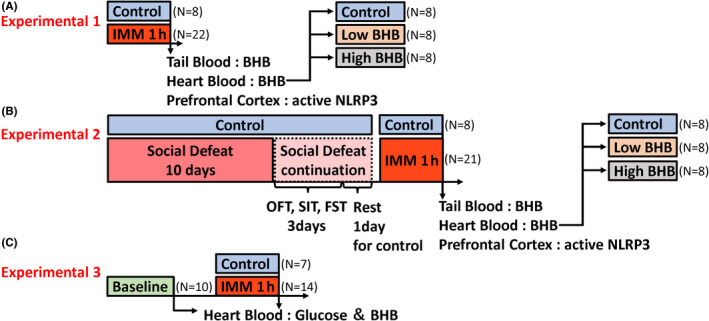
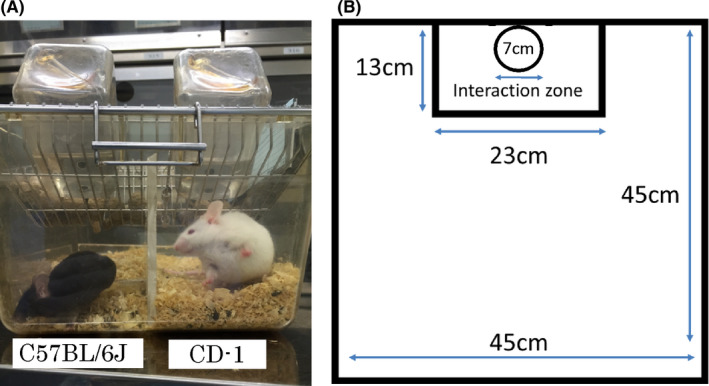
Male C57BL/6J mice were subjected to 1-hour restraint stress to examine changes in the endogenous beta-hydroxybutyrate and active NLRP3 levels in the prefrontal cortex. Subsequently, we created a depression model applying 10-day social defeat stress to the male C57BL/6J mice.
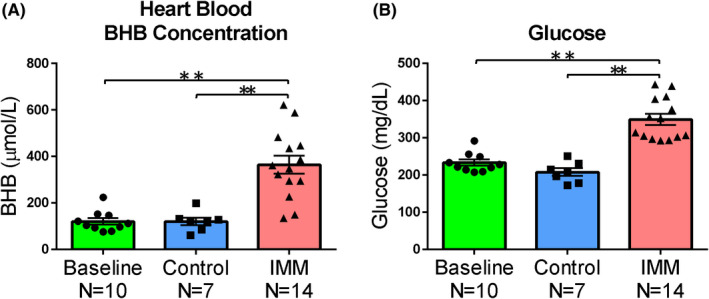
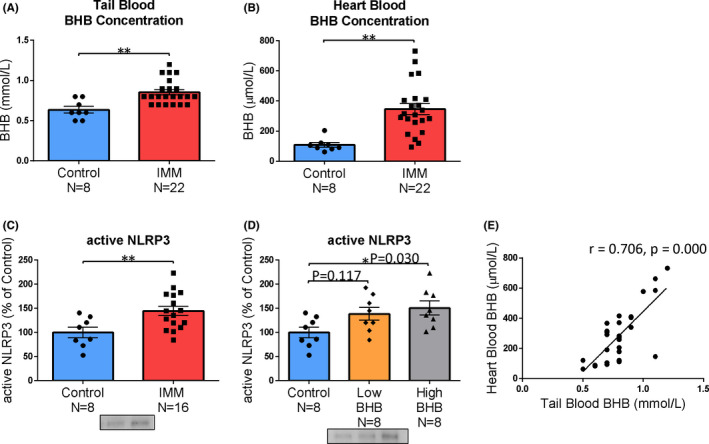
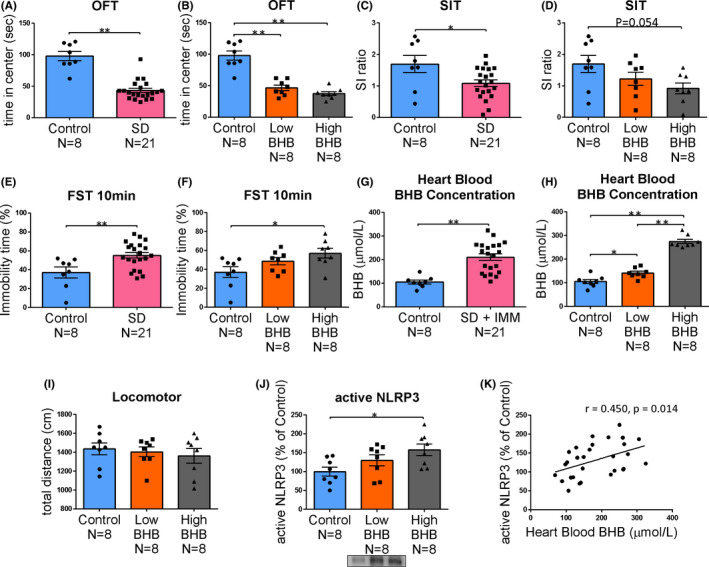
One-hour restraint stress rapidly increased beta-hydroxybutyrate levels in the blood. The active NLRP3 levels in the prefrontal cortex also increased significantly. A correlation was found between the increased beta-hydroxybutyrate levels in the blood and the active NLRP3 levels in the prefrontal cortex. The mice exposed to social defeat stress exhibited depression- and anxiety-like behavioral changes in the open field, social interaction, and forced swim tests. There was a correlation between these behavioral changes and endogenous beta-hydroxybutyrate levels. Among the social defeat model mice, those with high beta-hydroxybutyrate levels tended to have more depression- and anxiety-like behavior.
The increased blood beta-hydroxybutyrate levels due to psychological stress correlate with the active NLRP3 levels in the prefrontal cortex, suggesting that the increased beta-hydroxybutyrate levels due to stress may reflect a reaction to brain inflammation. In addition, mice with higher blood beta-hydroxybutyrate levels tend to exhibit increased depression- and anxiety-like behaviors; thus, an increase in blood beta-hydroxybutyrate levels due to stress may indicate stress vulnerability.
本研究旨在评估内源性β-羟丁酸对心理应激的反应及其与核苷酸结合域、富含亮氨酸重复、pyrin 域包含 3(NLRP3)炎性体和应激诱导行为的关系。
雄性 C57BL/6J 小鼠接受 1 小时束缚应激,以观察前额叶皮质中内源性β-羟丁酸和活性 NLRP3 水平的变化。随后,我们应用 10 天社交挫败应激对雄性 C57BL/6J 小鼠创建抑郁模型。
1 小时束缚应激可迅速增加血液中的β-羟丁酸水平。前额叶皮质中的活性 NLRP3 水平也显著增加。血液中β-羟丁酸水平的增加与前额叶皮质中活性 NLRP3 水平之间存在相关性。暴露于社交挫败应激的小鼠在旷场、社交互动和强迫游泳试验中表现出抑郁和焦虑样行为变化。这些行为变化与内源性β-羟丁酸水平之间存在相关性。在社交挫败模型小鼠中,β-羟丁酸水平较高的小鼠往往表现出更多的抑郁和焦虑样行为。
心理应激引起的血液β-羟丁酸水平升高与前额叶皮质中活性 NLRP3 水平相关,表明应激引起的β-羟丁酸水平升高可能反映了对脑炎症的反应。此外,血液β-羟丁酸水平较高的小鼠往往表现出更多的抑郁和焦虑样行为;因此,应激引起的血液β-羟丁酸水平升高可能表明应激易感性。