Department of Chemical Engineering and Biotechnology, Cambridge Centre for Neuropsychiatric Research, University of Cambridge, Cambridge, UK.
School of Psychology, University of Southampton, Southampton, UK.
Res Child Adolesc Psychopathol. 2021 Jul;49(7):849-860. doi: 10.1007/s10802-021-00784-2. Epub 2021 Feb 20.
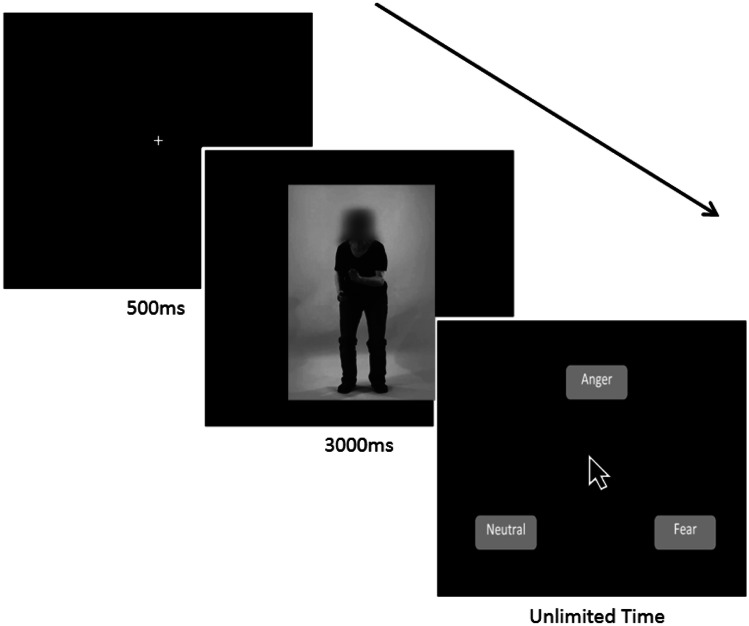
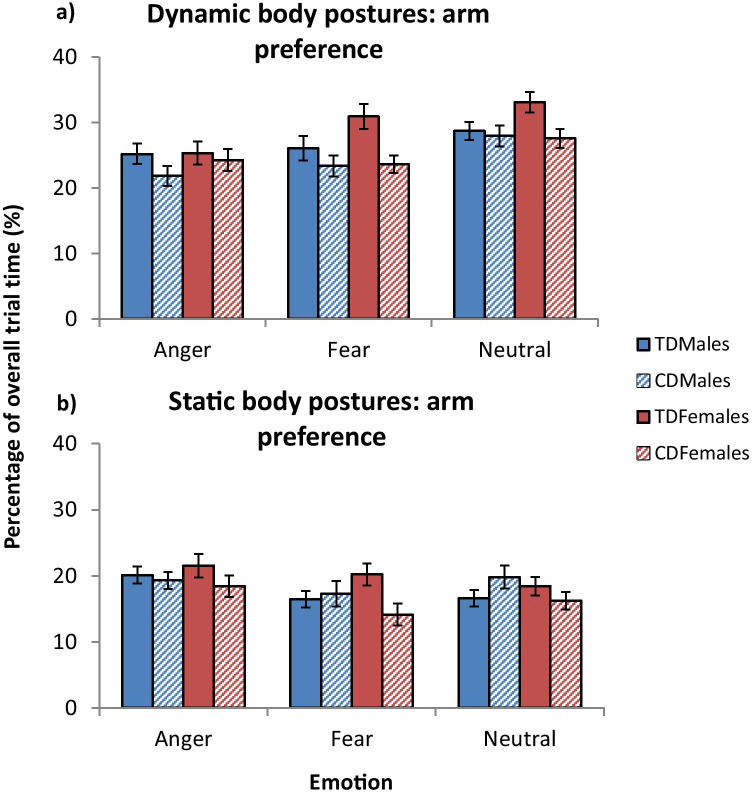
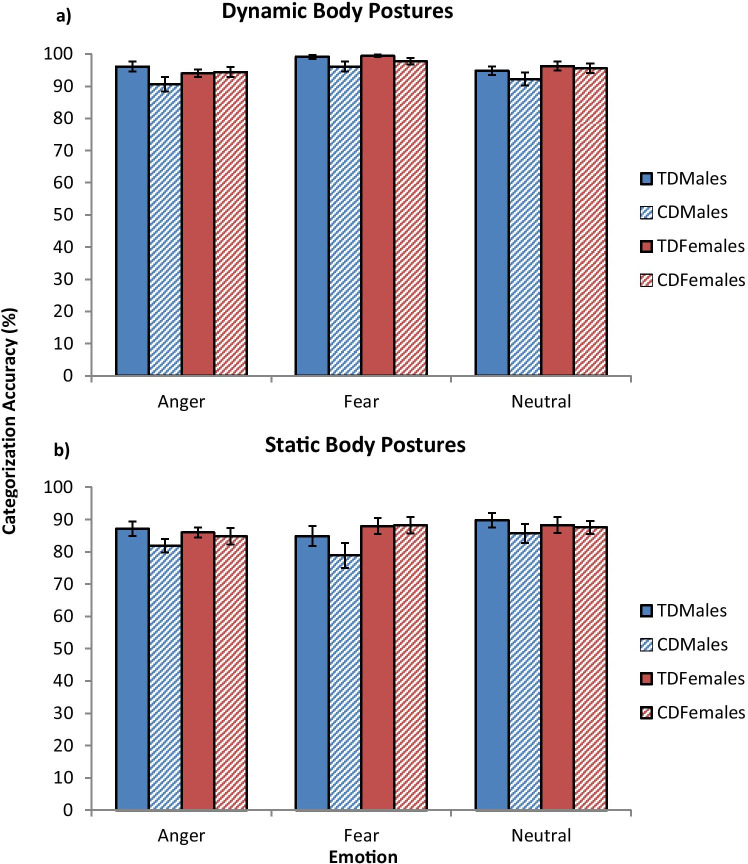
Adolescents with Conduct Disorder (CD) show deficits in recognizing facial expressions of emotion, but it is not known whether these difficulties extend to other social cues, such as emotional body postures. Moreover, in the absence of eye-tracking data, it is not known whether such deficits, if present, are due to a failure to attend to emotionally informative regions of the body. Male and female adolescents with CD and varying levels of callous-unemotional (CU) traits (n = 45) and age- and sex-matched typically-developing controls (n = 51) categorized static and dynamic emotional body postures. The emotion categorization task was paired with eye-tracking methods to investigate relationships between fixation behavior and recognition performance. Having CD was associated with impaired recognition of static and dynamic body postures and atypical fixation behavior. Furthermore, males were less likely to fixate emotionally-informative regions of the body than females. While we found no effects of CU traits on body posture recognition, the effects of CU traits on fixation behavior varied according to CD status and sex, with CD males with lower levels of CU traits showing the most atypical fixation behavior. Critically, atypical fixation behavior did not explain the body posture recognition deficits observed in CD. Our findings suggest that CD-related impairments in recognition of body postures of emotion are not due to attentional issues. Training programmes designed to ameliorate the emotion recognition difficulties associated with CD may need to incorporate a body posture component.
患有品行障碍 (CD) 的青少年在识别面部表情方面存在缺陷,但目前尚不清楚这些困难是否会扩展到其他社交线索,例如情绪身体姿势。此外,由于缺乏眼动追踪数据,尚不清楚如果存在这些缺陷,是否是由于未能关注身体中情感信息丰富的区域。患有 CD 且具有不同程度的冷酷无情 (CU) 特征的男性和女性青少年(n=45)和年龄及性别匹配的典型发育对照组(n=51)对静态和动态情绪身体姿势进行分类。情感分类任务与眼动追踪方法配对,以研究注视行为和识别性能之间的关系。患有 CD 与静态和动态身体姿势识别受损以及异常注视行为有关。此外,男性比女性更不可能注视身体中情感信息丰富的区域。虽然我们没有发现 CU 特征对身体姿势识别的影响,但 CU 特征对注视行为的影响因 CD 状态和性别而异,CD 男性中 CU 特征水平较低的表现出最异常的注视行为。至关重要的是,异常的注视行为并不能解释在 CD 中观察到的身体姿势识别缺陷。我们的研究结果表明,与 CD 相关的情绪身体姿势识别障碍不是由于注意力问题引起的。旨在改善与 CD 相关的情绪识别困难的培训计划可能需要纳入身体姿势成分。