Department of Cognitive Neuroscience, Donders Institute for Brain, Cognition and Behavior, Radboud University Medical Centre, Nijmegen, The Netherlands.
Centre for Cognition, Donders Institute for Brain, Cognition and Behavior, Radboud University, Nijmegen, The Netherlands.
Eur Child Adolesc Psychiatry. 2018 Sep;27(9):1143-1157. doi: 10.1007/s00787-018-1174-4. Epub 2018 Jun 19.
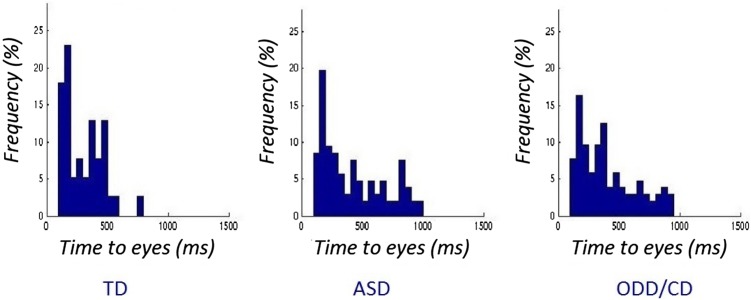
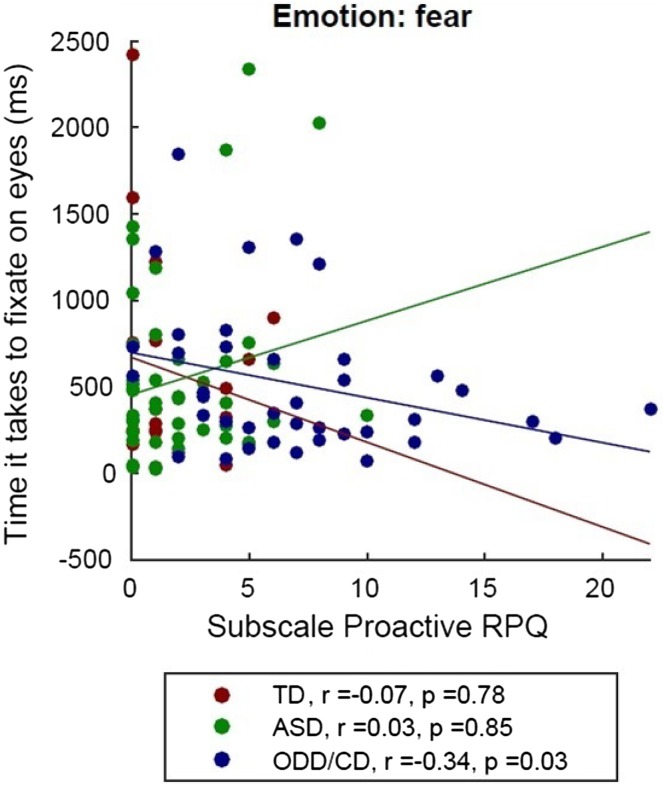
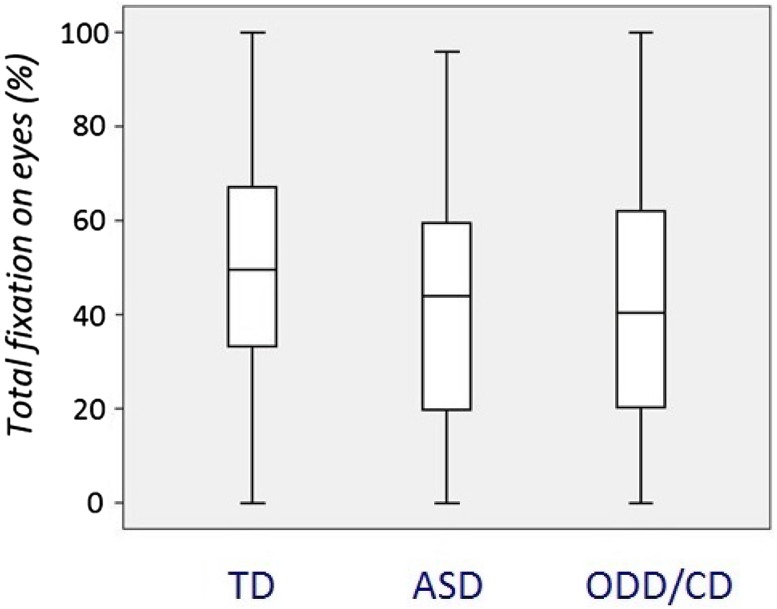
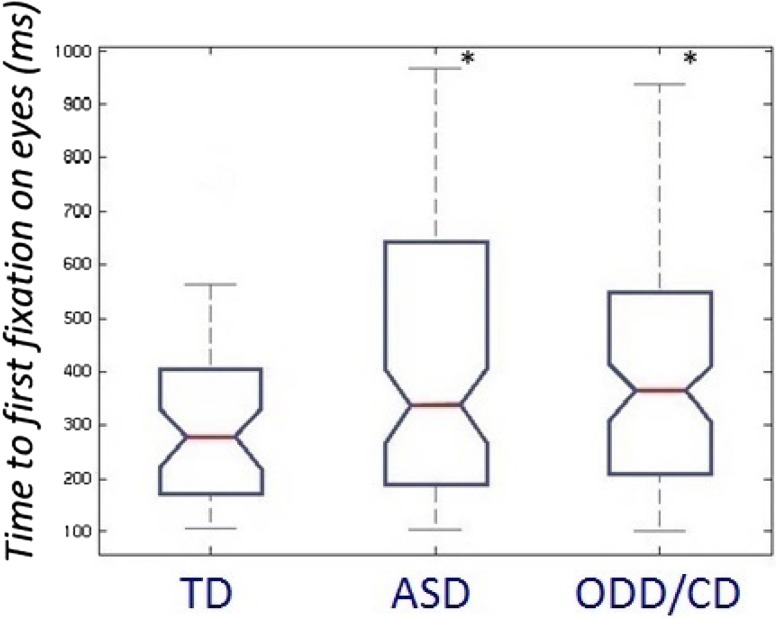
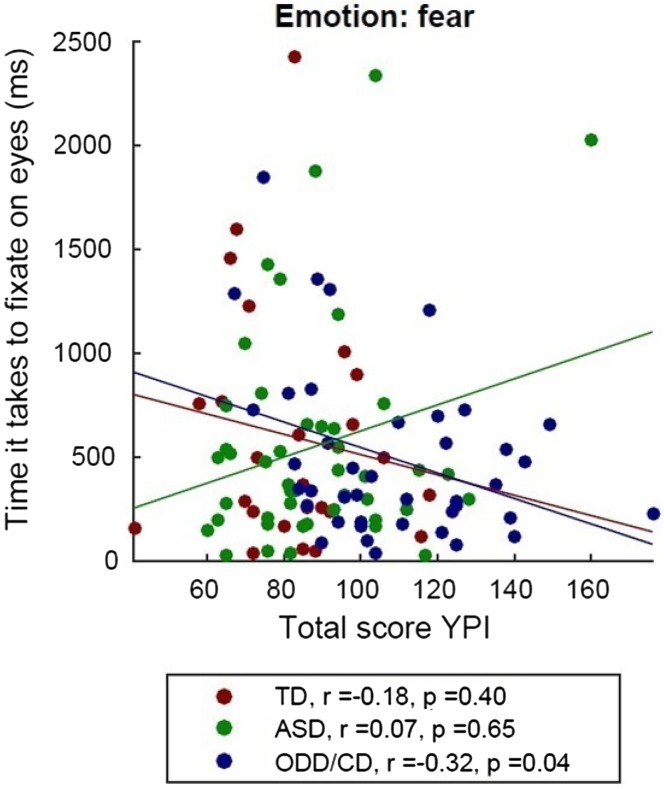
Autism Spectrum Disorder (ASD), Oppositional Defiant Disorder (ODD), and Conduct Disorder (CD) are often associated with emotion recognition difficulties. This is the first eye-tracking study to examine emotional face recognition (i.e., gazing behavior) in a direct comparison of male adolescents with Autism Spectrum Disorder or Oppositional Defiant Disorder/Conduct Disorder, and typically developing (TD) individuals. We also investigate the role of psychopathic traits, callous-unemotional (CU) traits, and subtypes of aggressive behavior in emotional face recognition. A total of 122 male adolescents (N = 50 ASD, N = 44 ODD/CD, and N = 28 TD) aged 12-19 years (M = 15.4 years, SD= 1.9) were included in the current study for the eye-tracking experiment. Participants were presented with neutral and emotional faces using a Tobii 1750 eye-tracking monitor to record gaze behavior. Our main dependent eye-tracking variables were: (1) fixation duration to the eyes of a face and (2) time to the first fixation to the eyes. Since distributions of eye-tracking variables were not completely Gaussian, non-parametric tests were chosen to investigate gaze behavior across the diagnostic groups with Autism Spectrum Disorder, Oppositional Defiant Disorder/Conduct Disorder, and Typically Developing individuals. Furthermore, we used Spearman correlations to investigate the links with psychopathy, callous, and unemotional traits and subtypes of aggression as assessed by questionnaires. The relative total fixation duration to the eyes was decreased in both the Autism Spectrum Disorder group and the Oppositional Defiant Disorder/Conduct Disorder group for several emotional expressions. In both the Autism Spectrum Disorder and the Oppositional Defiant Disorder/Conduct Disorder group, increased time to first fixation on the eyes of fearful faces only was nominally significant. The time to first fixation on the eyes was nominally correlated with psychopathic traits and proactive aggression. The current findings do not support strong claims for differential cross-disorder eye-gazing deficits and for a role of shared underlying psychopathic traits, callous-unemotional traits, and aggression subtypes. Our data provide valuable and novel insights into gaze timing distributions when looking at the eyes of a fearful face.
自闭症谱系障碍(ASD)、对立违抗性障碍(ODD)和品行障碍(CD)通常与情绪识别困难有关。这是第一项使用眼动追踪技术直接比较自闭症谱系障碍或对立违抗性障碍/品行障碍男性青少年与典型发育(TD)个体的情绪面孔识别(即注视行为)的研究。我们还研究了精神病态特征、无情特征和攻击行为亚型在情绪面孔识别中的作用。共有 122 名 12-19 岁(M=15.4 岁,SD=1.9)的男性青少年(ASD 组 N=50,ODD/CD 组 N=44,TD 组 N=28)参与了本研究中的眼动追踪实验。参与者使用 Tobii 1750 眼动追踪监测器观看中性和情绪面孔,以记录注视行为。我们的主要依赖眼动追踪变量是:(1)注视面孔眼睛的持续时间;(2)首次注视眼睛的时间。由于眼动追踪变量的分布不完全呈正态分布,因此选择非参数检验来研究自闭症谱系障碍、对立违抗性障碍/品行障碍和典型发育个体的诊断组之间的注视行为。此外,我们使用 Spearman 相关性来研究与精神病态、无情和无表情特征以及通过问卷评估的攻击行为亚型之间的联系。在自闭症谱系障碍组和对立违抗性障碍/品行障碍组中,几种情绪表达的眼睛相对总注视时间都减少了。在自闭症谱系障碍和对立违抗性障碍/品行障碍组中,只有首次注视恐惧面孔眼睛的时间增加具有名义显著性。首次注视眼睛的时间与精神病态特征和主动攻击行为具有名义相关性。目前的发现并不支持跨障碍注视缺陷的差异和共享潜在精神病态特征、无情特征和攻击行为亚型的作用的强烈主张。我们的数据为注视恐惧面孔时的注视时间分布提供了有价值的新见解。