Centre for Computational Chemistry, School of Chemistry, University of Bristol, Bristol, United Kingdom; Bristol Synthetic Biology Centre, BrisSynBio, Bristol, United Kingdom.
Research Software Engineering, Advanced Computing Research Centre, University of Bristol, Bristol, United Kingdom.
Biophys J. 2021 Mar 16;120(6):983-993. doi: 10.1016/j.bpj.2021.01.037. Epub 2021 Feb 18.
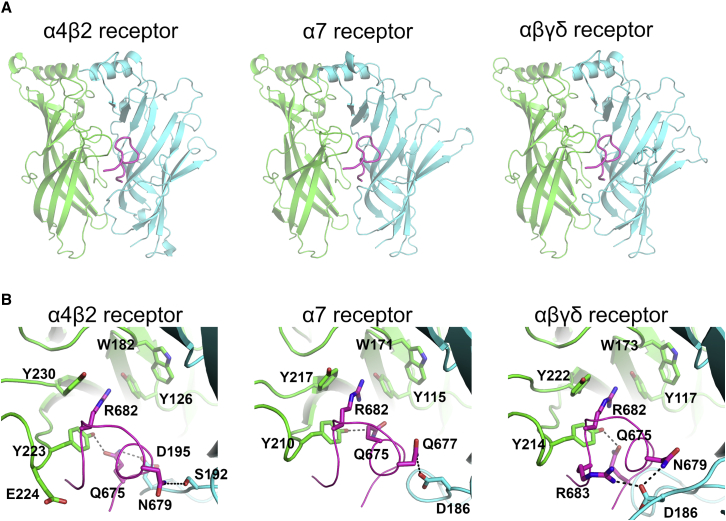
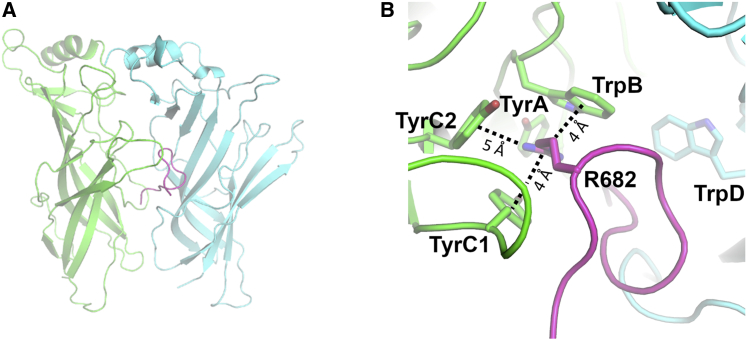
Changeux et al. (Changeux et al. C. R. Biol. 343:33-39.) recently suggested that the SARS-CoV-2 spike protein may interact with nicotinic acetylcholine receptors (nAChRs) and that such interactions may be involved in pathology and infectivity. This hypothesis is based on the fact that the SARS-CoV-2 spike protein contains a sequence motif similar to known nAChR antagonists. Here, we use molecular simulations of validated atomically detailed structures of nAChRs and of the spike to investigate the possible binding of the Y674-R685 region of the spike to nAChRs. We examine the binding of the Y674-R685 loop to three nAChRs, namely the human α4β2 and α7 subtypes and the muscle-like αβγδ receptor from Tetronarce californica. Our results predict that Y674-R685 has affinity for nAChRs. The region of the spike responsible for binding contains a PRRA motif, a four-residue insertion not found in other SARS-like coronaviruses. The conformational behavior of the bound Y674-R685 is highly dependent on the receptor subtype; it adopts extended conformations in the α4β2 and α7 complexes but is more compact when bound to the muscle-like receptor. In the α4β2 and αβγδ complexes, the interaction of Y674-R685 with the receptors forces the loop C region to adopt an open conformation, similar to other known nAChR antagonists. In contrast, in the α7 complex, Y674-R685 penetrates deeply into the binding pocket in which it forms interactions with the residues lining the aromatic box, namely with TrpB, TyrC1, and TyrC2. Estimates of binding energy suggest that Y674-R685 forms stable complexes with all three nAChR subtypes. Analyses of simulations of the glycosylated spike show that the Y674-R685 region is accessible for binding. We suggest a potential binding orientation of the spike protein with nAChRs, in which they are in a nonparallel arrangement to one another.
最近,Changeux 等人(Changeux 等人,C. R. Biol. 343:33-39.)提出,SARS-CoV-2 刺突蛋白可能与烟碱型乙酰胆碱受体(nAChRs)相互作用,这种相互作用可能与发病机制和感染性有关。这一假设基于以下事实,即 SARS-CoV-2 刺突蛋白包含与已知 nAChR 拮抗剂相似的序列基序。在这里,我们使用经过验证的原子细节结构的分子模拟 nAChRs 和 Spike 来研究 Spike 的 Y674-R685 区域与 nAChRs 结合的可能性。我们检查了 Y674-R685 环与三种 nAChRs(即人类α4β2 和 α7 亚型以及来自 Tetronarce californica 的肌肉样αβγδ受体)的结合情况。我们的结果预测 Y674-R685 对 nAChRs 具有亲和力。负责结合的 Spike 区域包含一个 PRRA 基序,这是一个四残基插入序列,在其他 SARS 样冠状病毒中不存在。结合的 Y674-R685 的构象行为高度依赖于受体亚型;它在α4β2 和α7 复合物中呈伸展构象,但与肌肉样受体结合时更紧凑。在α4β2 和αβγδ 复合物中,Y674-R685 与受体的相互作用迫使环 C 区域采用开放构象,类似于其他已知的 nAChR 拮抗剂。相比之下,在α7 复合物中,Y674-R685 深入穿透结合口袋,与芳香盒排列的残基形成相互作用,即与 TrpB、TyrC1 和 TyrC2 形成相互作用。结合能的估计表明,Y674-R685 与所有三种 nAChR 亚型形成稳定的复合物。对糖基化 Spike 的模拟分析表明,Y674-R685 区域可用于结合。我们提出了 Spike 蛋白与 nAChRs 的潜在结合取向,其中它们彼此呈非平行排列。