Wang Lihui, Yang Xin, Song Qiong, Fu Jiejun, Wang Wenchu, Du Kechen, Chen Shuai, Cao Jinjin, Huang Renbin, Zou Chunlin
Key Laboratory of Longevity and Aging-related Diseases of Chinese Ministry of Education, Center for Translational Medicine and School of Preclinical Medicine, Guangxi Medical University, Nanning, China.
Department of Pharmacology, Guangxi Medical University, Nanning, China.
Front Pharmacol. 2021 Feb 2;12:617555. doi: 10.3389/fphar.2021.617555. eCollection 2021.
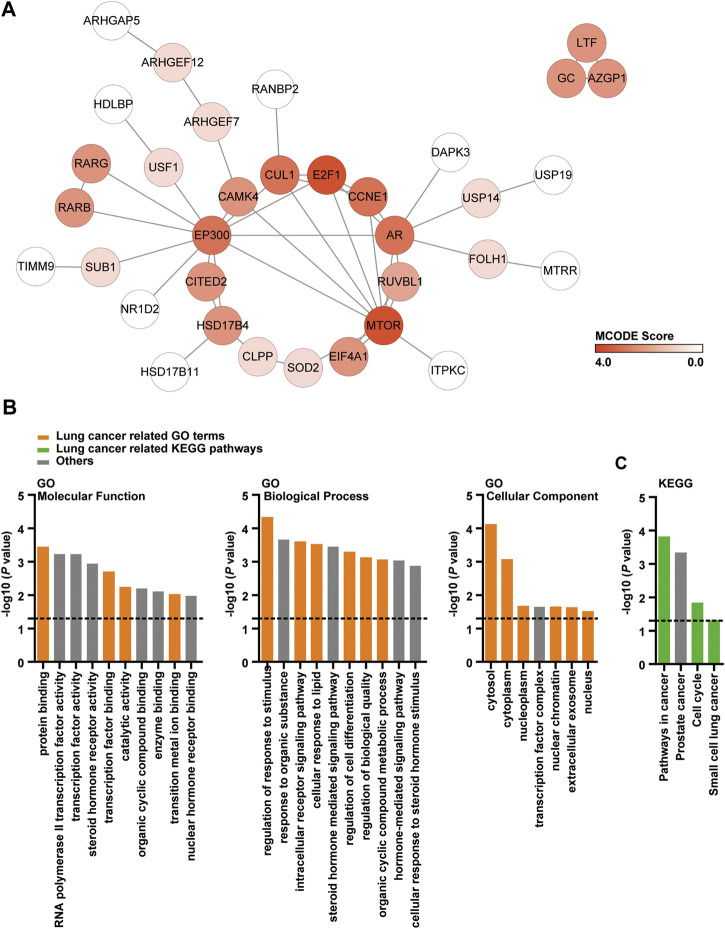
2-Dodecyl-6-Methoxycyclohexa-2, 5-Diene-1,4-Dione (DMDD) was purified from the roots of Previous research demonstrated that DMDD is a small molecular compound with significant therapeutic potential for tumors. However, the potential targets and pharmacological mechanism of DMDD to treat lung cancer has not been reported. We employed network pharmacology and experimental evaluation to reveal the pharmacological mechanism of DMDD against lung cancer. Potential therapeutic targets of DMDD were screened by PharmMapper. Differentially expressed genes (DEGs) in The Cancer Genome Atlas (TCGA) lung cancer data sets were extracted and analyzed by GEPIA2. The mechanism of DMDD against lung cancer was determined by PPI, gene ontology (GO) and KEGG pathway enrichment analysis. Survival analysis and molecular docking were employed to obtain the key targets of DMDD. Human lung cancer cell lines H1975 and PC9 were used to detect effects of DMDD treatment The expression of key targets after DMDD treated was validated by Western Blot. A total of 60 Homo sapiens potential therapeutic targets of DMDD and 3,545 DEGs in TCGA lung cancer datasets were identified. Gene ontology and pathway analysis revealed characteristic of the potential targets of DMDD and DEGs in lung cancer respectively. Cell cycle and pathways in cancer were overlapping with DMDD potential targets and lung cancer DEGs. Eight overlapping genes were found between DMDD potential therapeutic targets and lung cancer related DEGs. Survival analysis showed that high expression of DMDD potential targets and was significantly related to poor patient survival in lung cancer. Molecular docking found that DMDD exhibited significant binding affinities within the active site of CCNE1 and E2F1. Further tests showed that DMDD inhibited the proliferation, migration and clone formation in lung cancer cell lines (H1975 and PC9) in a dose and time dependent manner. Mechanistically, DMDD treatment decreased the expression of CDK2, CCNE1, E2F1 proteins and induced cell cycle arrest at the G1/S phase in H1975 and PC9 cells. These results delineated that DMDD holds therapeutic potential that blocks tumorigenesis by cell cycle regulation in lung cancer, and may provide potential therapies for lung cancer.
2-十二烷基-6-甲氧基环己-2,5-二烯-1,4-二酮(DMDD)是从[植物名称未给出]的根中纯化得到的。先前的研究表明,DMDD是一种小分子化合物,对肿瘤具有显著的治疗潜力。然而,DMDD治疗肺癌的潜在靶点和药理机制尚未见报道。我们采用网络药理学和实验评估来揭示DMDD抗肺癌的药理机制。通过PharmMapper筛选DMDD的潜在治疗靶点。从癌症基因组图谱(TCGA)肺癌数据集中提取差异表达基因(DEG),并通过GEPIA2进行分析。通过蛋白质-蛋白质相互作用(PPI)、基因本体(GO)和京都基因与基因组百科全书(KEGG)通路富集分析确定DMDD抗肺癌的机制。采用生存分析和分子对接来获得DMDD的关键靶点。用人肺癌细胞系H1975和PC9检测DMDD治疗的效果。通过蛋白质免疫印迹法验证DMDD处理后关键靶点的表达。共鉴定出60个DMDD在人类中的潜在治疗靶点和TCGA肺癌数据集中的3545个DEG。基因本体和通路分析分别揭示了DMDD潜在靶点和肺癌中DEG的特征。细胞周期和癌症相关通路与DMDD潜在靶点和肺癌DEG重叠。在DMDD潜在治疗靶点和肺癌相关DEG之间发现了8个重叠基因。生存分析表明,DMDD潜在靶点的高表达与肺癌患者的不良生存显著相关。分子对接发现,DMDD在细胞周期蛋白E1(CCNE1)和E2F1的活性位点内表现出显著的结合亲和力。进一步的试验表明,DMDD以剂量和时间依赖性方式抑制肺癌细胞系(H1975和PC9)的增殖、迁移和克隆形成。机制上,DMDD处理降低了细胞周期蛋白依赖性激酶2(CDK2)、CCNE1、E2F1蛋白的表达,并诱导H1975和PC9细胞在G1/S期发生细胞周期阻滞。这些结果表明,DMDD具有通过调节细胞周期来阻断肺癌肿瘤发生的治疗潜力,并可能为肺癌提供潜在的治疗方法。