Hou Jie, Ye Xiufen, Wang Yixing, Li Chuanlong
College of Intelligent Systems Science and Engineering, Harbin Engineering University, Harbin, China.
Front Genet. 2021 Feb 3;12:610087. doi: 10.3389/fgene.2021.610087. eCollection 2021.
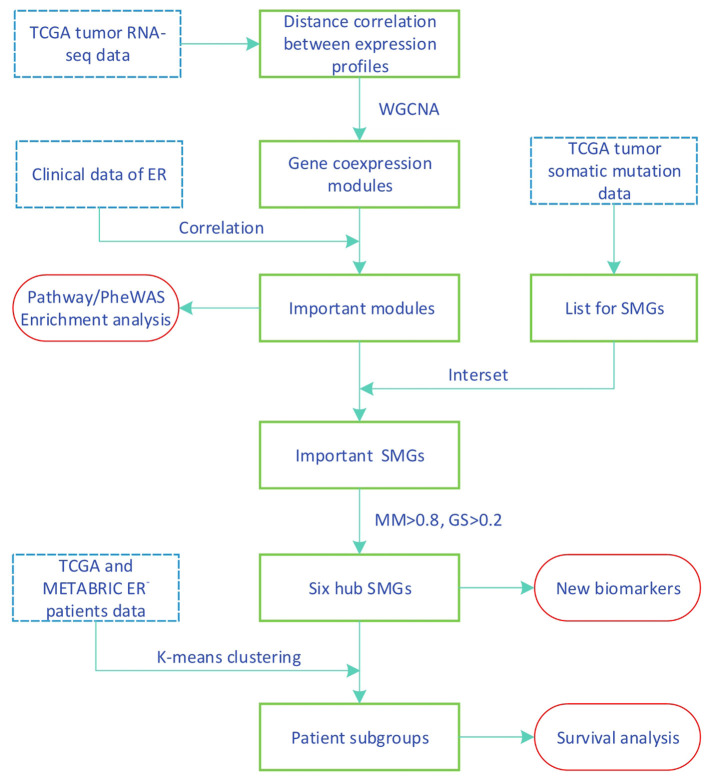
Patients with estrogen receptor-negative breast cancer generally have a worse prognosis than estrogen receptor-positive patients. Nevertheless, a significant proportion of the estrogen receptor-negative cases have favorable outcomes. Identifying patients with a good prognosis, however, remains difficult, as recent studies are quite limited. The identification of molecular biomarkers is needed to better stratify patients. The significantly mutated genes may be potentially used as biomarkers to identify the subtype and to predict outcomes. To identify the biomarkers of receptor-negative breast cancer among the significantly mutated genes, we developed a workflow to screen significantly mutated genes associated with the estrogen receptor in breast cancer by a gene coexpression module. The similarity matrix was calculated with distance correlation to obtain gene modules through a weighted gene coexpression network analysis. The modules highly associated with the estrogen receptor, called important modules, were enriched for breast cancer-related pathways or disease. To screen significantly mutated genes, a new gene list was obtained through the overlap of the important module genes and the significantly mutated genes. The genes on this list can be used as biomarkers to predict survival of estrogen receptor-negative breast cancer patients. Furthermore, we selected six hub significantly mutated genes in the gene list which were also able to separate these patients. Our method provides a new and alternative method for integrating somatic gene mutations and expression data for patient stratification of estrogen receptor-negative breast cancers.
雌激素受体阴性乳腺癌患者的预后通常比雌激素受体阳性患者更差。然而,相当一部分雌激素受体阴性病例的预后良好。然而,由于最近的研究相当有限,识别预后良好的患者仍然很困难。需要鉴定分子生物标志物以更好地对患者进行分层。显著突变的基因可能潜在地用作生物标志物来识别亚型并预测预后。为了在显著突变的基因中鉴定受体阴性乳腺癌的生物标志物,我们开发了一种工作流程,通过基因共表达模块筛选与乳腺癌中雌激素受体相关的显著突变基因。使用距离相关性计算相似性矩阵,通过加权基因共表达网络分析获得基因模块。与雌激素受体高度相关的模块,称为重要模块,富含与乳腺癌相关的途径或疾病。为了筛选显著突变的基因,通过重要模块基因与显著突变基因的重叠获得了一个新的基因列表。该列表上的基因可作为生物标志物来预测雌激素受体阴性乳腺癌患者的生存情况。此外,我们在基因列表中选择了六个中心显著突变基因,这些基因也能够区分这些患者。我们的方法为整合体细胞基因突变和表达数据以对雌激素受体阴性乳腺癌患者进行分层提供了一种新的替代方法。