Porath-Krause Anita, Campbell Ryan, Shoemaker Lauren, Sieben Andrew, Strauss Alexander T, Shaw Allison K, Seabloom Eric W, Borer Elizabeth T
Department of Ecology, Evolution, and Behavior University of Minnesota St. Paul MN USA.
Present address: Department of Botany University of Wyoming Laramie WY USA.
Ecol Evol. 2021 Jan 26;11(4):1877-1887. doi: 10.1002/ece3.7178. eCollection 2021 Feb.
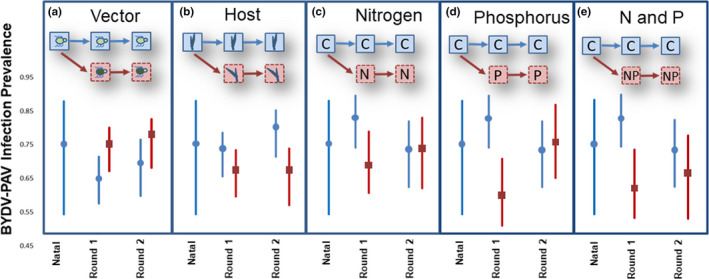
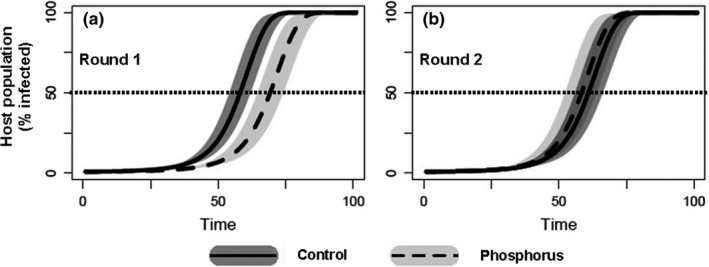
Pathogen spread rates are determined, in part, by the performance of pathogens under altered environmental conditions and their ability to persist while switching among hosts and vectors.To determine the effects of new conditions (host, vector, and nutrient) on pathogen spread rate, we introduced a vector-borne viral plant pathogen, Barley Yellow Dwarf Virus PAV (BYDV-PAV) into hosts, vectors, and host nutrient supplies that it had not encountered for thousands of viral generations. We quantified pathogen prevalence over the course of two serial inoculations under the new conditions. Using individual-level transmission rates from this experiment, we parameterized a dynamical model of disease spread and projected spread across host populations through a growing season.A change in nutrient conditions (increased supply of phosphorus) reduced viral transmission whereas shifting to a new vector or host species had no effect on infection prevalence. However, the reduction in the new nutrient environment was only temporary; infection prevalence recovered after the second inoculation. . These results highlight how robust the pathogen, BYDV-PAV, is to changes in its biotic and abiotic environment. Our study also highlights the need to quantify longitudinal infection information beyond snapshot assessments to project disease risk for pathogens in new environments.
病原体的传播速率部分取决于病原体在变化的环境条件下的表现,以及它们在宿主和媒介之间转换时持续存在的能力。为了确定新条件(宿主、媒介和养分)对病原体传播速率的影响,我们将一种由媒介传播的病毒性植物病原体——大麦黄矮病毒PAV(BYDV - PAV)引入到它数千代病毒未曾接触过的宿主、媒介和宿主养分供应环境中。我们在新条件下的两次连续接种过程中对病原体的流行情况进行了量化。利用该实验中个体水平的传播速率,我们对疾病传播的动力学模型进行了参数化,并预测了整个生长季节病原体在宿主种群中的传播情况。养分条件的变化(磷供应增加)降低了病毒传播,而转换到新的媒介或宿主物种对感染流行率没有影响。然而,在新养分环境下传播率的降低只是暂时的;第二次接种后感染流行率恢复了。这些结果凸显了病原体BYDV - PAV对其生物和非生物环境变化的适应能力有多强。我们的研究还强调,除了快照评估之外,还需要量化纵向感染信息,以预测新环境中病原体的疾病风险。