Reuben R C, Gyar S D, Makut M D, Adoga M P
German Centre for Integrative Biodiversity Research (iDiv), Halle-Jena-Leipzig, Germany.
Department of Microbiology, Nasarawa State University, Keffi, Nigeria.
New Microbes New Infect. 2021 Mar;40:100851. doi: 10.1016/j.nmni.2021.100851. Epub 2021 Feb 16.
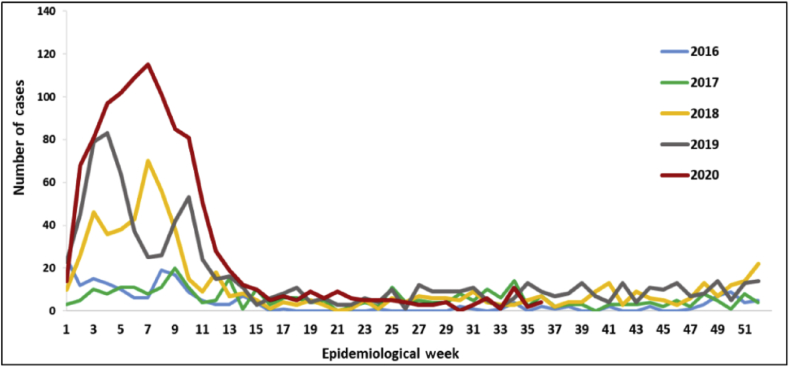
While the coronavirus disease 2019 (COVID-19) pandemic has multiple devastating public health and socio-economic effects across the world, Nigeria along with other West African countries is simultaneously faced with a recurrent Lassa fever epidemic. The complicating scenario is the similarity in the clinical manifestation of COVID-19 and Lassa fever, making the misdiagnosis of the initial presentation of both diseases a significant risk with an increased likelihood of co-infection. However, the strict implementation of COVID-19 infection prevention and control measures across Nigeria after the initial outbreaks concurrently resulted in the reduction of Lassa fever cases. The abrupt change in the behaviour of Lassa fever epidemiological data, which are attributable to the implementation of COVID-19 infection prevention and control measures at the national, sub-national and community levels, requires detailed investigation during and after the COVID-19 epidemic to elucidate the interactions and evolutionary dynamics of Lassa fever cases in Nigeria.
虽然2019冠状病毒病(COVID-19)大流行在全球产生了多重毁灭性的公共卫生和社会经济影响,但尼日利亚与其他西非国家同时面临着反复出现的拉沙热疫情。复杂的情况是COVID-19和拉沙热在临床表现上有相似之处,这使得两种疾病初始症状的误诊成为一个重大风险,且合并感染的可能性增加。然而,在最初疫情爆发后,尼日利亚各地严格实施COVID-19感染预防和控制措施,同时导致了拉沙热病例的减少。拉沙热流行病学数据行为的突然变化,这可归因于在国家、次国家和社区层面实施的COVID-19感染预防和控制措施,需要在COVID-19疫情期间及之后进行详细调查,以阐明尼日利亚拉沙热病例的相互作用和演变动态。