Siddiqui Shoib S, Vaill Michael, Do Raymond, Khan Naazneen, Verhagen Andrea L, Zhang Wu, Lenz Heinz-Josef, Johnson-Pais Teresa L, Leach Robin J, Fraser Gary, Wang Charles, Feng Gen-Sheng, Varki Nissi, Varki Ajit
Departments of Medicine, Cellular and Molecular Medicine, and Pathology, Glycobiology Research and Training Cente and Center for Academic Research and Training in Anthropogeny University of California San Diego CA USA.
Present address: Department of Biotechnology American University of Ras Al Khaimah (AURAK American University of Ras Al Khaimah Road Al Burairat Area Ras Al Khaimah UAE.
FASEB Bioadv. 2020 Dec 8;3(2):69-82. doi: 10.1096/fba.2020-00092. eCollection 2021 Feb.
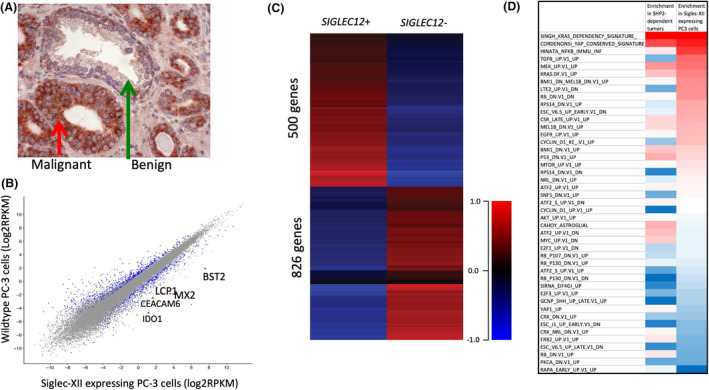
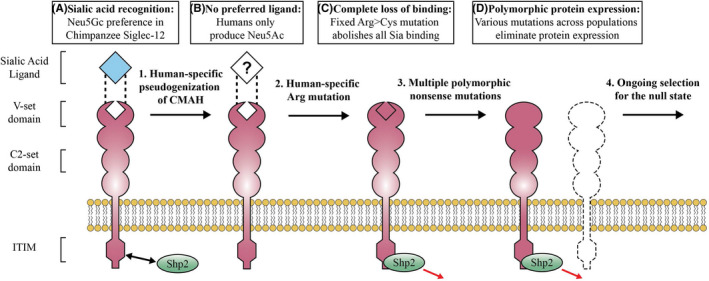
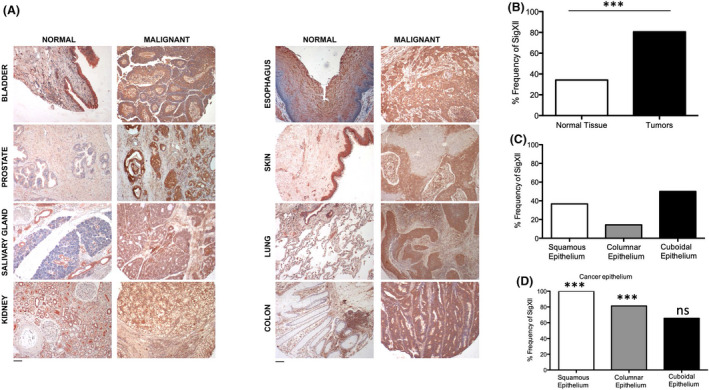
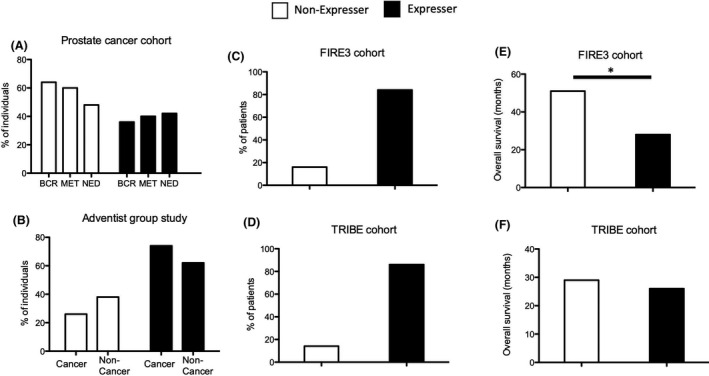
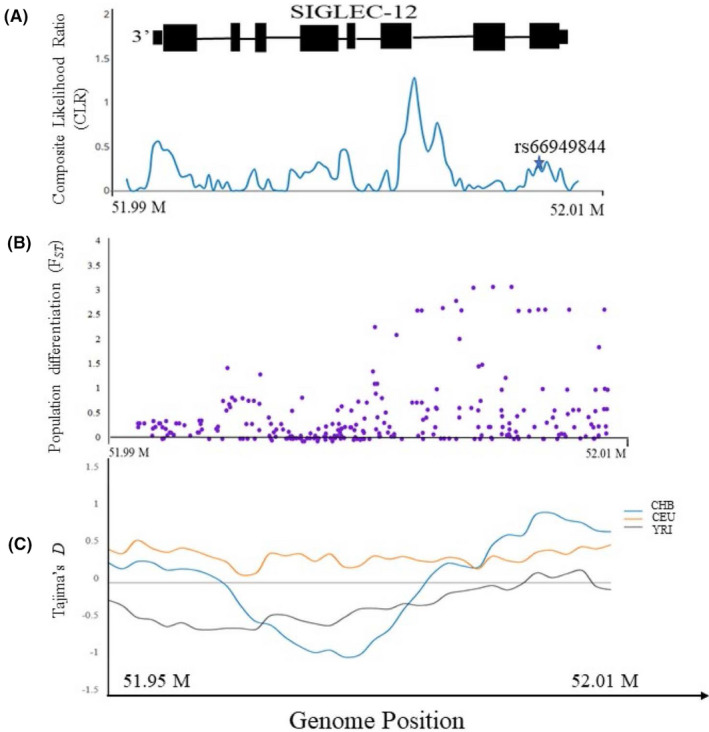
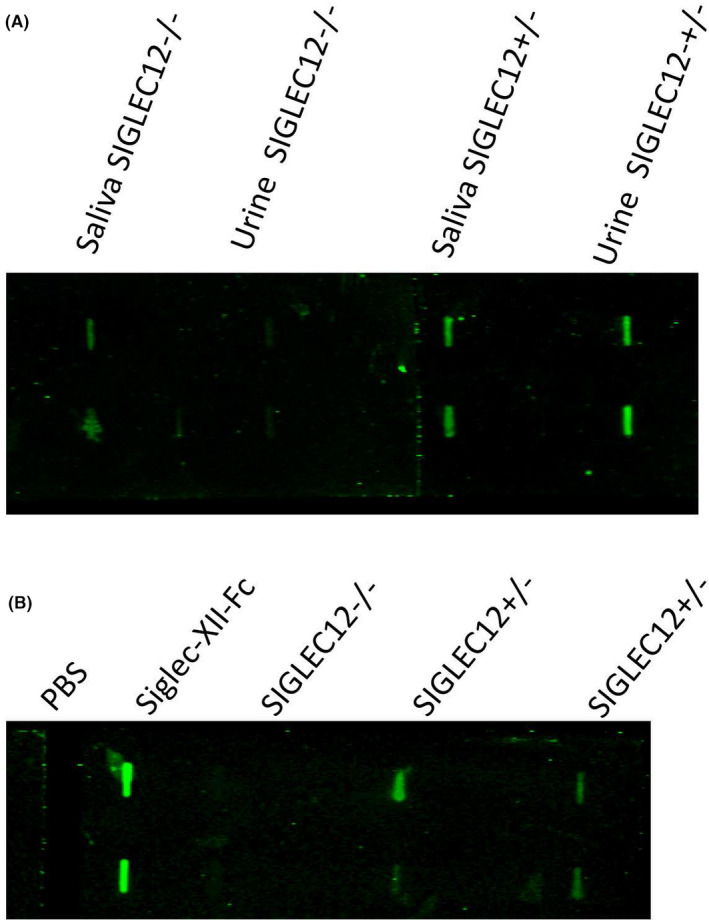
Compared with our closest living evolutionary cousins, humans appear unusually prone to develop carcinomas (cancers arising from epithelia). The gene, which encodes the Siglec-XII protein expressed on epithelial cells, has several uniquely human features: a fixed homozygous missense mutation inactivating its natural ligand recognition property; a polymorphic frameshift mutation eliminating full-length protein expression in ~60%-70% of worldwide human populations; and, genomic features suggesting a negative selective sweep favoring the pseudogene state. Despite the loss of canonical sialic acid binding, Siglec-XII still recruits Shp2 and accelerates tumor growth in a mouse model. We hypothesized that dysfunctional Siglec-XII facilitates human carcinoma progression, correlating with known tumorigenic signatures of Shp2-dependent cancers. Immunohistochemistry was used to detect Siglec-XII expression on tissue microarrays. PC-3 prostate cancer cells were transfected with Siglec-XII and transcription of genes enriched with Siglec-XII was determined. Genomic status was determined for four different cancer cohorts. Finally, a dot blot analysis of human urinary epithelial cells was established to determine the Siglec-XII expressors versus non-expressors. Forced expression in a null carcinoma cell line enriched transcription of genes associated with cancer progression. While Siglec-XII was detected as expected in ~30%-40% of normal epithelia, ~80% of advanced carcinomas showed strong expression. Notably, >80% of late-stage colorectal cancers had a functional allele, correlating with overall increased mortality. Thus, advanced carcinomas are much more likely to occur in individuals whose genomes have an intact gene, likely because the encoded Siglec-XII protein recruits Shp2-related oncogenic pathways. The finding has prognostic, diagnostic, and therapeutic implications.
与现存亲缘关系最近的进化近亲相比,人类似乎异常容易患上 carcinomas(源自上皮细胞的癌症)。该基因编码在上皮细胞上表达的Siglec-XII蛋白,具有几个独特的人类特征:一个固定的纯合错义突变使其天然配体识别特性失活;一个多态性移码突变在全球约60%-70%的人群中消除了全长蛋白表达;以及基因组特征表明存在有利于假基因状态的负向选择扫荡。尽管丧失了典型的唾液酸结合能力,但Siglec-XII在小鼠模型中仍能招募Shp2并加速肿瘤生长。我们推测功能失调的Siglec-XII促进了人类癌症进展,这与Shp2依赖性癌症已知的致瘤特征相关。免疫组织化学用于检测组织微阵列上的Siglec-XII表达。用Siglec-XII转染PC-3前列腺癌细胞,并测定富含Siglec-XII的基因的转录情况。确定了四个不同癌症队列的基因组状态。最后,建立了人尿上皮细胞的斑点印迹分析,以确定Siglec-XII表达者与非表达者。在一个空癌细胞系中强制表达可富集与癌症进展相关的基因转录。虽然在约30%-40%的正常上皮细胞中如预期检测到Siglec-XII,但约80%的晚期癌症显示出强表达。值得注意的是,超过80%的晚期结直肠癌具有功能性等位基因,这与总体死亡率增加相关。因此,晚期癌症更有可能发生在基因组具有完整基因的个体中,可能是因为编码的Siglec-XII蛋白招募了与Shp2相关的致癌途径。这一发现具有预后、诊断和治疗意义。