
司美格鲁肽转换研究(STS研究):一项回顾性队列研究。
Switch-to-Semaglutide Study (STS-Study): a Retrospective Cohort Study.
作者信息
Hepprich Matthias, Zillig Daniela, Florian-Reynoso Manuel A, Donath Marc Y, Rudofsky Gottfried
机构信息
Clinic of Endocrinology and Metabolic Disorders, Cantonal Hospital Olten, Baslerstrasse 150, Olten, Switzerland.
Clinic of Endocrinology, Diabetes and Metabolism, University Hospital Basel, Petersgraben 4, Basel, Switzerland.
出版信息
Diabetes Ther. 2021 Mar;12(3):943-954. doi: 10.1007/s13300-021-01016-y. Epub 2021 Feb 22.
INTRODUCTION
Despite expert consensus guidelines, data is scarce on how to switch patients with type 2 diabetes when treatment with glucagon-like peptide 1 (GLP-1) receptor agonists is not effective and whether a switch to semaglutide brings any benefit on glucose and weight control for patients with type 2 diabetes.
METHODS
Retrospective cohort analysis of patients with type 2 diabetes who were switched from any GLP-1 agonist in a stable dose to subcutaneously administered semaglutide. Primary endpoint was change of glycated haemoglobin (HbA1c) at 6 months. Secondary endpoints were weight, body mass index (BMI), heart rate, blood pressure and adverse events.
RESULTS
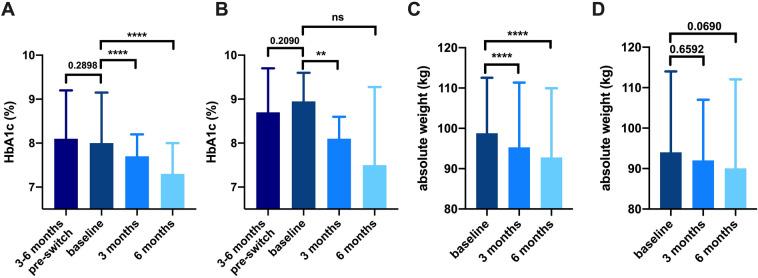
In total, 77 patients (median age 65 years) with long-standing type 2 diabetes (median 15 years, median HbA1c 8.4%/68 mmol/l, median BMI 33 kg/m) were included. HbA1c was significantly lower 6 months after switching to semaglutide (7.3%; 56 mmol/l). Median body weight was significantly lower at 3 months (94 kg) and 6 months (93 kg) compared to baseline (98 kg). An equipotential dose switch of semaglutide was used in 61 patients (79%) and a stepwise initiation approach was used in 16 patients (21%). Both treatment regimens improved glucose control and weight. Side effects occurred in 28 patients (36%).
CONCLUSION
Switching to semaglutide from established GLP-1 analogue therapy improved HbA1c and body weight. Both equipotential and stepwise dosing initiation appear to be effective and well tolerated.
引言
尽管有专家共识指南,但关于如何在胰高血糖素样肽-1(GLP-1)受体激动剂治疗无效时转换2型糖尿病患者的治疗,以及转换为司美格鲁肽是否能给2型糖尿病患者的血糖和体重控制带来益处的数据却很匮乏。
方法
对从稳定剂量的任何GLP-1激动剂转换为皮下注射司美格鲁肽的2型糖尿病患者进行回顾性队列分析。主要终点是6个月时糖化血红蛋白(HbA1c)的变化。次要终点是体重、体重指数(BMI)、心率、血压和不良事件。
结果
总共纳入了77例(中位年龄65岁)患有长期2型糖尿病(中位病程15年,中位HbA1c 8.4%/68 mmol/l,中位BMI 33 kg/m²)的患者。转换为司美格鲁肽6个月后,HbA1c显著降低(7.3%;56 mmol/l)。与基线(98 kg)相比,3个月时(94 kg)和6个月时(93 kg)的中位体重显著降低。61例患者(79%)采用了司美格鲁肽等剂量转换,16例患者(21%)采用了逐步起始治疗方法。两种治疗方案均改善了血糖控制和体重。28例患者(36%)出现了副作用。
结论
从已确立的GLP-1类似物治疗转换为司美格鲁肽可改善HbA1c和体重。等剂量和逐步给药起始似乎都是有效的且耐受性良好。


 Zotero 插件