Department of Internal Medicine II-Cardiology, Pneumology and Angiology, University Hospital Bonn, Bonn, Germany.
Department of Cardiology I, University Hospital Muenster, Muenster, Germany.
PLoS One. 2021 Feb 22;16(2):e0247197. doi: 10.1371/journal.pone.0247197. eCollection 2021.
Sarcoidosis is a systemic inflammatory granulomatous disease, frequently affecting the lung. If left untreated, it may end in lung fibrosis. Proangiogenic and profibrotic vascular endothelial growth factor (VEGF), transforming growth factor (TGF)-β1, fibroblast growth factor (FGF)-2 and platelet-derived growth factor (PDGF)-AB are a known therapeutical target in pulmonary fibrosing diseases, e.g. IPF, but there is no targeted therapy option for pulmonary fibrosis in sarcoidosis.
The aim of our study was to determine the association of these markers' serum levels on lung function and the patients' quality of life in a long-term follow-up of sarcoidosis patients, to provide further information for finding targeted therapy options for pulmonary sarcoidosis.
54 patients with sarcoidosis underwent blood sampling, pulmonary function testing and answered the King's Brief Interstitial Lung Disease (K-BILD) questionnaire at baseline and at three-years follow-up. Serum levels of profibrotic and angiogenic markers were assessed at baseline by enzyme-linked immunosorbent assay.
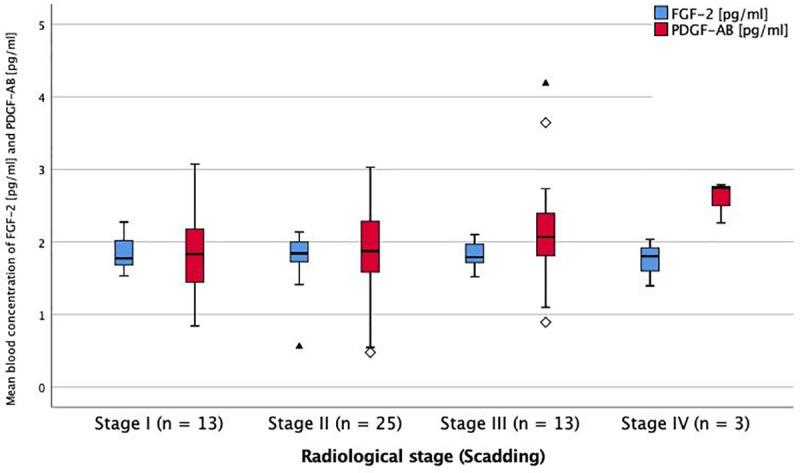
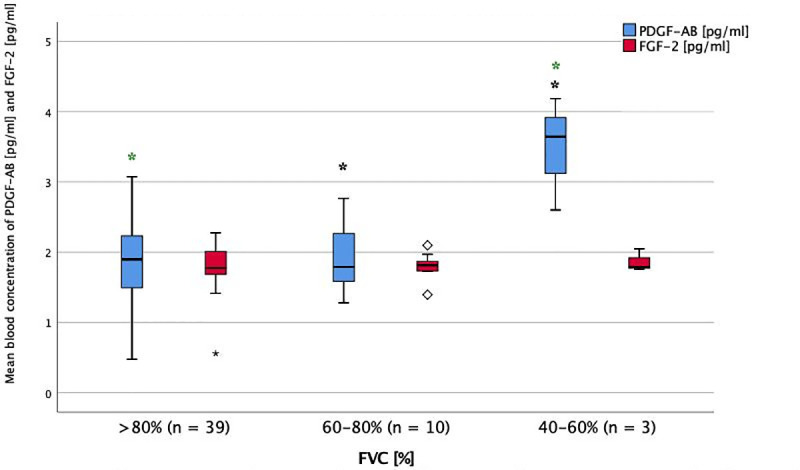
Between 2015 and 2018, 54 patients with biopsy proven sarcoidosis were enrolled. Throughout the observation period, there was a significant decrease in the diffusion capacity for carbon monoxide (DLCO) [%] (-6.5504 ± 13,39, p = 0.001) and forced expiratory volume in one second predicted (FEV1) [%] (-6.07 ± 12.09, p = 0.001). Patients with greater impairment of forced vital capacity (FVC) did have significantly higher serum levels of VEGF (p = 0.03) and PDGF-AB (p<0.001). The K-BILD questionnaire did not change significantly during follow-up. However, patients with worsening K-BILD scores did have significantly higher serum-levels of PDGF-AB (2.67 pg/ml ± 0.93 vs. 1.88 pg/ml ± 0.60, p = 0.004) at baseline, compared to those with unchanged or increasing K-BILD scores.
Among patients with pulmonary sarcoidosis, baseline serum levels of VEGF and PDGF-AB were associated with pulmonary function impairment. Furthermore, PDGF-AB was associated with worsening K-BILD scores. No such association was observed for FGF-2 and TGF-ß1. VEGF and PDGF-AB may be possible prognostic and therapeutic targets in sarcoidosis as a fibrosing ILD beyond IPF.
结节病是一种系统性炎症性肉芽肿性疾病,常累及肺部。如果不进行治疗,可能会导致肺纤维化。促血管生成和促纤维化的血管内皮生长因子(VEGF)、转化生长因子(TGF)-β1、成纤维细胞生长因子(FGF)-2 和血小板衍生生长因子(PDGF)-AB 是肺纤维化疾病(如特发性肺纤维化,IPF)的已知治疗靶点,但结节病的肺纤维化尚无靶向治疗选择。
我们的研究目的是确定这些标志物的血清水平与长期随访中结节病患者肺功能和患者生活质量的相关性,为寻找肺结节病的靶向治疗选择提供进一步信息。
54 例结节病患者在基线和 3 年随访时进行了采血、肺功能检查,并回答了 King 的简要间质性肺病(K-BILD)问卷。通过酶联免疫吸附试验在基线时评估了促纤维化和血管生成标志物的血清水平。
2015 年至 2018 年间,共纳入 54 例经活检证实的结节病患者。在整个观察期间,一氧化碳弥散量(DLCO)[%](-6.5504 ± 13.39,p = 0.001)和第一秒用力呼气量(FEV1)[%](-6.07 ± 12.09,p = 0.001)显著下降。用力肺活量(FVC)受损更严重的患者 VEGF(p = 0.03)和 PDGF-AB(p<0.001)的血清水平显著更高。K-BILD 问卷在随访期间没有明显变化。然而,K-BILD 评分恶化的患者基线时 PDGF-AB 血清水平显著升高(2.67 pg/ml ± 0.93 比 1.88 pg/ml ± 0.60,p = 0.004),与 K-BILD 评分不变或升高的患者相比。
在患有肺结节病的患者中,基线时 VEGF 和 PDGF-AB 的血清水平与肺功能损害有关。此外,PDGF-AB 与 K-BILD 评分的恶化有关。FGF-2 和 TGF-β1 没有观察到这种相关性。VEGF 和 PDGF-AB 可能是 IPF 以外的纤维化间质性肺病的潜在预后和治疗靶点。