Department of Laboratory Medicine, Institute of Biomedicine, Sahlgrenska Center for Cancer Research, Sahlgrenska Academy, University of Gothenburg, Box 425, Medicinaregatan 1G, SE-13 90, Gothenburg, Sweden.
Present address: Department of Surgery, National University Hospital of Iceland, 13-A Hringbraut, Reykjavik, Iceland.
BMC Cancer. 2021 Feb 22;21(1):185. doi: 10.1186/s12885-021-07854-0.
The growth factor progranulin has been implicated in numerous biological processes such as wound healing, inflammation and progressive tumorigenesis. Both progranulin and its receptor sortilin are known to be highly expressed in subgroups of breast cancer and have been associated with various clinical properties including tamoxifen resistance. Recent data further suggest that progranulin, via its receptor sortilin, drives breast cancer stem cell propagation in vitro and increases metastasis formation in an in vivo breast cancer xenograft model. In this retrospective biomarker analysis, we aimed to determine whether tumor co-expression of progranulin and sortilin has prognostic and treatment predictive values for breast cancer patients.
We explored how co-expression of progranulin and sortilin was associated with established clinical markers by analyzing a tissue microarray including 560 randomized premenopausal breast cancer patients receiving either 2 years of tamoxifen treatment or no adjuvant treatment, with a median follow-up time of 28 years. Breast cancer-specific survival was analyzed using Kaplan-Meier and Cox Proportional Hazards regression models to assess the prognostic and predictive value of progranulin and sortilin in relation to known clinical markers.
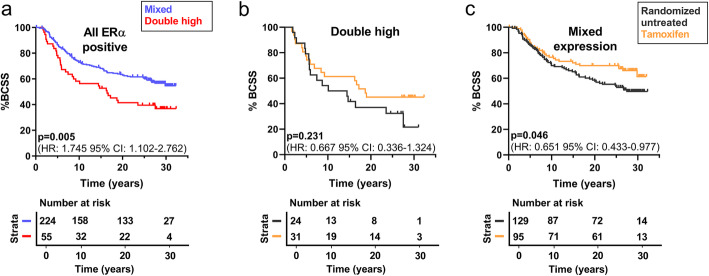
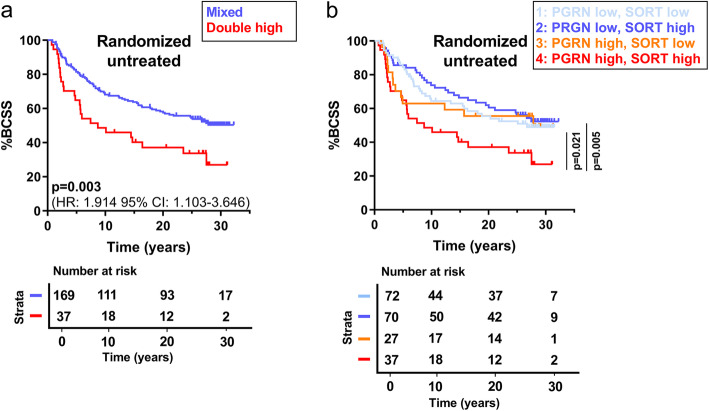
Co-expression of progranulin and sortilin was observed in 20% of the breast cancer samples. In untreated patients, prognostic considerations could be detailed separately from treatment prediction and the high progranulin and sortilin expressing subgroup was significantly associated with breast cancer-specific death in multivariable analyses (HR=2.188, CI: 1.317-3.637, p=0.003) along with tumor size, high tumor grade and lymph node positivity. When comparing the untreated patients with tamoxifen treated patients in the ERα positive subgroup, co-expression of progranulin and sortilin was not linked to tamoxifen resistance.
Data suggest that co-expression of progranulin and its receptor sortilin is a novel prognostic biomarker combination identifying a highly malignant subgroup of breast cancer. Importantly, this subpopulation could potentially be targeted with anti-sortilin based therapies.
生长因子颗粒蛋白聚糖(progranulin) 参与众多生物学过程,如伤口愈合、炎症和肿瘤的进行性发生。颗粒蛋白聚糖及其受体分选蛋白(sortilin) 在乳腺癌的亚群中表达水平较高,与包括他莫昔芬耐药性在内的各种临床特征相关。最近的数据进一步表明,颗粒蛋白聚糖通过其受体分选蛋白,在体外驱动乳腺癌干细胞的增殖,并在体内乳腺癌异种移植模型中增加转移的形成。在这项回顾性生物标志物分析中,我们旨在确定肿瘤中颗粒蛋白聚糖和分选蛋白的共表达是否对乳腺癌患者具有预后和治疗预测价值。
我们通过分析包括 560 名接受 2 年他莫昔芬治疗或无辅助治疗的随机绝经前乳腺癌患者的组织微阵列,探讨了颗粒蛋白聚糖和分选蛋白的共表达与已建立的临床标志物的相关性,中位随访时间为 28 年。使用 Kaplan-Meier 和 Cox 比例风险回归模型分析乳腺癌特异性生存,以评估颗粒蛋白聚糖和分选蛋白与已知临床标志物的相关性的预后和预测价值。
在 20%的乳腺癌样本中观察到颗粒蛋白聚糖和分选蛋白的共表达。在未治疗的患者中,预后因素可以与治疗预测分开考虑,多变量分析显示高颗粒蛋白聚糖和分选蛋白表达亚组与乳腺癌特异性死亡显著相关(HR=2.188,CI:1.317-3.637,p=0.003),同时还与肿瘤大小、高肿瘤分级和淋巴结阳性相关。当将未治疗的患者与 ERα 阳性亚组的接受他莫昔芬治疗的患者进行比较时,颗粒蛋白聚糖和分选蛋白的共表达与他莫昔芬耐药性无关。
数据表明,颗粒蛋白聚糖及其受体分选蛋白的共表达是一种新的预后生物标志物组合,可识别乳腺癌的高度恶性亚群。重要的是,该亚群可能可以通过针对分选蛋白的治疗来靶向治疗。