Department of Molecular Medicine and Surgery Karolinska Institutet Stockholm Sweden.
Department of Vascular Surgery Karolinska University Hospital Stockholm Sweden.
J Am Heart Assoc. 2021 Feb;10(5):e019592. doi: 10.1161/JAHA.120.019592. Epub 2021 Feb 23.
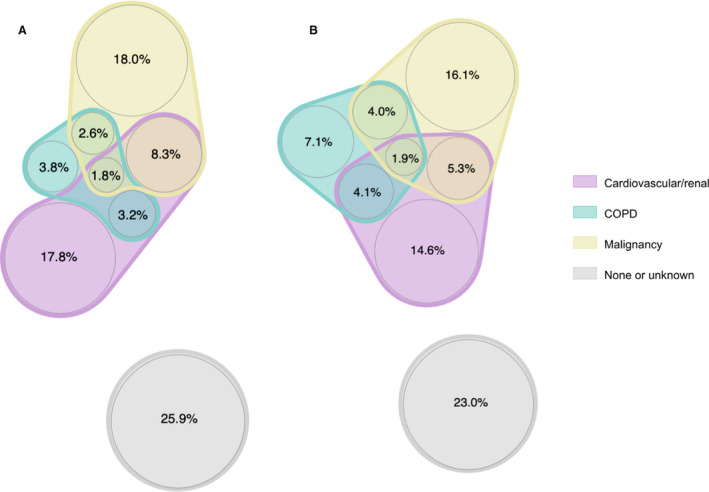
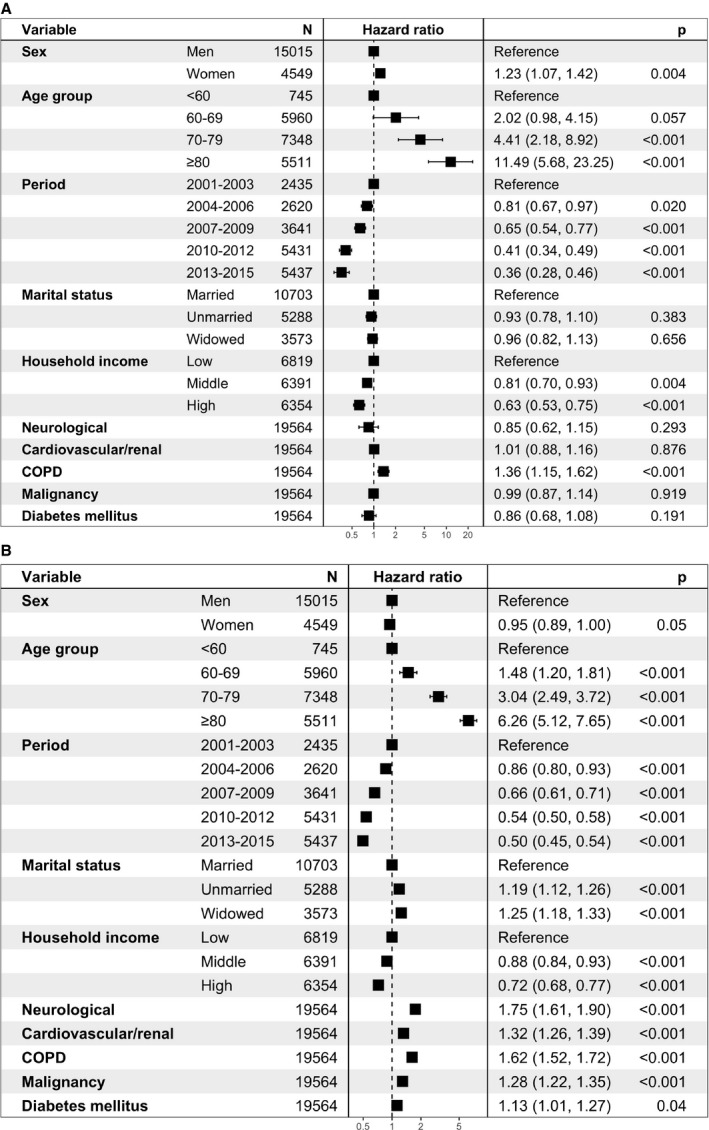
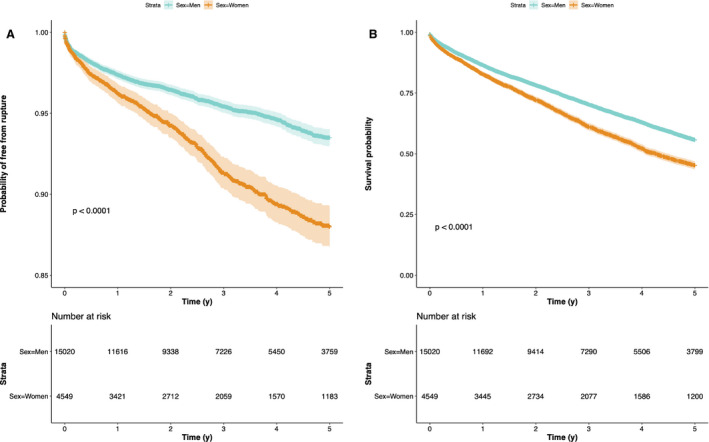
Background Studies on intact abdominal aortic aneurysms mainly focus on treated patients, and data on untreated patients are sparse. The objective was to investigate sex differences among untreated patients regarding rupture and mortality rates and to determine predictors for these events. Sex-specific causes of death were evaluated. Methods and Results All patients ≥40 years diagnosed from 2001 to 2015 (n=32 393) with intact abdominal aortic aneurysms were identified in national registries; 60% (n=19 569) were untreated. Comorbid loads, crude rupture, and mortality rates were assessed. Predictors of 5-year rupture and mortality were analyzed in Cox models (sex, age, comorbidities, income, and marital status). The proportion of men and women with multiple comorbidities was similar. Within 5 years, 798 ruptures occurred (9.7% women versus 6.9% men, <0.001). Ruptures were independently predicted by female sex (hazard ratio [HR], 1.23; 95% CI, 1.07-1.42; =0.004), chronic obstructive pulmonary disease (HR, 1.36; 95% CI, 1.15-1.62; <0.001), age (HR, 11.49; 95% CI, 5.68-23.25 for ≥80 years; <0.001), and income (HR, 0.63; 95% CI, 0.53-0.75 for highest tertile; <0.001). After 5 years, 56.5% women and 50.4% men were deceased. Mortality was not independently predicted by female sex. Rupture was the third most common cause of death (11.9% women versus 8.7% men; <0.001). The median time-to-events was 2.8 years. Conclusions A considerable proportion of patients with intact abdominal aortic aneurysms in surveillance remain untreated. Despite surveillance algorithms, the healthcare system fails to prevent a high number of ruptures, especially among women. The time-to-event data highlight the urgency to develop more individualized surveillance.
针对未治疗的腹主动脉瘤患者的研究主要集中在已接受治疗的患者,而针对未治疗患者的数据则较为匮乏。本研究旨在调查未治疗患者的破裂和死亡率的性别差异,并确定这些事件的预测因素。评估了特定性别的死亡原因。
在全国登记处中确定了 2001 年至 2015 年间所有≥40 岁诊断为腹主动脉瘤且未破裂的患者(n=32393);其中 60%(n=19569)未经治疗。评估了合并症负担、破裂的发生率和死亡率。使用 Cox 模型分析了 5 年破裂和死亡率的预测因素(性别、年龄、合并症、收入和婚姻状况)。
在 5 年内,发生了 798 例破裂(女性为 9.7%,男性为 6.9%,<0.001)。女性(危险比[HR],1.23;95%置信区间[CI],1.07-1.42;=0.004)、慢性阻塞性肺疾病(HR,1.36;95%CI,1.15-1.62;<0.001)、年龄(HR,11.49;95%CI,80 岁及以上为 5.68-23.25;<0.001)和收入(HR,0.63;95%CI,最高三分位组为 0.53-0.75;<0.001)是破裂的独立预测因素。5 年后,56.5%的女性和 50.4%的男性死亡。女性的死亡不是破裂的独立预测因素。破裂是第三位最常见的死亡原因(女性为 11.9%,男性为 8.7%;<0.001)。中位时间到事件为 2.8 年。
在监测中,相当一部分腹主动脉瘤患者未得到治疗。尽管有监测算法,但医疗系统未能预防大量破裂,尤其是在女性中。时间事件数据突出表明迫切需要制定更个体化的监测方案。