Department of Genetics, Albert Einstein College of Medicine, Bronx, New York.
Department of Microbiology and Immunology, Albert Einstein College of Medicine, Bronx, New York.
Clin Cancer Res. 2021 May 1;27(9):2636-2647. doi: 10.1158/1078-0432.CCR-20-4226. Epub 2021 Feb 23.
Cancer-associated fibroblasts (CAFs) are an important component of the tumor microenvironment, but a systematic investigation of their molecular characteristics and clinical relevance are lacking. Here, we sought to compare CAFs across multiple cancer types to identify critical molecular pathways activated in CAF subtypes, which may contribute to clinical outcome, disease progression, and immunotherapy resistance.
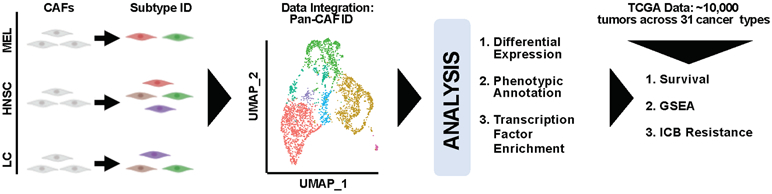
We performed integrated analysis of CAFs from melanoma, head and neck squamous cell carcinoma, and lung cancer, and identified the molecular characteristics that are distinctly active in each CAF subtype. Gene signatures for individual CAF subtypes were identified and used to study the association of subtype abundance with clinical outcome and immunotherapy resistance.
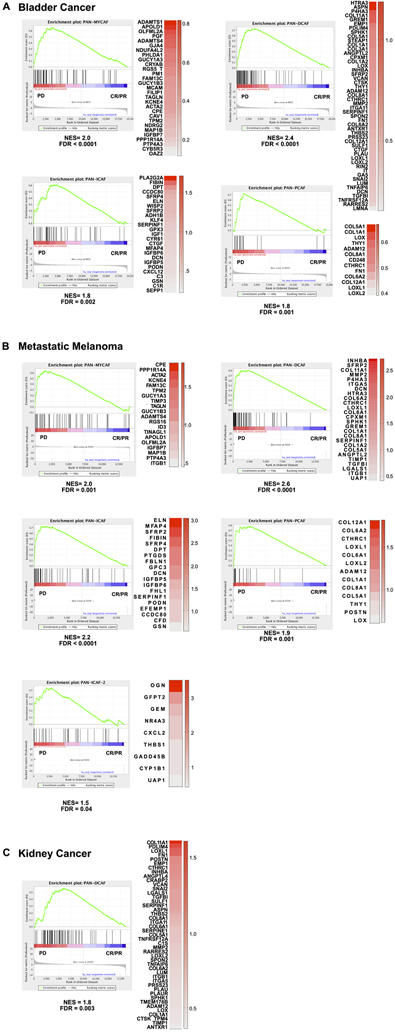
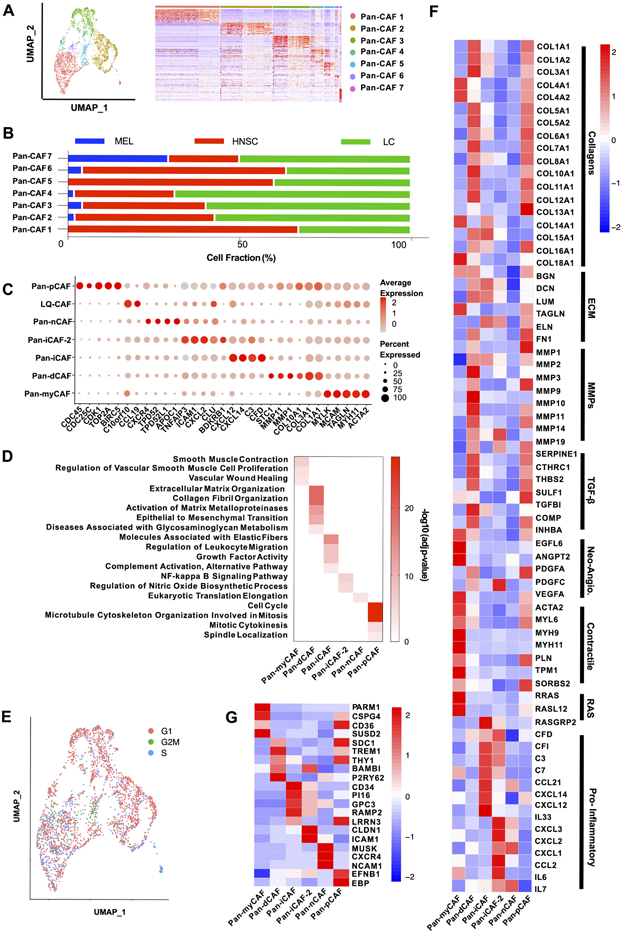
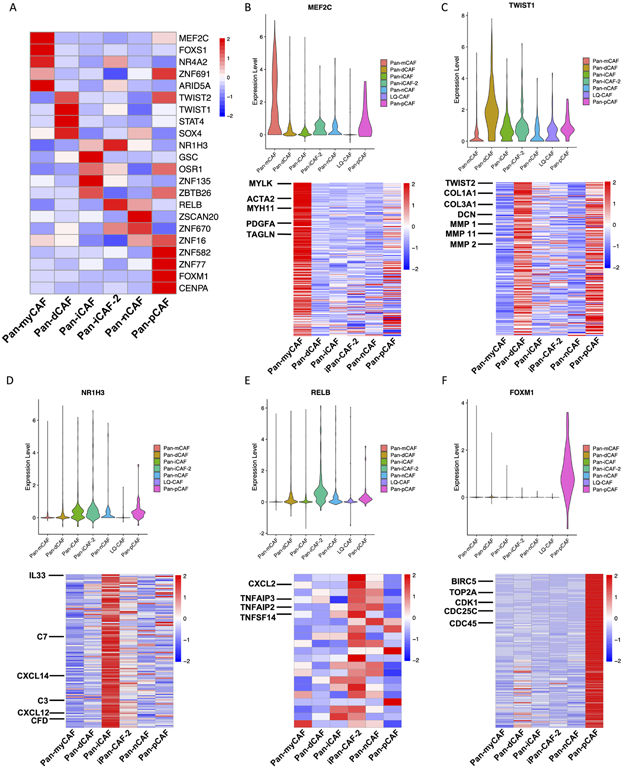
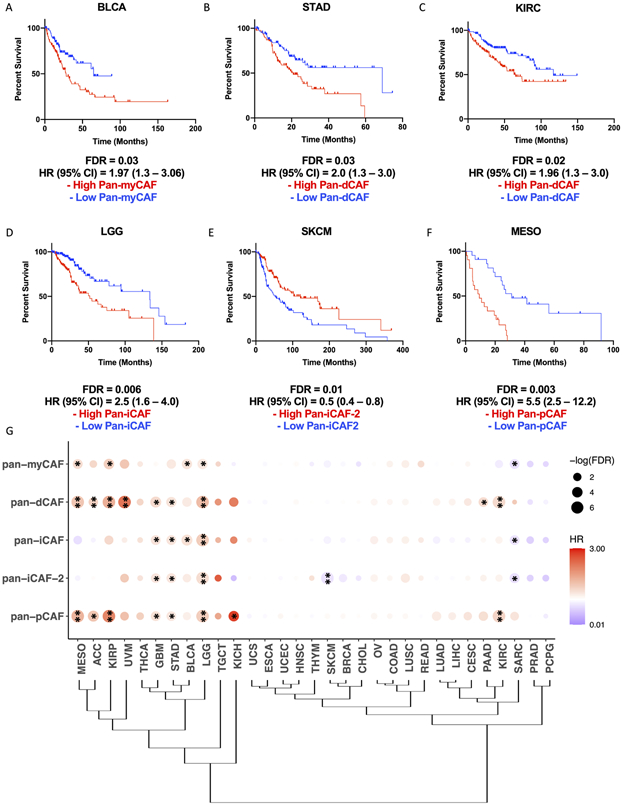
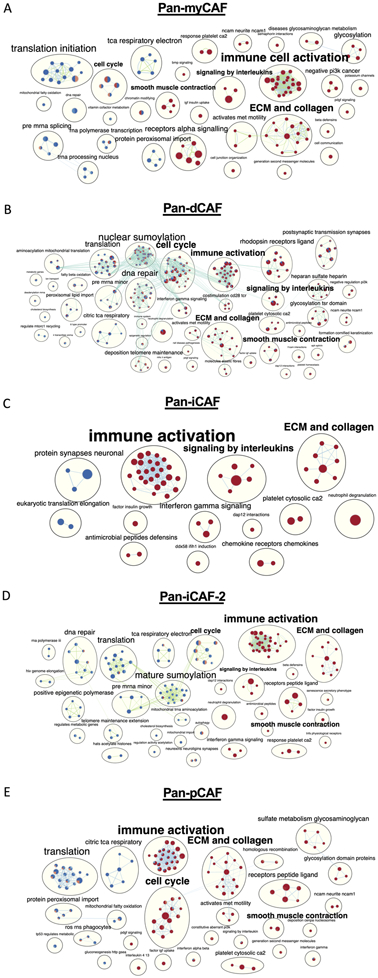
We identified six CAF subtypes (pan-CAF) shared across cancer types and uncovered the molecular characteristics and genetic pathways distinguishing them. Interestingly, these CAF subtypes express distinct immunosuppressive factors, such as CXCL12 and CXLC14, and stem cell-promoting factor IL6. In addition, we identified novel transcriptional drivers (MEF2C, TWIST1, NR1H3, RELB, and FOXM1) key to CAF heterogeneity. Furthermore, we showed that CAF subtypes were associated with different clinical outcomes and uncovered key molecular pathways that could activate or suppress cancer progression or were involved in resistance to anti-PD1 or anti-PD-L1 immunotherapy.
Our study identifies the molecular characteristics of CAF subtypes shared across several cancer types, implicates cancer types that may benefit from CAF subtype targeted therapies, and identifies specific CAF subtypes associated with immunotherapy resistance.
癌症相关成纤维细胞(CAF)是肿瘤微环境的重要组成部分,但对其分子特征和临床相关性的系统研究仍有所欠缺。在此,我们试图对多种癌症类型中的 CAF 进行比较,以鉴定在 CAF 亚群中被激活的关键分子通路,这些通路可能有助于临床结局、疾病进展和免疫治疗耐药性。
我们对黑色素瘤、头颈部鳞状细胞癌和肺癌中的 CAF 进行了综合分析,鉴定了在每个 CAF 亚群中明显活跃的分子特征。确定了各个 CAF 亚群的基因特征,并用于研究亚群丰度与临床结局和免疫治疗耐药性的关联。
我们鉴定了六种在癌症类型间共享的 CAF 亚群(泛 CAF),并揭示了区分它们的分子特征和遗传途径。有趣的是,这些 CAF 亚群表达不同的免疫抑制因子,如 CXCL12 和 CXLC14,以及促进干细胞的因子 IL6。此外,我们鉴定了新型转录驱动因子(MEF2C、TWIST1、NR1H3、RELB 和 FOXM1),这些因子对 CAF 异质性至关重要。此外,我们表明 CAF 亚群与不同的临床结局相关,并揭示了可能激活或抑制癌症进展的关键分子途径,或参与抗 PD1 或抗 PD-L1 免疫治疗耐药性的途径。
我们的研究鉴定了几种癌症类型中共享的 CAF 亚群的分子特征,提示了可能受益于 CAF 亚群靶向治疗的癌症类型,并鉴定了与免疫治疗耐药性相关的特定 CAF 亚群。