Ayano Getinet, Belete Asmare, Duko Bereket, Tsegay Light, Dachew Berihun Assefa
Ethiopia Ministry of Health, Addis Ababa, Ethiopia
Department of Public Health, Curtin University, Perth, Western Australia, Australia.
BMJ Open. 2021 Feb 23;11(2):e040061. doi: 10.1136/bmjopen-2020-040061.
To assess the global prevalence estimates of depressive symptoms, dysthymia and major depressive disorders (MDDs) among homeless people.
Systematic review and meta-analysis.
Databases including PubMed, Scopus and Web of Science were systematically searched up to February 2020 to identify relevant studies that have reported data on the prevalence of depressive symptoms, dysthymia and MDDs among homeless people.
Original epidemiological studies written in English that addressed the prevalence of depressive problems among homeless people.
A random-effect meta-analysis was performed to pool the prevalence estimated from individual studies. Subgroup and sensitivity analyses were employed to compare the prevalence across the groups as well as to identify the source of heterogeneities. The Joanna Briggs Institute's quality assessment checklist was used to measure the study quality. Cochran's Q and the I test were used to assess heterogeneity between the studies.
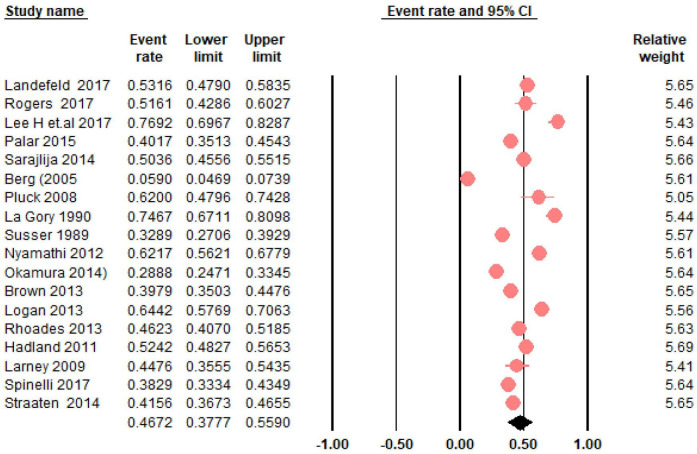
Forty publications, including 17 215 participants, were included in the final analysis. This meta-analysis demonstrated considerably higher prevalence rates of depressive symptoms 46.72% (95% CI 37.77% to 55.90%), dysthymia 8.25% (95% CI 4.79% to 11.86%), as well as MDDs 26.24% (95% CI 21.02% to 32.22%) among homeless people. Our subgroup analysis showed that the prevalence of depressive symptoms was high among younger homeless people (<25 years of age), whereas the prevalence of MDD was high among older homeless people (>50 years of age) when compared with adults (25-50 years).
This review showed that nearly half, one-fourth and one-tenth of homeless people are suffering from depressive symptoms, dysthymia and MDDs, respectively, which are notably higher than the reported prevalence rates in the general population. The findings suggest the need for appropriate mental health prevention and treatment strategies for this population group.
评估无家可归者中抑郁症状、心境恶劣和重度抑郁症(MDD)的全球患病率估计值。
系统评价和荟萃分析。
对包括PubMed、Scopus和Web of Science在内的数据库进行系统检索,直至2020年2月,以识别报告了无家可归者抑郁症状、心境恶劣和MDD患病率数据的相关研究。
用英文撰写的关于无家可归者抑郁问题患病率的原始流行病学研究。
进行随机效应荟萃分析,汇总各独立研究估计的患病率。采用亚组分析和敏感性分析来比较各组的患病率,并识别异质性来源。使用乔安娜·布里格斯研究所的质量评估清单来衡量研究质量。采用Cochran's Q检验和I²检验评估研究之间的异质性。
最终分析纳入了40篇出版物,包括17215名参与者。该荟萃分析表明,无家可归者中抑郁症状的患病率相当高,为46.72%(95%可信区间37.77%至55.90%),心境恶劣为8.25%(95%可信区间4.79%至11.86%),MDD为26.24%(95%可信区间21.02%至32.22%)。我们的亚组分析显示,与成年人(25 - 50岁)相比,年轻无家可归者(<25岁)中抑郁症状的患病率较高,而老年无家可归者(>50岁)中MDD的患病率较高。
本综述表明,分别有近一半、四分之一和十分之一的无家可归者患有抑郁症状、心境恶劣和MDD,这明显高于一般人群报告的患病率。研究结果表明需要为这一人群制定适当的心理健康预防和治疗策略。