Jnaneswar Avinash, Jha Kunal, Barman Diplina, Singh Arpita, Pathak Mona, Kumar Gunjan
Department of Public Health Dentistry, Kalinga Institute of Dental Sciences, KIIT University, BBSR, Odisha, India.
Department of Biostatistics, Kalinga Institute of Medical Sciences, KIIT University, BBSR, Odisha, India.
Indian J Community Med. 2020 Oct-Dec;45(4):534-538. doi: 10.4103/ijcm.IJCM_56_20. Epub 2020 Oct 28.
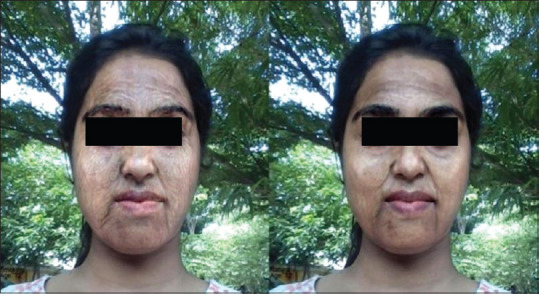
The study objective was to test the effectiveness of a photoaging software (APRILAGE) intervention based on personalized, vivid illustrations of "smoker's face" among smokers aged 18-24 years of age in Bhubaneswar city through a self-structured questionnaire.
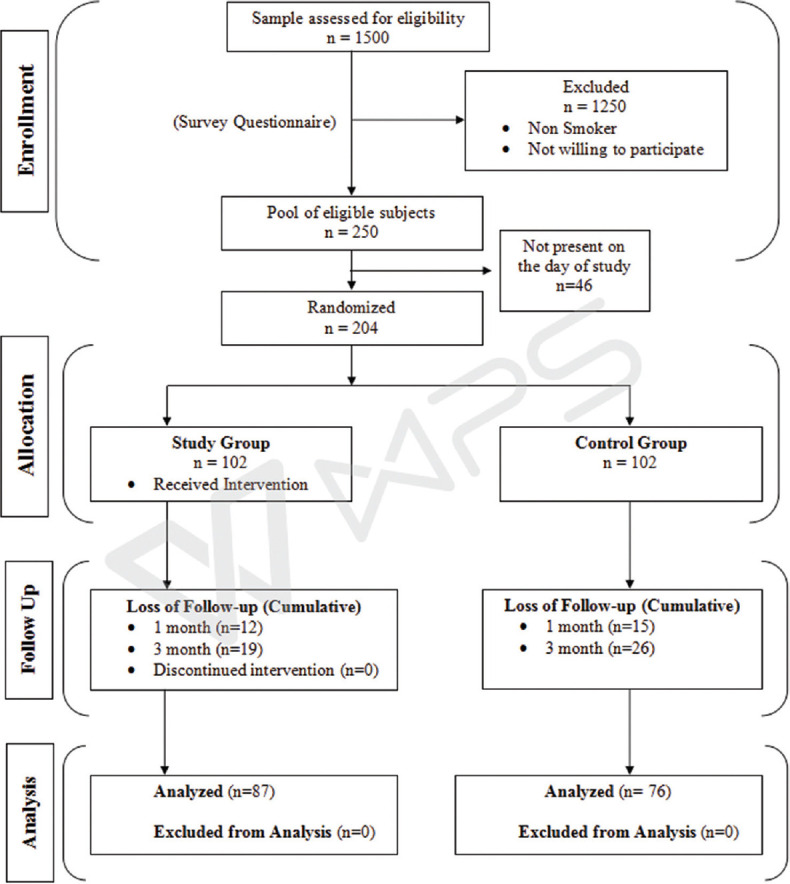
A total of 204 engineering college students were randomized into two groups: intervention and control. A self-structured questionnaire in the form of Google Form was distributed among the participants. The study group participants were photographed using Aprilage Software. Follow-up data were collected using the same questionnaire at 1-month and 3-month intervals. Statistical Analysis was done using STATA 15 software. Descriptive statistics and the relation between the dependent and independent variables were done using the nonparametric tests of significance. The probability value was kept at 0.05.
Significant reduction in nicotine dependency, was seen in 64.36% of the study population ( < 0.0001). There was a shift from severely dependent group to moderately or low dependence group in 33% of the study occupants.
Aging software intervention is contemporary, congenial, and admissible and can be espoused to educate youngsters along with the conventional motivational methods. This method successfully delivers smoking cessation advice to young adults. This novel approach can be implemented in motivating young smokers to quit smoking.
本研究旨在通过一份自行编制的问卷,测试一款光老化软件(APRILAGE)干预措施在布巴内斯瓦尔市18 - 24岁吸烟者中基于“吸烟者面容”个性化生动插图的有效性。
总共204名工科大学生被随机分为两组:干预组和对照组。以谷歌表单形式的自行编制问卷分发给参与者。研究组参与者使用Aprilage软件拍照。在1个月和3个月的间隔时间使用相同问卷收集随访数据。使用STATA 15软件进行统计分析。使用非参数显著性检验进行描述性统计以及分析自变量和因变量之间的关系。概率值设定为0.05。
64.36%的研究人群尼古丁依赖显著降低(<0.0001)。33%的研究对象从严重依赖组转变为中度或低度依赖组。
老化软件干预是现代的、适宜的且可接受的,并且可以与传统的激励方法一起用于教育年轻人。这种方法成功地向年轻人提供了戒烟建议。这种新方法可用于激励年轻吸烟者戒烟。