Boor Peter, Eichhorn Philip, Hartmann Arndt, Lax Sigurd F, Märkl Bruno, Menter Thomas, Skok Kristijan, Slotta-Huspenina Julia, von Stillfried Saskia, Tzankov Alexandar, Weirich Gregor
Institut für Pathologie, Universitätsklinikum Aachen, RTWH Aachen, Aachen, Deutschland.
Institut für Pathologie, Universitätsklinikum Erlangen, Erlangen, Deutschland.
Pathologe. 2021 Mar;42(2):197-207. doi: 10.1007/s00292-021-00925-w. Epub 2021 Feb 24.
The COVID-19 pandemic represents a so far unknown challenge for the medical community. Autopsies are important for studying this disease, but their safety was challenged at the beginning of the pandemic.
To determine whether COVID-19 autopsies can be performed under existing legal conditions and which safety standards are required.
The autopsy procedure undertaken in five institutions in Germany, Austria, and Switzerland is detailed with respect to legal and safety standards.
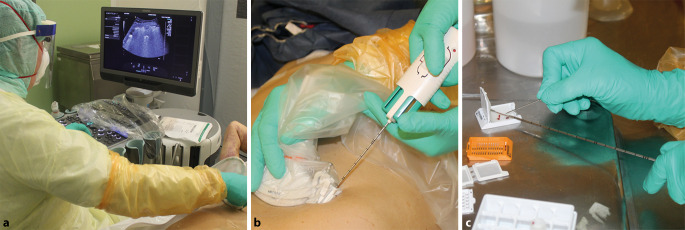
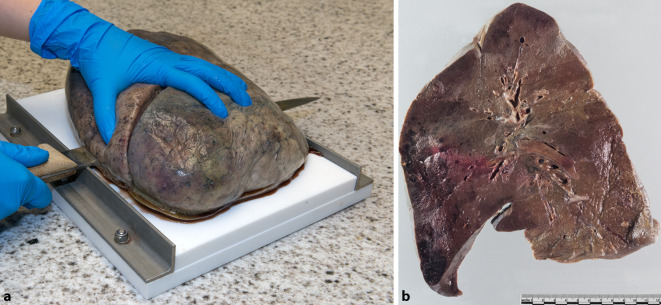
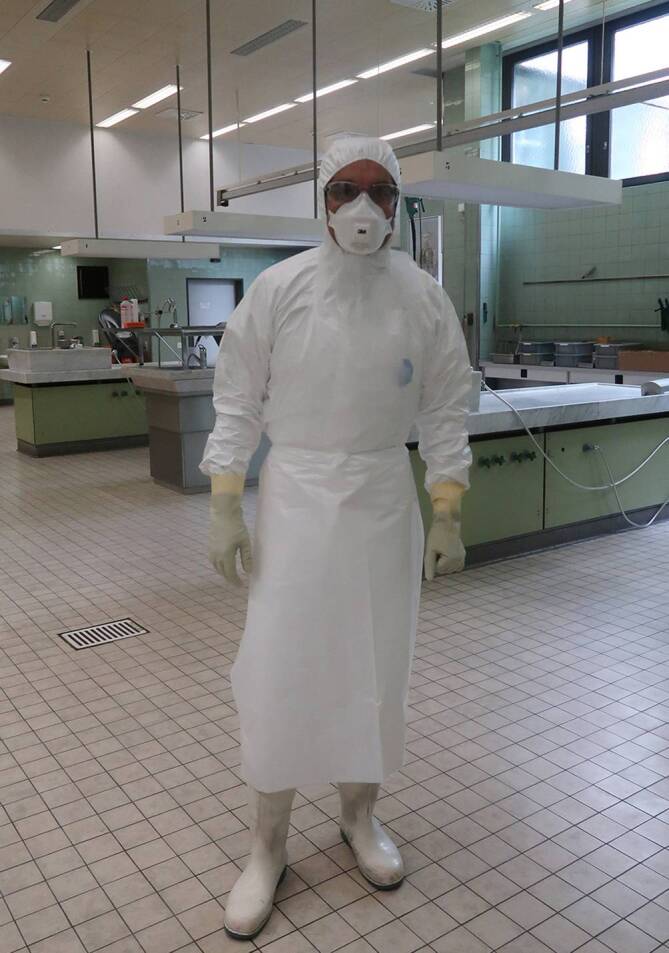
In all institutions the autopsies were performed in technically feasible rooms. The personal equipment consisted of functional clothing including a disposable gown and apron, a surgical cap, eye protection, FFP‑3 masks, and two pairs of gloves. In four institutions, complete autopsies were performed; in one institution the ultrasound-guided biopsy within the postmortal imaging and biopsy program. The latter does not allow the appreciation of gross organ pathology; however, it is able to retrieve standardized biopsies for diagnostic and research purposes. Several scientific articles in highly ranked journals resulted from these autopsies and allowed deep insights into organ damage and conclusions to better understand the pathomechanisms. Viral RNA was frequently detectable in the COVID-19 deceased, but the issue of infectivity remains unresolved and it is questionable if Ct values are greater than 30.
With appropriate safeguards, autopsies of people who have died from COVID-19 can be performed safely and are highly relevant to medical research.
新型冠状病毒肺炎(COVID-19)大流行给医学界带来了迄今为止未知的挑战。尸检对于研究这种疾病很重要,但在大流行初期其安全性受到了挑战。
确定在现有法律条件下是否可以进行COVID-19尸检以及需要哪些安全标准。
详细介绍了德国、奥地利和瑞士五个机构所采用的尸检程序的法律和安全标准。
在所有机构中,尸检均在技术上可行的房间内进行。个人防护装备包括功能性服装,其中有一次性长袍和围裙、手术帽、眼部防护用品、FFP-3口罩以及两副手套。在四个机构中进行了完整的尸检;在一个机构中,在死后成像和活检程序中进行了超声引导下活检。后者无法观察到大体器官病理学情况;然而,它能够获取标准化活检样本用于诊断和研究目的。这些尸检产生了几篇发表在高影响力期刊上的科学文章,使人们能够深入了解器官损伤情况,并得出结论以更好地理解发病机制。在COVID-19死者中经常可检测到病毒RNA,但传染性问题仍未解决,并且当Ct值大于30时是否具有传染性也存在疑问。
通过适当的保障措施,可以安全地对死于COVID-19的人进行尸检,并且这对医学研究具有高度相关性。