Department of Nephropathology, University Clinic Erlangen, Krankenhausstr. 8-10, 91054, Erlangen, Germany.
Institute of Pathology and Department of Nephrology, Section Translational Nephropathology, University Clinic of the RWTH Aachen, Aachen, Germany.
Pathologe. 2021 Nov;42(Suppl 1):76-80. doi: 10.1007/s00292-020-00900-x. Epub 2021 Mar 1.
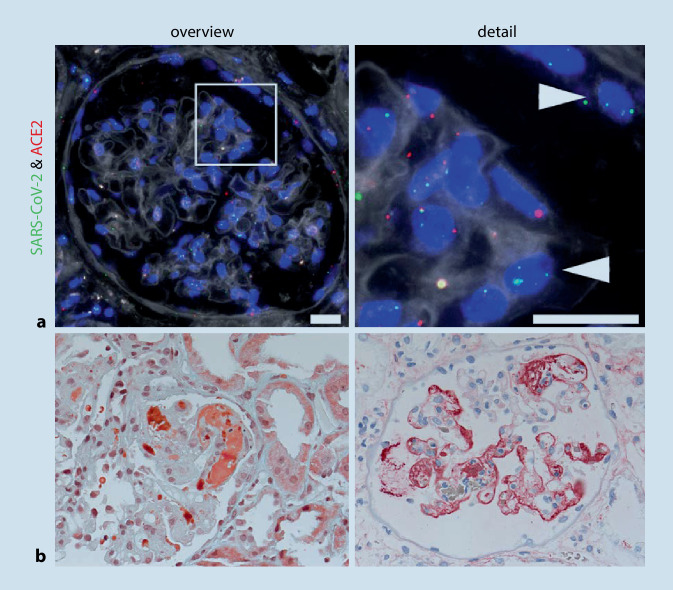
Apart from pulmonary disease, acute kidney injury (AKI) is one of the most frequent and most severe organ complications in severe coronavirus disease 2019 (COVID-19). The SARS-CoV‑2 virus has been detected in renal tissue. Patients with chronic kidney disease (CKD) before and on dialysis and specifically renal transplant patients represent a particularly vulnerable population. The increasing number of COVID-19 infected patients with renal involvement led to an evolving interest in the analysis of its pathophysiology, morphology and modes of virus detection in the kidney. Meanwhile, there are ample data from several autopsy and kidney biopsy studies that differ in the quantity of cases as well as in their quality. While the detection of SARS-CoV‑2 RNA in the kidney leads to reproducible results, the use of electron microscopy for visualisation of the virus is difficult and currently critically discussed due to various artefacts. The exact contribution of indirect or direct effects on the kidney in COVID-19 are not yet known and are currently the focus of intensive research.
除肺部疾病外,急性肾损伤(AKI)也是严重 2019 冠状病毒病(COVID-19)中最常见和最严重的器官并发症之一。肾脏组织中已检测到 SARS-CoV-2 病毒。有慢性肾脏病(CKD)病史、正在透析以及肾移植患者是特别脆弱的人群。越来越多 COVID-19 感染合并肾脏受累的患者,促使人们对其病理生理学、形态学以及肾脏中病毒检测模式进行了分析。同时,还有来自多个尸检和肾活检研究的大量数据,这些研究在病例数量和质量上存在差异。虽然肾脏中 SARS-CoV-2 RNA 的检测可得出可重复的结果,但使用电子显微镜观察病毒却较为困难,目前由于各种假象的存在,该方法受到了严格的讨论。COVID-19 中对肾脏的间接或直接影响的确切贡献尚不清楚,目前是密集研究的重点。