
偏头痛治疗药物对 CGRP 通路具有差异化调节作用。
Migraine therapeutics differentially modulate the CGRP pathway.
机构信息
Teva Biologics, Redwood City, CA, USA.
出版信息
Cephalalgia. 2021 Apr;41(5):499-514. doi: 10.1177/0333102420983282. Epub 2021 Feb 24.
BACKGROUND
The clinical efficacy of migraine therapeutic agents directed towards the calcitonin-gene related peptide (CGRP) pathway has confirmed the key role of this axis in migraine pathogenesis. Three antibodies against CGRP - fremanezumab, galcanezumab and eptinezumab - and one antibody against the CGRP receptor, erenumab, are clinically approved therapeutics for the prevention of migraine. In addition, two small molecule CGRP receptor antagonists, ubrogepant and rimegepant, are approved for acute migraine treatment. Targeting either the CGRP ligand or receptor is efficacious for migraine treatment; however, a comparison of the mechanism of action of these therapeutic agents is lacking in the literature.
METHODS
To gain insights into the potential differences between these CGRP pathway therapeutics, we compared the effect of a CGRP ligand antibody (fremanezumab), a CGRP receptor antibody (erenumab) and a CGRP receptor small molecule antagonist (telcagepant) using a combination of binding, functional and imaging assays.
RESULTS
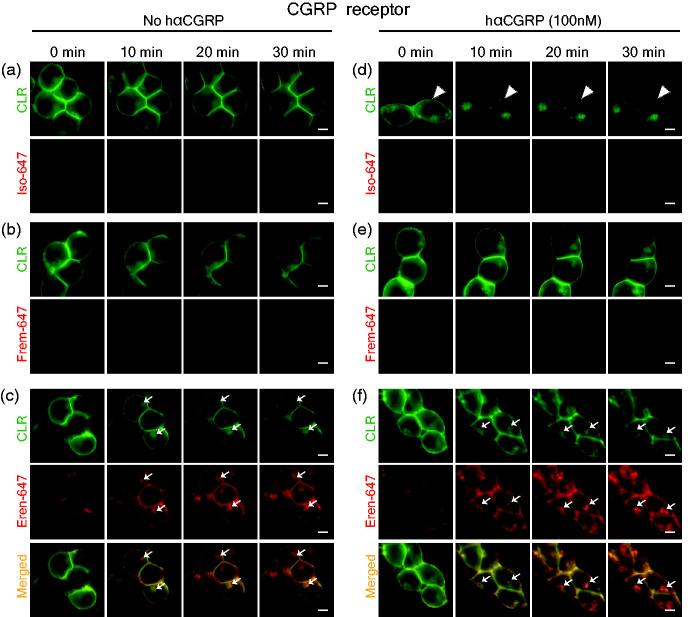
Erenumab and telcagepant antagonized CGRP, adrenomedullin and intermedin cAMP signaling at the canonical human CGRP receptor. In contrast, fremanezumab only antagonized CGRP-induced cAMP signaling at the human CGRP receptor. In addition, erenumab, but not fremanezumab, bound and internalized at the canonical human CGRP receptor. Interestingly, erenumab also bound and internalized at the human AMY receptor, a CGRP receptor family member. Both erenumab and telcagepant antagonized amylin-induced cAMP signaling at the AMY receptor while fremanezumab did not affect amylin responses.
CONCLUSION
The therapeutic effect of agents targeting the CGRP ligand versus receptor for migraine prevention (antibodies) or acute treatment (gepants) may involve distinct mechanisms of action. These findings suggest that differing mechanisms could affect efficacy, safety, and/or tolerability in migraine patients.
背景
靶向降钙素基因相关肽(CGRP)通路的偏头痛治疗药物的临床疗效证实了该轴在偏头痛发病机制中的关键作用。三种针对 CGRP 的抗体——依那西普单抗、加兰他敏和依替替单抗——和一种针对 CGRP 受体的抗体——埃普替单抗,均已被批准用于偏头痛的预防治疗。此外,两种小分子 CGRP 受体拮抗剂——ubrogepant 和 rimegepant,已被批准用于急性偏头痛治疗。靶向 CGRP 配体或受体均对偏头痛治疗有效;然而,文献中缺乏对这些治疗药物作用机制的比较。
方法
为了深入了解这些 CGRP 通路治疗药物之间的潜在差异,我们使用结合、功能和成像测定法比较了一种 CGRP 配体抗体(依那西普单抗)、一种 CGRP 受体抗体(埃普替单抗)和一种 CGRP 受体小分子拮抗剂(telcagepant)的作用。
结果
埃普替单抗和 telcagepant 拮抗了人 CGRP 受体的 CGRP、肾上腺髓质素和中间素 cAMP 信号传导。相比之下,依那西普单抗仅拮抗人 CGRP 受体的 CGRP 诱导的 cAMP 信号传导。此外,埃普替单抗结合并内化到了人 CGRP 受体,而依那西普单抗则没有。有趣的是,埃普替单抗还结合并内化到了人 AMY 受体(CGRP 受体家族成员)。埃普替单抗和 telcagepant 均拮抗 AMY 受体的淀粉样蛋白诱导的 cAMP 信号传导,而依那西普单抗则不影响淀粉样蛋白的反应。
结论
针对偏头痛预防(抗体)或急性治疗(gepants)的靶向 CGRP 配体与受体的治疗药物的治疗效果可能涉及不同的作用机制。这些发现表明,不同的机制可能会影响偏头痛患者的疗效、安全性和/或耐受性。




 Zotero 插件