van Veelen Nancy, van der Arend Britt W H, Hiele E, van Zwet E W, Terwindt Gisela M
Department of Neurology, Leiden University Medical Centre, Leiden, The Netherlands.
Department of Internal Medicine, Erasmus MC, Rotterdam, The Netherlands.
Eur J Neurol. 2025 Jan;32(1):e16542. doi: 10.1111/ene.16542. Epub 2024 Nov 28.
Limited options exist for migraine prevention after stopping anti-calcitonin gene-related peptide monoclonal antibodies. A systematic review examining the benefits of switching between different classes (ligand vs. receptor monoclonal antibody) is essential, alongside well-designed real-world studies.
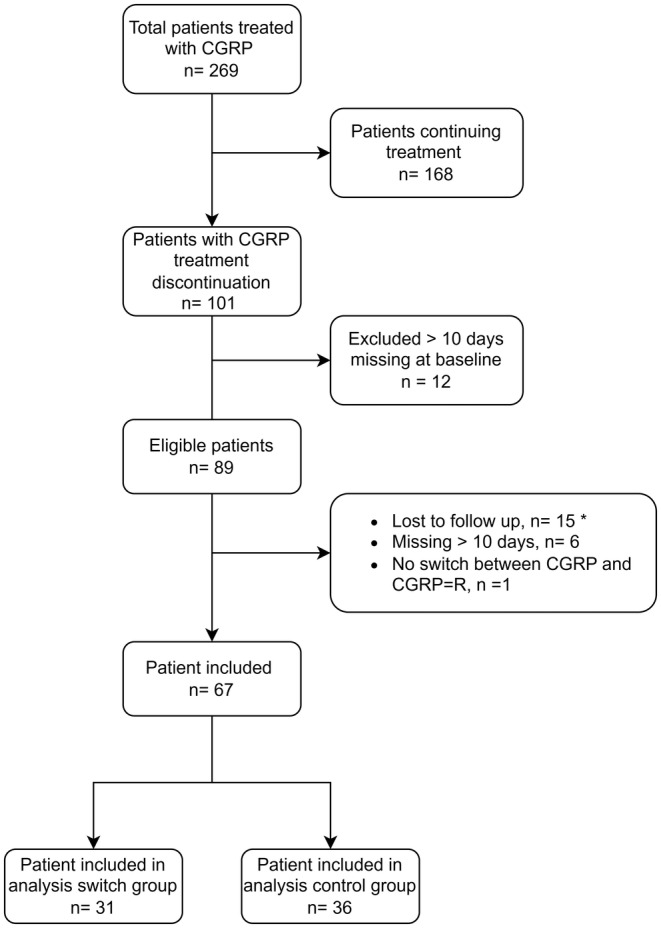
In this cohort study 67 patients were included, who discontinued their first treatment with erenumab or fremanezumab. Patients (n = 31) switched to another monoclonal antibody class within 3 months, whilst those in the control group (n = 36) received standard care. Allocation to either group relied largely on the availability of alternative monoclonal antibody treatments, introducing pseudo-random allocation. Changes in monthly migraine days were compared between groups 3 months post-discontinuation of the first monoclonal antibody or initiation of a different monoclonal antibody class. A multivariate regression model was conducted that accounted for potential confounding factors.
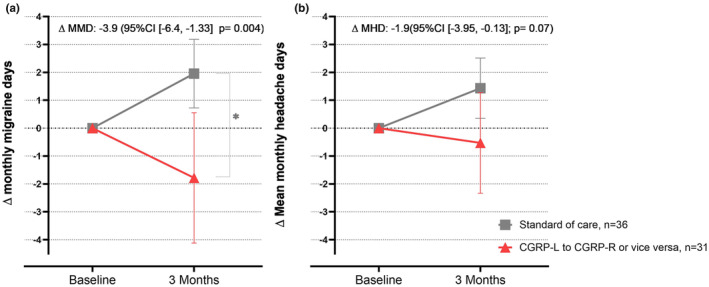
The groups were comparable at baseline and poor treatment response was the main reason for treatment discontinuation of the first monoclonal antibody. The switching cohort experienced a reduction of 3.9 monthly migraine days (95% confidence interval -6.4, -1.3, p = 0.004) compared with the control group.
Transitioning to a different anti-calcitonin gene-related peptide monoclonal class yields reduction in monthly migraine days compared to returning to standard care for patients with inadequate initial treatment response.
停用抗降钙素基因相关肽单克隆抗体后,偏头痛预防的选择有限。除精心设计的真实世界研究外,系统评价不同类别(配体与受体单克隆抗体)之间转换的益处至关重要。
在这项队列研究中,纳入了67例停用依瑞奈单抗或夫雷尼单抗首次治疗的患者。31例患者在3个月内转换为另一类单克隆抗体,而对照组(36例)接受标准治疗。两组的分配很大程度上取决于替代单克隆抗体治疗的可用性,引入了伪随机分配。在停用第一种单克隆抗体3个月后或开始使用不同类单克隆抗体时,比较两组每月偏头痛天数的变化。进行了多变量回归模型以考虑潜在的混杂因素。
两组在基线时具有可比性,治疗反应不佳是停用第一种单克隆抗体的主要原因。与对照组相比,转换组每月偏头痛天数减少了3.9天(95%置信区间-6.4,-1.3,p = 0.004)。
对于初始治疗反应不足的患者,与恢复标准治疗相比,转换为不同的抗降钙素基因相关肽单克隆抗体类别可减少每月偏头痛天数。