Department of Organismic and Evolutionary Biology, Harvard University, Cambridge, MA, 02138, USA.
Department of Integrative Biology, University of Windsor, Windsor, ON, N9B 3P4, Canada.
Sci Rep. 2021 Feb 24;11(1):4466. doi: 10.1038/s41598-021-83880-z.
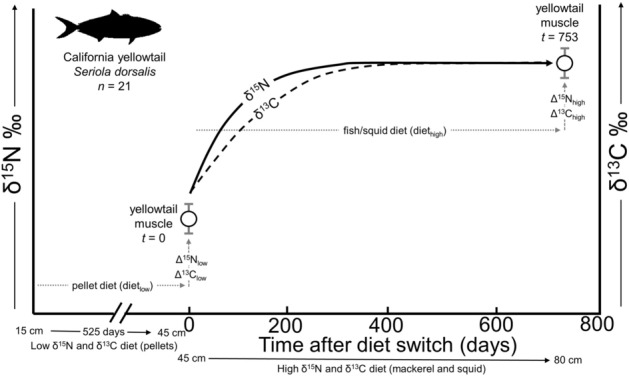
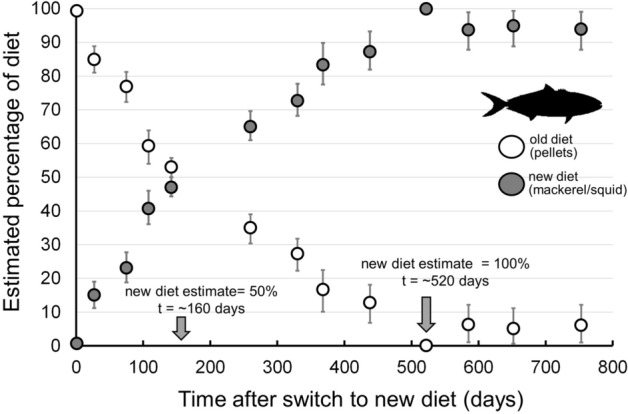
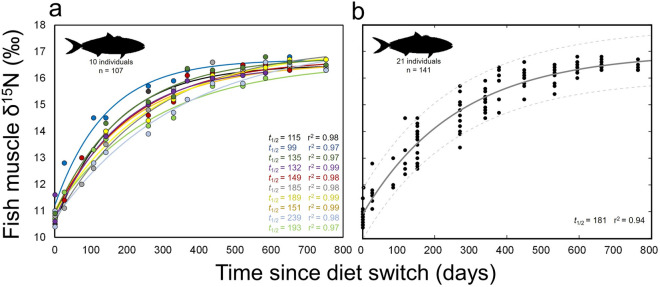
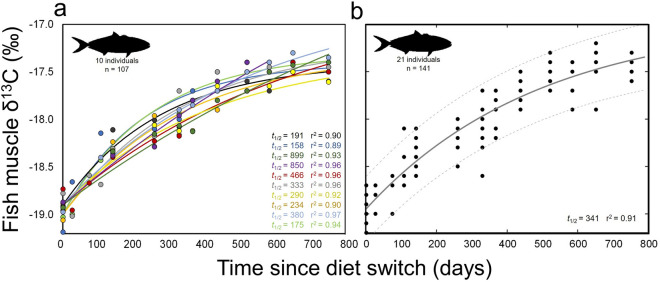
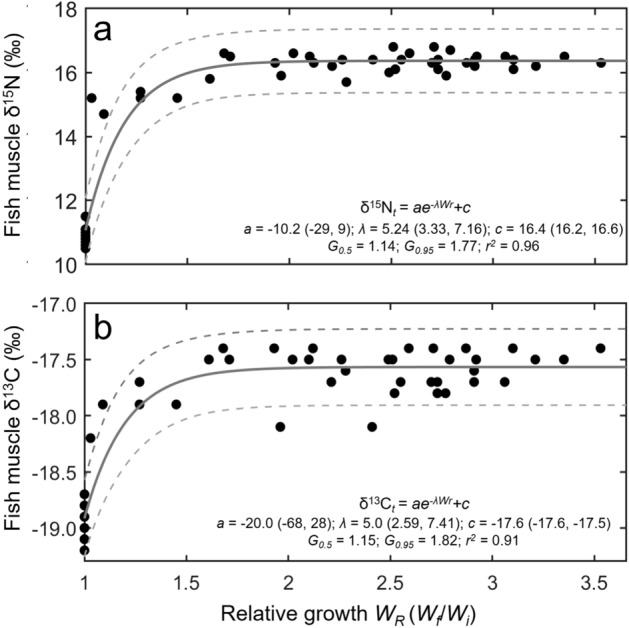
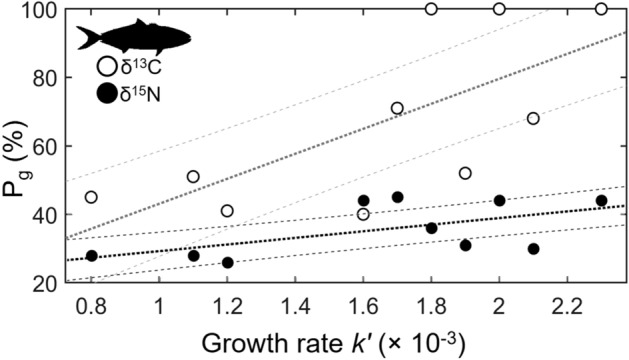
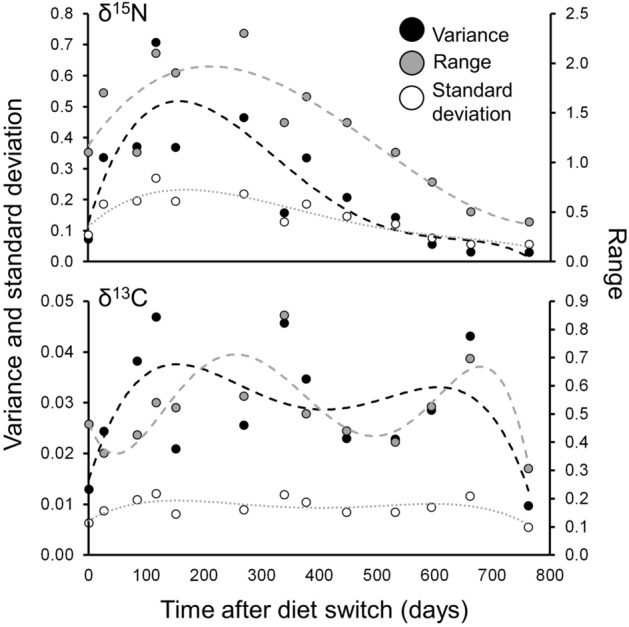
Stable isotope analysis (SIA) measurements from long-term captivity studies provide required parameters for interpretation of consumer SIA data. We raised young-of-the-year (14-19 cm) California yellowtail (Seriola dorsalis) on a low δN and δC diet (pellet aquaculture feed) for 525 days, then switched to a high δN and δC diet (mackerel and squid) for 753 days. Yellowtail muscle was sequentially sampled from each individual after the diet switch (0 to 753 days) and analyzed for δN and δC, allowing for calculation of diet-tissue discrimination factors (DTDFs) from two isotopically different diets (low δN and δC: pellets; high δN and δC: fish/squid) and turnover rates of N and C. DTDFs were diet dependent: ΔN = 5.1‰, ΔC = 3.6‰ for pellets and ΔN = 2.6‰, ΔC = 1.3‰ for fish/squid. Half-life estimates from N and C turnover rates for pooled yellowtail were 181 days and 341 days, respectively, but varied considerably by individual (N: 99-239 d; C: 158-899 d). Quantifying DTDFs supports isotopic approaches to field data that assume isotopic steady-state conditions (e.g., mixing models for diet reconstruction). Characterizing and quantifying turnover rates allow for estimates of diet/habitat shifts and "isotopic clock" approaches, and observed inter-individual variability suggests the need for large datasets in field studies. We provide diet-dependent DTDFs and growth effects on turnover rates, and associated error around these parameters, for application to field-collected SIA data from other large teleosts.
稳定同位素分析(SIA)测量来自长期圈养研究,为解释消费者 SIA 数据提供必需的参数。我们用低氮和低碳饮食(颗粒水产养殖饲料)饲养幼鱼(14-19 厘米)加州黄尾(Seriola dorsalis)525 天,然后切换到高氮和高碳饮食(鲭鱼和鱿鱼)753 天。在饮食切换后(0 至 753 天),从每个个体中连续采集黄尾肌肉样本并进行氮和碳同位素分析,允许从两种不同的同位素饮食(低氮和低碳:颗粒;高氮和高碳:鱼/鱿鱼)计算饮食组织辨别因子(DTDFs)和氮和碳的周转率。DTDFs 取决于饮食:颗粒的 ΔN=5.1‰,ΔC=3.6‰,而鱼/鱿鱼的 ΔN=2.6‰,ΔC=1.3‰。氮和碳周转率的半衰期估计值分别为 181 天和 341 天,但个体差异很大(N:99-239d;C:158-899d)。量化 DTDFs 支持假设同位素稳态条件(例如,饮食重建的混合模型)的野外数据的同位素方法。特征和量化周转率允许对饮食/栖息地变化和“同位素时钟”方法进行估计,并且观察到的个体间变异性表明需要在野外研究中使用大型数据集。我们提供了适用于从其他大型硬骨鱼收集的野外 SIA 数据的依赖于饮食的 DTDFs 和对周转率的生长影响,以及这些参数的相关误差。