Zhang Hengli, Tang Yizhen, Yan Xiaowei, Ma Lihua, Geng Yulei, Li Fan, Tang Guangxian
Department of Ophthalmology, Shijiazhuang People's Hospital, Shijiazhuang, Hebei 050000, China.
Department of Ophthalmology and Visual Science, Eye Institute, Eye & ENT Hospital, Shanghai Medical College, Fudan University, Shanghai 200031, China.
J Ophthalmol. 2021 Feb 10;2021:6639583. doi: 10.1155/2021/6639583. eCollection 2021.
To compare the effectiveness and safety of carbon dioxide (CO) laser-assisted deep sclerectomy surgery (CLASS) and trabeculectomy (Trab) for treatment of primary open-angle glaucoma (POAG).
In this retrospective and comparative study, 77 eyes of 62 patients with POAG were studied and divided into the CLASS and Trab groups. The best-corrected visual acuity (BCVA), intraocular pressure (IOP), number of medications, surgical success rate, and complications were analyzed.
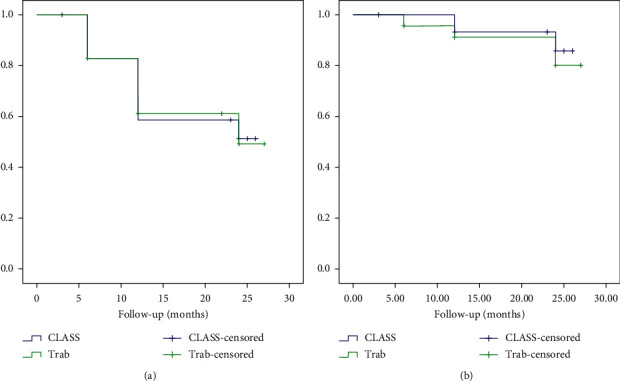
The mean follow-up periods were 27.89 ± 2.94 months and 26.11 ± 2.06 months in the CLASS and Trab groups, respectively. 30 eyes (24 patients) underwent CLASS and 47 eyes (38 patients) underwent Trab. The BCVA in the CLASS and Trab groups was recovered to baseline at postoperative 1 week and 1 month, respectively. At last follow-up visits, a remarkable reduction in the IOP and number of medications was observed in both groups, and no significant difference was found in those between the two groups. The complete success rates were 51.7% and 47.7% in postoperative 24 months in the CLASS and Trab groups, respectively ( > 0.05). There were higher rates of delayed anterior chamber formation (21.3%) and thin-wall filtrating blebs (10.6%) in the Trab group. Meanwhile, the peripheral anterior synechiae were only observed in the CLASS group, and the ratio was 30%.
CLASS is an effective and safe treatment modality for POAG, with fewer filtering bleb-related complications and quicker visual recovery in the early postoperative stage than trabeculectomy. The efficacy of lowering intraocular pressure was similar for both procedures.
比较二氧化碳(CO)激光辅助深层巩膜切除术(CLASS)和小梁切除术(Trab)治疗原发性开角型青光眼(POAG)的有效性和安全性。
在这项回顾性比较研究中,对62例POAG患者的77只眼进行研究,并分为CLASS组和Trab组。分析最佳矫正视力(BCVA)、眼压(IOP)、用药数量、手术成功率和并发症。
CLASS组和Trab组的平均随访期分别为27.89±2.94个月和26.11±2.06个月。30只眼(24例患者)接受了CLASS手术,47只眼(38例患者)接受了Trab手术。CLASS组和Trab组的BCVA分别在术后1周和1个月恢复至基线水平。在最后一次随访时,两组的IOP和用药数量均显著降低,两组之间无显著差异。CLASS组和Trab组术后24个月的完全成功率分别为51.7%和47.7%(>0.05)。Trab组延迟前房形成(21.3%)和薄壁滤过泡(10.6%)的发生率较高。同时,仅在CLASS组观察到周边前粘连,比例为30%。
CLASS是一种治疗POAG的有效且安全的方法,与小梁切除术相比,滤过泡相关并发症较少,术后早期视力恢复更快。两种手术降低眼压的疗效相似。