Department of Public Health, Faculty of Medicine, University of Szeged, Szeged, Hungary.
Department of Ophthalmology, Szent-Györgyi Albert Clinical Center, Faculty of Medicine, University of Szeged, Szeged, Hungary.
J Diabetes Res. 2021 Feb 5;2021:6646645. doi: 10.1155/2021/6646645. eCollection 2021.
Diabetic retinopathy (DR) is the leading cause of vision loss among active adults in industrialized countries. We aimed to investigate the prevalence of diabetes mellitus (DM), DR and its different grades, in patients with DM in the Csongrád County, South-Eastern region, Hungary. Furthermore, we aimed to detect the risk factors for developing DR and the diabetology/ophthalmology screening patterns and frequencies, as well as the effect of socioeconomic status- (SES-) related factors on the health and behavior of DM patients.
A cross-sectional study was conducted on adults (>18 years) involving handheld fundus camera screening (Smartscope Pro Optomed, Finland) and image assessment using the Spectra DR software (Health Intelligence, England). Self-completed questionnaires on self-perceived health status (SPHS) and health behavior, as well as visual acuity, HbA1c level, type of DM, and attendance at healthcare services were also recorded.
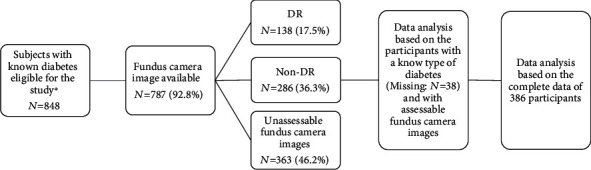
787 participants with fundus camera images and full self-administered questionnaires were included in the study; 46.2% of the images were unassessable. T1D and T2D were present in 13.5% and 86.5% of the participants, respectively. Among the T1D and T2D patients, 25.0% and 33.5% had DR, respectively. The SES showed significant proportion differences in the T1D group. Lower education was associated with a lower DR rate compared to non-DR (7.7% vs. 40.5%), while bad/very bad perceived financial status was associated with significantly higher DR proportion compared to non-DR (63.6% vs. 22.2%). Neither the SPHS nor the health behavior showed a significant relationship with the disease for both DM groups. Mild nonproliferative retinopathy without maculopathy (R1M0) was detected in 6% and 23% of the T1D and T2D patients having DR, respectively; R1 with maculopathy (R1M1) was present in 82% and 66% of the T1D and T2D groups, respectively. Both moderate nonproliferative retinopathy with maculopathy (R2M1) and active proliferative retinopathy with maculopathy (R3M1) were detected in 6% and 7% of the T1D and T2D patients having DR, respectively. The level of HbA1c affected the attendance at the diabetology screening (HbA1c > 7% associated with >50% of all quarter-yearly attendance in DM patients, and with 10% of the diabetology screening nonattendance).
The prevalence of DM and DR in the studied population in Hungary followed the country trend, with a slightly higher sight-threatening DR than the previously reported national average. SES appears to affect the DR rate, in particular, for T1D. Although DR screening using handheld cameras seems to be simple and dynamic, much training and experience, as well as overcoming the issue of decreased optic clarity is needed to achieve a proper level of image assessability, and in particular, for use in future telemedicine or artificial intelligence screening programs.
糖尿病视网膜病变(DR)是工业化国家活跃成年人视力丧失的主要原因。我们旨在调查匈牙利东南部绍罗格县糖尿病患者中糖尿病(DM)、DR 及其不同程度的患病率。此外,我们旨在检测发生 DR 的危险因素以及糖尿病/眼科筛查模式和频率,以及社会经济地位(SES)相关因素对 DM 患者健康和行为的影响。
对成年人(>18 岁)进行横断面研究,包括手持式眼底相机筛查(芬兰 Smartscope Pro Optomed)和使用 Spectra DR 软件(英格兰 Health Intelligence)进行图像评估。还记录了自我感知健康状况(SPHS)和健康行为以及视力、HbA1c 水平、DM 类型以及医疗保健服务就诊情况的自我完成的问卷。
共有 787 名参与者进行了眼底相机图像和完整的自我管理问卷检查,其中 46.2%的图像无法评估。13.5%的参与者患有 1 型糖尿病(T1D),86.5%的参与者患有 2 型糖尿病(T2D)。在 T1D 和 T2D 患者中,分别有 25.0%和 33.5%患有 DR。SES 在 T1D 组中表现出显著的比例差异。与非 DR 相比,受教育程度较低与较低的 DR 发生率相关(7.7%对 40.5%),而较差/非常差的财务状况感知与非 DR 相比,DR 比例显著更高(63.6%对 22.2%)。无论 DM 组如何,SPHS 或健康行为均与疾病无显著关系。在患有 DR 的 T1D 和 T2D 患者中,分别有 6%和 23%检测到轻度非增生性视网膜病变且无黄斑病变(R1M0);分别有 82%和 66%的 T1D 和 T2D 组患者存在 R1 伴黄斑病变(R1M1)。在患有 DR 的 T1D 和 T2D 患者中,分别有 6%和 7%检测到中度非增生性伴黄斑病变(R2M1)和活动性增生性伴黄斑病变(R3M1)。HbA1c 水平影响糖尿病筛查的就诊情况(HbA1c > 7%与 DM 患者所有季度就诊的 50%以上相关,与 10%的糖尿病筛查失访相关)。
匈牙利研究人群中的 DM 和 DR 患病率与该国趋势一致,视力威胁性 DR 略高于先前报告的全国平均水平。SES 似乎会影响 DR 发生率,特别是对 T1D 而言。虽然使用手持式相机进行 DR 筛查似乎简单且具有动态性,但需要大量的培训和经验,以及克服视力清晰度下降的问题,以达到适当的图像评估水平,特别是在未来的远程医疗或人工智能筛查计划中。