Department of Plant Ecology and Ecosystems Research, Albrecht Von Haller Institute for Plant Sciences, Georg August University of Goettingen, Göttingen, Germany.
Institute of Soil Science, Center for Earth System Research and Sustainability (CEN), University of Hamburg, Hamburg, Germany.
Oecologia. 2021 Mar;195(3):797-812. doi: 10.1007/s00442-021-04860-8. Epub 2021 Feb 25.
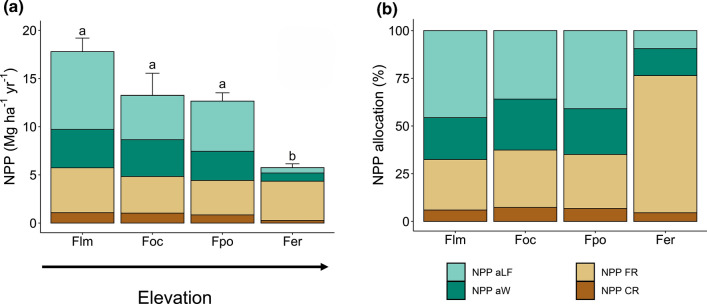
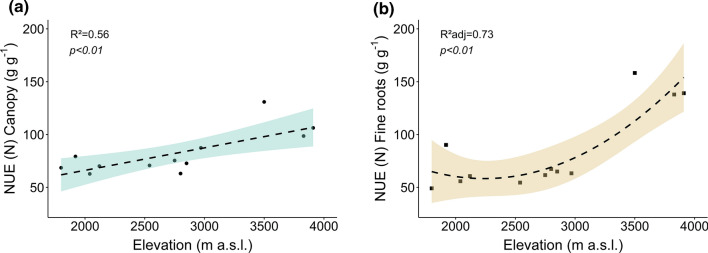
Tropical forests represent the largest store of terrestrial biomass carbon (C) on earth and contribute over-proportionally to global terrestrial net primary productivity (NPP). How climate change is affecting NPP and C allocation to tree components in forests is not well understood. This is true for tropical forests, but particularly for African tropical forests. Studying forest ecosystems along elevation and related temperature and moisture gradients is one possible approach to address this question. However, the inclusion of belowground productivity data in such studies is scarce. On Mt. Kilimanjaro (Tanzania), we studied aboveground (wood increment, litter fall) and belowground (fine and coarse root) NPP along three elevation transects (c. 1800-3900 m a.s.l.) across four tropical montane forest types to derive C allocation to the major tree components. Total NPP declined continuously with elevation from 8.5 to 2.8 Mg C ha year due to significant decline in aboveground NPP, while fine root productivity (sequential coring approach) remained unvaried with around 2 Mg C ha year, indicating a marked shift in C allocation to belowground components with elevation. The C and N fluxes to the soil via root litter were far more important than leaf litter inputs in the subalpine Erica forest. Thus, the shift of C allocation to belowground organs with elevation at Mt. Kilimanjaro and other tropical forests suggests increasing nitrogen limitation of aboveground tree growth at higher elevations. Our results show that studying fine root productivity is crucial to understand climate effects on the carbon cycle in tropical forests.
热带雨林是地球上陆地生物量碳(C)的最大储存库,对全球陆地净初级生产力(NPP)的贡献不成比例。气候变化如何影响森林的 NPP 和 C 分配到树木组成部分,目前还不是很清楚。对于热带森林来说,这是事实,但特别是对于非洲热带森林来说。沿着海拔和相关温度和湿度梯度研究森林生态系统是解决这个问题的一种可能方法。然而,在这些研究中纳入地下生产力数据的情况很少。在坦桑尼亚的乞力马扎罗山(Kilimanjaro),我们沿着三个海拔梯度(约 1800-3900 米)研究了四个热带山地森林类型的地上(木材增量、凋落物)和地下(细根和粗根)NPP,以得出 C 分配到主要树木组成部分。总 NPP 随着海拔的升高从 8.5 到 2.8 Mg C ha year 连续下降,这是由于地上 NPP 的显著下降,而细根生产力(连续取芯法)保持不变,约为 2 Mg C ha year,表明 C 分配随着海拔的升高向地下部分显著转移。通过根凋落物向土壤输送的 C 和 N 通量远比亚高山 Erica 森林中通过叶凋落物输入的更为重要。因此,乞力马扎罗山和其他热带森林中 C 分配向地下器官随海拔的升高而发生转移表明,在较高海拔地区,地上树木生长的氮限制越来越严重。我们的研究结果表明,研究细根生产力对于理解气候变化对热带森林碳循环的影响至关重要。