Laboratório de Imunofarmacologia, Instituto Oswaldo Cruz, Fundação Oswaldo Cruz - Fiocruz, Rio de Janeiro, Brazil.
Programa de Pós-graduação em Biologia Molecular e Celular, Universidade Federal do Estado do Rio de Janeiro - UNIRIO, Rio de Janeiro, Brazil.
J Neuroinflammation. 2021 Feb 25;18(1):60. doi: 10.1186/s12974-021-02106-1.
The term sepsis is used to designate a systemic condition of infection and inflammation associated with hemodynamic changes that result in organic dysfunction. Gestational sepsis can impair the development of the central nervous system and may promote permanent behavior alterations in the offspring. The aim of our work was to evaluate the effects of maternal sepsis on inflammatory cytokine levels and synaptic proteins in the hippocampus, neocortex, frontal cortex, and cerebellum of neonatal, young, and adult mice. Additionally, we analyzed the motor development, behavioral features, and cognitive impairments in neonatal, young and adult offspring.
Pregnant mice at the 14 embryonic day (E14) were intratracheally instilled with saline 0.9% solution (control group) or Klebsiella spp. (3 × 10 CFU) (sepsis group) and started on meropenem after 5 h. The offspring was sacrificed at postnatal day (P) 2, P8, P30, and P60 and samples of liver, lung, and brain were collected for TNF-α, IL-1β, and IL-6 measurements by ELISA. Synaptophysin, PSD95, and β-tubulin levels were analyzed by Western blot. Motor tests were performed at all analyzed ages and behavioral assessments were performed in offspring at P30 and P60.
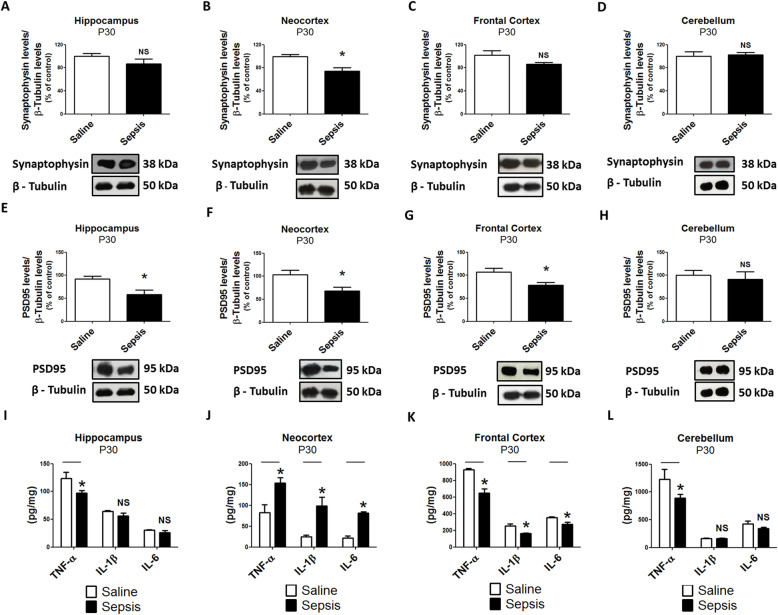
Gestational sepsis induces a systemic pro-inflammatory response in neonates at P2 and P8 characterized by an increase in cytokine levels. Maternal sepsis induced systemic downregulation of pro-inflammatory cytokines, while in the hippocampus, neocortex, frontal cortex, and cerebellum an inflammatory response was detected. These changes in the brain immunity were accompanied by a reduction of synaptophysin and PSD95 levels in the hippocampus, neocortex, frontal cortex, and cerebellum, in all ages. Behavioral tests demonstrated motor impairment in neonates, and depressive-like behavior, fear-conditioned memory, and learning impairments in animals at P30 and P60, while spatial memory abilities were affected only at P60, indicating that gestational sepsis not only induces an inflammatory response in neonatal mouse brains, but also affects neurodevelopment, and leads to a plethora of behavioral alterations and cognitive impairments in the offspring.
These data suggest that maternal sepsis may be causatively related to the development of depression, learning, and memory impairments in the litter.
败血症是用来描述一种与血流动力学变化相关的全身性感染和炎症状态,这些变化会导致器官功能障碍。妊娠期败血症会损害中枢神经系统的发育,并可能导致后代出现永久性的行为改变。我们的工作目的是评估母体败血症对新生、幼龄和成年小鼠海马体、新皮层、额叶皮层和小脑内炎症细胞因子水平和突触蛋白的影响。此外,我们还分析了新生、幼龄和成年后代的运动发育、行为特征和认知障碍。
将 14 日龄胚胎(E14)的孕鼠经气管内滴注生理盐水 0.9%溶液(对照组)或肺炎克雷伯菌(3×10 CFU)(败血症组),5 小时后开始使用美罗培南。新生鼠于生后第 2、8、30 和 60 天处死,采集肝、肺和脑组织样本,通过 ELISA 法检测 TNF-α、IL-1β 和 IL-6。通过 Western blot 法分析突触小体相关蛋白、PSD95 和 β-微管蛋白的水平。在所有分析的年龄进行运动测试,在 P30 和 P60 进行行为评估。
母体败血症会导致新生鼠在 P2 和 P8 时发生全身性促炎反应,表现为细胞因子水平升高。母体败血症诱导全身促炎细胞因子下调,而在海马体、新皮层、额叶皮层和小脑则检测到炎症反应。这些脑免疫变化伴随着海马体、新皮层、额叶皮层和小脑突触小体相关蛋白和 PSD95 水平的降低,所有年龄均如此。行为测试显示,新生鼠运动能力受损,P30 和 P60 的动物表现出抑郁样行为、恐惧条件记忆和学习障碍,而空间记忆能力仅在 P60 受到影响,这表明母体败血症不仅会导致新生鼠大脑发生炎症反应,还会影响神经发育,并导致后代出现多种行为改变和认知障碍。
这些数据表明,母体败血症可能与后代的抑郁、学习和记忆障碍的发生有因果关系。