Bausch F Jacquerioz, Beran D, Hering H, Boulle P, Chappuis F, Dromer C, Saaristo P, Perone S Aebischer
Division of Tropical and Humanitarian Medicine, Geneva University Hospitals, Rue Michel-Servet 1, 1206, Geneva, Switzerland.
Faculty of Medicine, University of Geneva, Rue Gabrielle-Perret-Gentil 6, 1205, Geneva, Switzerland.
Confl Health. 2021 Feb 25;15(1):9. doi: 10.1186/s13031-021-00345-w.
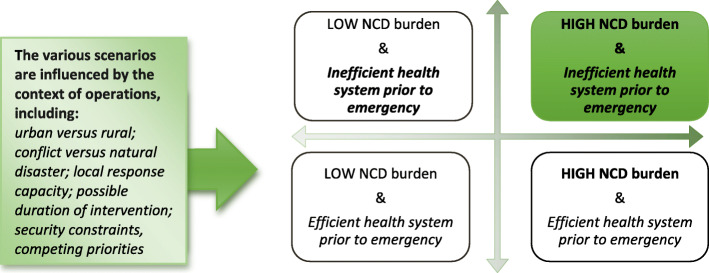
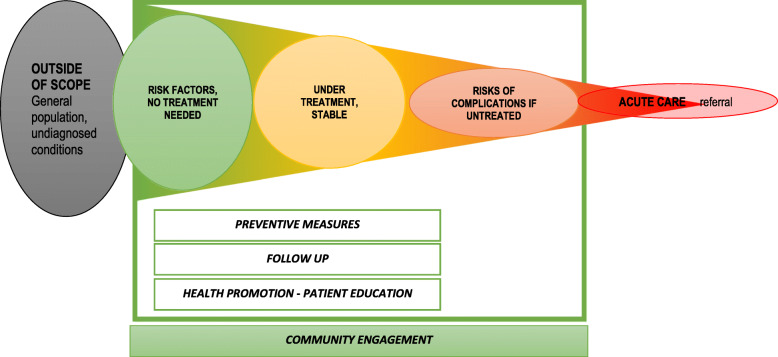
Non-communicable diseases (NCD) represent an increasing global challenge with the majority of mortality occurring in low- and middle-income countries (LMICs). Concurrently, many humanitarian crises occur in these countries and the number of displaced persons, either refugees or internally displaced, has reached the highest level in history. Until recently NCDs in humanitarian contexts were a neglected issue, but this is changing. Humanitarian actors are now increasingly integrating NCD care in their activities and recognizing the need to harmonize and enhance NCD management in humanitarian crises. However, there is a lack of a standardized response during operations as well as a lack of evidence-based NCD management guidelines in humanitarian settings. An informal working group on NCDs in humanitarian settings, formed by members of the World Health Organization, Médecins Sans Frontières, the International Committee of the Red Cross, the International Federation of the Red Cross and others, and led by the United Nations High Commissioner for Refugees, teamed up with the University of Geneva and Geneva University Hospitals to develop operational considerations for NCDs in humanitarian settings. This paper presents these considerations, aiming at ensuring appropriate planning, management and care for NCD-affected persons during the different stages of humanitarian emergencies. Key components include access to treatment, continuity of care including referral pathways, therapeutic patient education/patient self-management, community engagement and health promotion. In order to implement these components, a standardized approach will support a consistent response, and should be based on an ethical foundation to ensure that the "do no harm" principle is upheld. Advocacy supported by evidence is important to generate visibility and resource allocation for NCDs. Only a collaborative approach of all actors involved in NCD management will allow the spectrum of needs and continuum of care for persons affected by NCDs to be properly addressed in humanitarian programmes.
非传染性疾病(NCD)是一项日益严峻的全球性挑战,大多数死亡发生在低收入和中等收入国家(LMICs)。与此同时,这些国家发生了许多人道主义危机,难民或境内流离失所者的数量已达到历史最高水平。直到最近,人道主义背景下的非传染性疾病一直是一个被忽视的问题,但这种情况正在改变。人道主义行为体现在越来越多地将非传染性疾病护理纳入其活动中,并认识到有必要在人道主义危机中协调和加强非传染性疾病管理。然而,在行动中缺乏标准化应对措施,在人道主义环境中也缺乏循证非传染性疾病管理指南。由世界卫生组织、无国界医生组织、红十字国际委员会、红十字会与红新月会国际联合会及其他组织成员组成的人道主义环境中非传染性疾病非正式工作组,在联合国难民事务高级专员的领导下,与日内瓦大学和日内瓦大学医院合作,为人道主义环境中的非传染性疾病制定行动考量。本文介绍了这些考量,旨在确保在人道主义紧急情况的不同阶段,对受非传染性疾病影响的人员进行适当的规划、管理和护理。关键要素包括获得治疗、护理连续性(包括转诊途径)、治疗性患者教育/患者自我管理以及社区参与和健康促进。为了实施这些要素,标准化方法将支持一致的应对措施,并且应以道德为基础,以确保坚持“不伤害”原则。基于证据的宣传对于提高非传染性疾病的可见度和资源分配很重要。只有参与非传染性疾病管理的所有行为体采取协作方法,才能在人道主义方案中妥善解决受非传染性疾病影响人员的各种需求和护理连续性问题。