Jiang Lifang, Xie Na, Chen Mingtao, Liu Yanyan, Wang Shuaishuai, Mao Jun, Li Jiabin, Huang Xiaohui
Department of Basic and Clinical Pharmacology, School of Pharmacy, Anhui Medical University, Hefei, China.
Anhui Province Key Laboratory of Major Autoimmune Diseases, School of Pharmacy, Anhui Institute of Innovative Drugs, Anhui Medical University, Hefei, China.
Front Microbiol. 2021 Feb 9;11:605962. doi: 10.3389/fmicb.2020.605962. eCollection 2020.
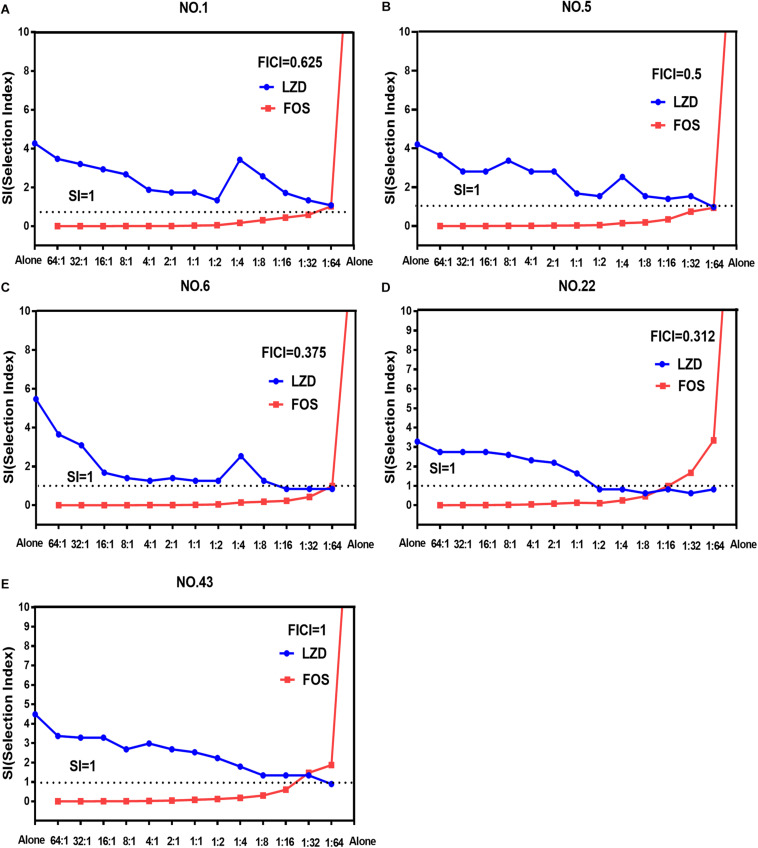
Enterococci, the main pathogens associated with nosocomial infections, are resistant to many common antibacterial drugs including β-lactams, aminoglycosides, etc. Combination therapy is considered an effective way to prevent bacterial resistance. Preliminary studies in our group have shown that linezolid combined with fosfomycin has synergistic or additive antibacterial activity against enterococci, while the ability of the combination to prevent resistance remains unknown. In this study, we determined mutant prevention concentration (MPC) and mutant selection window (MSW) of linezolid, fosfomycin alone and in combination including different proportions for five clinical isolates of and characterized the resistance mechanism for resistant mutants. The results indicated that different proportions of linezolid combined with fosfomycin had presented different MPCs and MSWs. Compared with linezolid or fosfomycin alone, the combination can restrict the enrichment of resistant mutants at a lower concentration. A rough positive correlation between the selection index (SI) of the two agents in combination and the fractional inhibitory concentration index (FICI) of the combination displayed that the smaller FICI of linezolid and fosfomycin, the more probable their MSWs were to close each other. Mutations in ribosomal proteins (L3 and L4) were the mechanisms for linezolid resistant mutants. Among the fosfomycin-resistant mutants, only two strains have detected the MurA gene mutation related to fosfomycin resistance. In conclusion, the synergistic combination of linezolid and fosfomycin closing each other's MSW could effectively suppress the selection of enterococcus resistant mutants, suggesting that the combination may be an alternative for preventing enterococcal resistance. In this study, the resistance mechanism of fosfomycin remains to be further studied.
肠球菌是与医院感染相关的主要病原体,对包括β-内酰胺类、氨基糖苷类等许多常见抗菌药物耐药。联合治疗被认为是预防细菌耐药的有效方法。我们小组的初步研究表明,利奈唑胺与磷霉素联合对肠球菌具有协同或相加抗菌活性,而该联合用药预防耐药的能力尚不清楚。在本研究中,我们测定了利奈唑胺、磷霉素单独及不同比例联合对5株临床分离株的突变预防浓度(MPC)和突变选择窗(MSW),并对耐药突变株的耐药机制进行了表征。结果表明,不同比例的利奈唑胺与磷霉素联合呈现出不同的MPC和MSW。与利奈唑胺或磷霉素单独使用相比,联合用药能在较低浓度下限制耐药突变株的富集。两药联合的选择指数(SI)与联合抑菌浓度指数(FICI)之间大致呈正相关,表明利奈唑胺与磷霉素的FICI越小,其MSW越有可能相互靠近。核糖体蛋白(L3和L4)突变是利奈唑胺耐药突变株的耐药机制。在磷霉素耐药突变株中,仅2株检测到与磷霉素耐药相关的MurA基因突变。总之,利奈唑胺与磷霉素联合的协同作用使彼此的MSW闭合,可有效抑制肠球菌耐药突变株的选择,提示该联合用药可能是预防肠球菌耐药的一种选择。本研究中,磷霉素的耐药机制仍有待进一步研究。