Halcrow Peter W, Geiger Jonathan D, Chen Xuesong
Department of Biomedical Sciences, School of Medicine and Health Sciences, University of North Dakota, Grand Forks, ND, United States.
Front Cell Dev Biol. 2021 Feb 9;9:627639. doi: 10.3389/fcell.2021.627639. eCollection 2021.
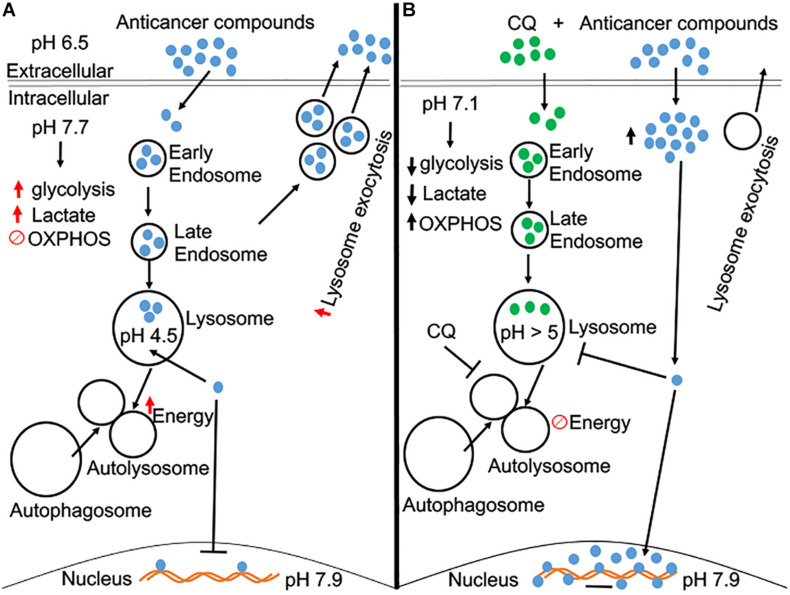
Resistance to the anti-cancer effects of chemotherapeutic agents (chemoresistance) is a major issue for people living with cancer and their providers. A diverse set of cellular and inter-organellar signaling changes have been implicated in chemoresistance, but it is still unclear what processes lead to chemoresistance and effective strategies to overcome chemoresistance are lacking. The anti-malaria drugs, chloroquine (CQ) and its derivative hydroxychloroquine (HCQ) are being used for the treatment of various cancers and CQ and HCQ are used in combination with chemotherapeutic drugs to enhance their anti-cancer effects. The widely accepted anti-cancer effect of CQ and HCQ is their ability to inhibit autophagic flux. As diprotic weak bases, CQ and HCQ preferentially accumulate in acidic organelles and neutralize their luminal pH. In addition, CQ and HCQ acidify the cytosolic and extracellular environments; processes implicated in tumorigenesis and cancer. Thus, the anti-cancer effects of CQ and HCQ extend beyond autophagy inhibition. The present review summarizes effects of CQ, HCQ and proton pump inhibitors on pH of various cellular compartments and discuss potential mechanisms underlying their pH-dependent anti-cancer effects. The mechanisms considered here include their ability to de-acidify lysosomes and inhibit autophagosome lysosome fusion, to de-acidify Golgi apparatus and secretory vesicles thus affecting secretion, and to acidify cytoplasm thus disturbing aerobic metabolism. Further, we review the ability of these agents to prevent chemotherapeutic drugs from accumulating in acidic organelles and altering their cytosolic concentrations.
对化疗药物抗癌作用的耐药性(化疗耐药)是癌症患者及其医疗服务提供者面临的一个主要问题。多种细胞和细胞器间信号变化与化疗耐药有关,但导致化疗耐药的具体过程仍不清楚,且缺乏克服化疗耐药的有效策略。抗疟疾药物氯喹(CQ)及其衍生物羟氯喹(HCQ)正被用于治疗各种癌症,并且CQ和HCQ与化疗药物联合使用以增强其抗癌效果。CQ和HCQ被广泛认可的抗癌作用是它们抑制自噬流的能力。作为二元弱酸,CQ和HCQ优先在酸性细胞器中积累并中和其腔内pH值。此外,CQ和HCQ使胞质和细胞外环境酸化;这些过程与肿瘤发生和癌症有关。因此,CQ和HCQ的抗癌作用超出了自噬抑制的范围。本综述总结了CQ、HCQ和质子泵抑制剂对各种细胞区室pH值的影响,并讨论了其pH值依赖性抗癌作用的潜在机制。这里考虑的机制包括它们使溶酶体去酸化并抑制自噬体-溶酶体融合、使高尔基体和分泌囊泡去酸化从而影响分泌以及使细胞质酸化从而扰乱有氧代谢的能力。此外,我们综述了这些药物防止化疗药物在酸性细胞器中积累并改变其胞质浓度的能力。