Souza da Silva Ricella M, Queiroga Eduardo M, Paz Alexandre R, Neves Fabiana F P, Cunha Karin S, Dias Eliane P
Postgraduation Program in Pathology, School of Medicine, Fluminense Federal University, Niterói, Rio de Janeiro,Brazil.
Pathological Anatomy Service, Lauro Wanderley University Hospital of Federal University of Paraíba, João Pessoa, Paraíba, Brazil.
Clin Pathol. 2021 Feb 11;14:2632010X21989686. doi: 10.1177/2632010X21989686. eCollection 2021 Jan-Dec.
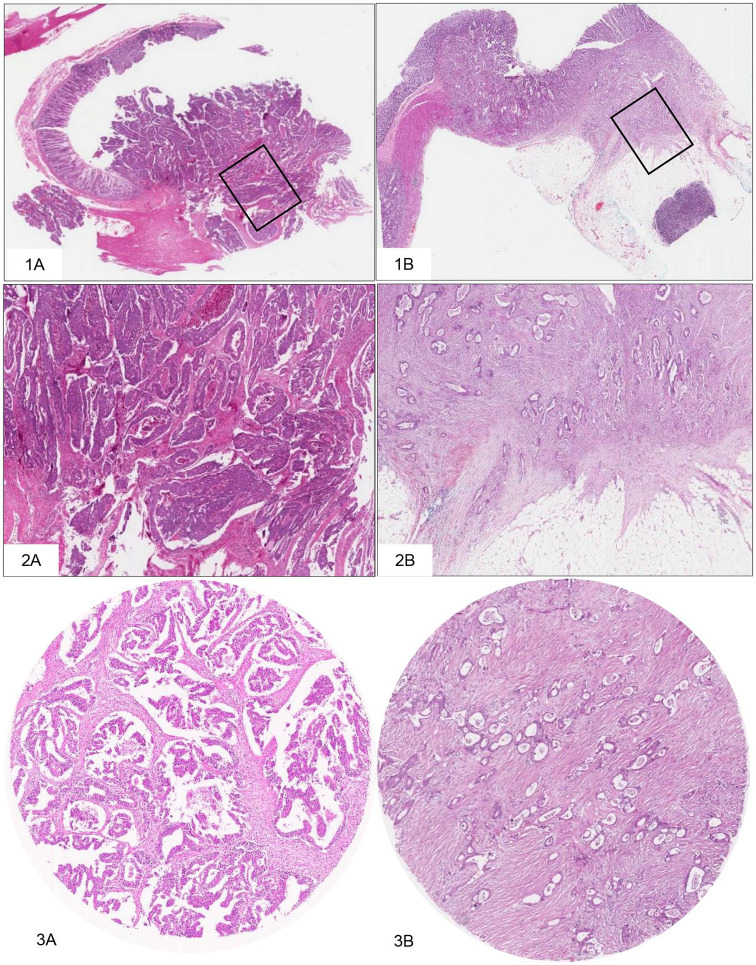
The tumor stroma plays a relevant role in the initiation and evolution of solid tumors. Tumor-stroma ratio (TSR) is a histological feature that expresses the proportion of the stromal component that surrounds cancer cells. In different studies, the TSR represents a potential prognostic factor: a rich stroma in tumor tissue can promote invasion and aggressiveness. The aim of this study was to evaluate the reproducibility and determine the interobserver agreement in the TSR score. The stromal estimate was evaluated in patients diagnosed with colorectal adenocarcinoma (CRA), who underwent surgical resection. We also evaluated age, gender, and other anatomopathological features. Tumor-stroma ratio was calculated based on the slide used in routine diagnostic pathology to determine the T-status. Stromal percentages were separated into 2 categories: ⩽50%-low stroma and >50%-high stroma. The interobserver agreement in the TSR scoring was evaluated among 4 pathologists at different stages of professional experience, using 2 different ways to learn the scoring system. In total, 98 patients were included in this study; 54.1% were male, with a mean age of 61.9 years. Localized disease was diagnosed in 60.2% of patients. Stromal-poor CRA was predominant. The concordance between the TSR percentages of the 4 pathologists was substantial (Kappa > 0.6). There was greater agreement among pathologists for stromal-poor tumors. Substantial agreement and high reproducibility were observed in the determination of TSR score. The TSR score is feasible, suggesting that the presented methodology can be used to facilitate the determination of the stromal proportion of potential prognostic factor.
肿瘤基质在实体瘤的发生和发展中起着重要作用。肿瘤-基质比(TSR)是一种组织学特征,它表示围绕癌细胞的基质成分的比例。在不同的研究中,TSR是一个潜在的预后因素:肿瘤组织中丰富的基质可促进侵袭和侵袭性。本研究的目的是评估TSR评分的可重复性并确定观察者间的一致性。对接受手术切除的结肠直肠腺癌(CRA)患者的基质估计进行了评估。我们还评估了年龄、性别和其他解剖病理学特征。根据常规诊断病理学中用于确定T分期的切片计算肿瘤-基质比。基质百分比分为2类:≤50%为低基质,>50%为高基质。使用2种不同的方式学习评分系统,在4名处于不同专业经验阶段的病理学家之间评估TSR评分的观察者间一致性。本研究共纳入98例患者;54.1%为男性,平均年龄61.9岁。60.2%的患者被诊断为局限性疾病。基质贫乏的CRA占主导。4名病理学家的TSR百分比之间的一致性很高(kappa>0.6)。病理学家对基质贫乏的肿瘤意见更一致。在TSR评分的确定中观察到高度一致性和高可重复性。TSR评分是可行的,这表明所提出的方法可用于促进潜在预后因素的基质比例的确定。